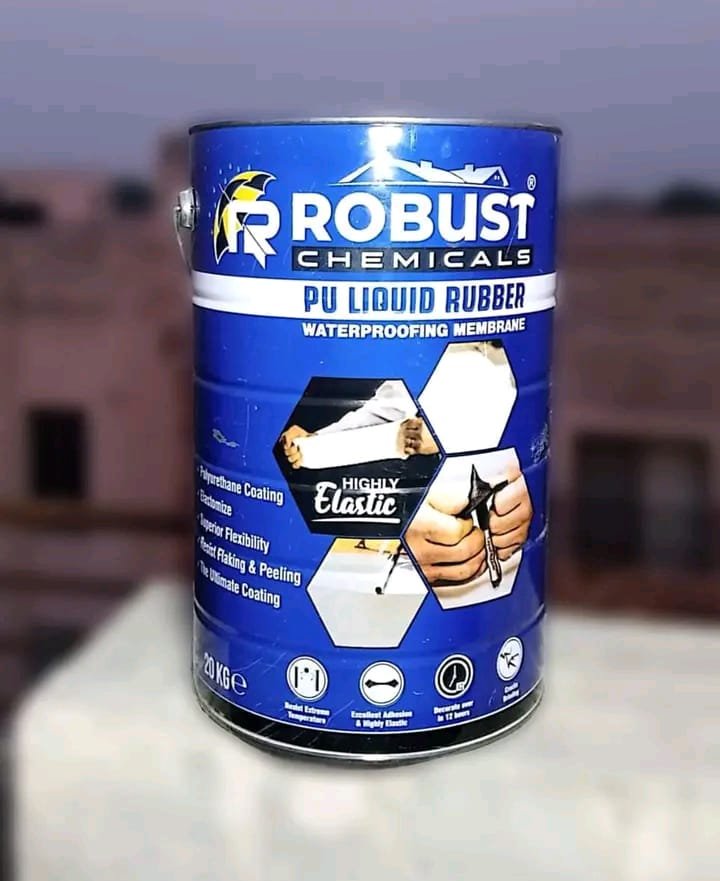
Robuat Polyurethane Liquid Rubber — Ultimate Waterproofing & Protective Coating Solution
Introduction
Robust Polyurethane Liquid Rubber is an advanced, single-component or two-component waterproofing and protective membrane made from high-quality polyurethane polymers. It forms a highly elastic, seamless, and durable coating that adheres strongly to a variety of substrates including concrete, metal, asphalt, wood, and masonry. Designed for modern construction needs, polyurethane liquid rubber provides long-lasting protection against water, moisture, UV rays, and harsh weather conditions.
It is widely used in roof waterproofing, basements, water tanks, terraces, foundations, and bridge decks, offering a flexible and permanent waterproof barrier.
Chemical Composition
Polyurethane liquid rubber is based on polyurethane prepolymers and curing agents that crosslink when exposed to humidity or mixed (in the case of two-component systems). This crosslinking process forms a rubber-like, flexible membrane that bonds strongly to the substrate surface.
Main ingredients include:
-
Polyurethane prepolymer (based on isocyanates and polyols)
-
Curing agents or catalysts
-
Additives for UV resistance, adhesion, and flexibility
-
Solvents or water (depending on formulation)
Key Features & Benefits
100% Waterproofing Protection:
Creates a seamless, joint-free membrane that prevents water ingress even under high hydrostatic pressure.
Highly Elastic and Flexible:
Remains flexible under temperature variations and can bridge cracks up to several millimeters without damage.
Strong Adhesion:
Adheres firmly to concrete, metal, tiles, bitumen, wood, and many other substrates.
UV and Weather Resistant:
Excellent performance under continuous exposure to sunlight, rain, and temperature fluctuations — ideal for external applications.
Chemical Resistance:
Resistant to alkalis, mild acids, and common industrial pollutants.
Durability:
Once cured, it provides a long service life (up to 20–25 years) with minimal maintenance.
Easy Application:
Can be applied using a brush, roller, trowel, or airless spray — forming a uniform, continuous membrane.
Eco-friendly Options Available:
Low-VOC and solvent-free grades are available for environmentally sensitive areas.
Applications of Polyurethane Liquid Rubber
Polyurethane Liquid Rubber is versatile and suitable for both commercial and industrial waterproofing. Common applications include:
-
Roofs and terraces
-
Basements and foundations
-
Water tanks (potable and non-potable)
-
Balconies and podium decks
-
Retaining walls
-
Wet areas (bathrooms, kitchens)
-
Bridge decks and tunnels
-
Gutters, planters, and expansion joints
-
Industrial floors and chemical containment areas
Surface Preparation
Before applying polyurethane liquid rubber, ensure the surface is:
-
Clean and Dry: Remove dust, oil, grease, and loose materials.
-
Sound and Stable: Repair cracks, honeycombs, and voids using suitable repair mortars.
-
Primed: Apply polyurethane or epoxy primer to enhance adhesion (depending on substrate type).
-
Smooth Surface: Fill major undulations and ensure no standing water remains.
Application Instructions
-
Mixing (for 2-component systems):
Mix resin (Part A) and hardener (Part B) as per manufacturer’s ratio until a uniform consistency is achieved. -
Application:
-
Apply the first coat using a brush, roller, or spray.
-
Allow it to dry for 6–8 hours (depending on temperature).
-
Apply the second coat crosswise for better coverage and thickness uniformity.
-
-
Thickness:
Recommended dry film thickness is 1.5–2 mm for most waterproofing applications. -
Curing:
Allow curing for 24–48 hours before exposure to water or foot traffic. -
Optional Reinforcement:
For areas with high movement or stress (like corners and joints), use fiberglass mesh reinforcement between coats.
Technical Properties
| Property | Typical Value |
|---|---|
| Appearance | Liquid, various colors (usually grey or white) |
| Density | 1.2 – 1.4 g/cm³ |
| Elongation at Break | 400% – 800% |
| Tensile Strength | 1.5 – 3.0 MPa |
| Adhesion Strength | > 1.0 MPa |
| Service Temperature | -30°C to +90°C |
| Water Absorption | < 0.5% |
| UV Resistance | Excellent |
| Chemical Resistance | Good (acids, alkalis, salts) |
Storage and Shelf Life
-
Store in a cool, dry place away from direct sunlight and moisture.
-
Shelf life: 12 months in unopened original packaging.
-
Keep containers tightly closed after use.
Safety Precautions
-
Use protective gloves, goggles, and masks during application.
-
Ensure adequate ventilation in enclosed areas.
-
Avoid direct skin or eye contact.
-
Keep away from open flames and heat sources.
Advantages Over Traditional Waterproofing Materials
| Feature | Polyurethane Liquid Rubber | Bitumen/APP Membrane | Acrylic Coating |
|---|---|---|---|
| Seamless | ✅ Yes | ❌ No | ✅ Yes |
| Elasticity | Excellent | Moderate | Good |
| UV Resistance | Excellent | Poor | Moderate |
| Lifespan | 20–25 years | 5–10 years | 7–12 years |
| Chemical Resistance | High | Moderate | Low |
| Crack Bridging | Excellent | Poor | Moderate |
Conclusion
Polyurethane Liquid Rubber stands out as a next-generation waterproofing solution for modern infrastructure. Its seamless, elastic, and weather-resistant membrane ensures complete protection of buildings from water damage, corrosion, and UV degradation. Whether used on roofs, basements, or industrial structures, it provides unmatched performance, longevity, and reliability — making it a preferred choice for architects, engineers, and contractors worldwide.
SEO Keywords
-
Polyurethane liquid rubber in Pakistan
-
Liquid rubber waterproofing
-
Polyurethane waterproof coating
-
Roof waterproofing membrane
-
PU liquid waterproofing
-
Polyurethane coating for concrete
-
Best waterproofing solution
-
Flexible waterproof coating
Advanced Technical Insights into Polyurethane Liquid Rubber
Polyurethane Liquid Rubber represents a technological advancement in waterproofing chemistry, offering unmatched protection in diverse climatic and structural conditions. Its unique polymer structure allows it to form an elastic yet durable membrane that performs exceptionally well in Pakistan’s hot, humid, and monsoon-prone environments, where temperature variations and heavy rainfall demand flexible, long-lasting waterproofing solutions.
Unlike conventional waterproofing systems that rely on rigid or bituminous layers, polyurethane membranes maintain permanent elasticity and chemical stability. Even under continuous stress, UV exposure, and ponding water, the coating preserves its waterproof integrity without cracking, blistering, or delaminating.
How Polyurethane Liquid Rubber Works
When applied to a prepared surface, polyurethane liquid rubber undergoes a chemical curing reaction. The isocyanate groups in the resin react with ambient moisture or the hardener (in two-component systems), forming urethane linkages that create a highly cross-linked, rubber-like film.
This film acts as an impermeable barrier, completely sealing micro-pores, cracks, and gaps on the substrate. Its elasticity ensures that even when the base material expands or contracts due to temperature changes, the waterproofing layer stretches and compresses without losing adhesion or continuity.
Additionally, the cured membrane forms a hydrophobic surface, meaning it repels water molecules, preventing absorption or seepage. This mechanism provides double-layer protection—mechanical adhesion and chemical resistance—to ensure long-term waterproofing performance.
Enhanced Formulations for Specialized Applications
At Robust Construction Chemicals, Polyurethane Liquid Rubber formulations can be tailored for specific site needs and environmental conditions:
1. Solvent-Based Polyurethane Liquid Rubber
-
Offers rapid curing and high adhesion on difficult surfaces.
-
Excellent for exposed roofs and metallic structures.
-
High tensile strength and superior UV resistance.
-
Ideal for cold regions where faster drying is required.
2. Water-Based Polyurethane Liquid Rubber
-
Eco-friendly, low-VOC formulation.
-
Suitable for indoor applications such as bathrooms, kitchens, and potable water tanks.
-
Provides excellent elasticity and crack-bridging capacity.
-
Safer for the environment and applicators.
3. Two-Component Polyurethane Systems
-
Designed for heavy-duty and industrial applications.
-
Exceptional chemical resistance against fuels, acids, and industrial effluents.
-
Cures faster and delivers a higher mechanical strength film.
-
Suitable for concrete decks, basements, tunnels, and bridge structures.
Performance Characteristics and Engineering Benefits
Polyurethane Liquid Rubber offers superior engineering properties that make it the preferred choice for architects, engineers, and builders focused on quality and longevity.
1. Crack Bridging Ability
With elongation properties exceeding 500–800%, polyurethane coatings can easily bridge dynamic and static cracks in concrete substrates, ensuring watertight performance even under thermal or structural movement.
2. Excellent Hydrostatic Pressure Resistance
It can withstand positive and negative hydrostatic pressures, making it perfect for underground structures, basements, and retaining walls where continuous water pressure may occur.
3. Seamless and Joint-Free
Unlike torch-applied membranes that require overlaps or joints, polyurethane liquid rubber forms a monolithic, continuous film without weak points, eliminating leakage paths.
4. Reflective and Energy Efficient
When applied in white or light-colored versions, the coating reflects sunlight and reduces heat absorption — enhancing building comfort and contributing to energy efficiency and reduced cooling costs.
5. Resistance to Root Penetration
In green roof or planter applications, polyurethane rubber resists root growth and biological attack, ensuring long-term membrane integrity.
6. Mechanical and Chemical Durability
The cured film exhibits strong resistance against abrasion, foot traffic, and mild chemical exposure, ensuring reliability in industrial floors, chemical plants, and utility structures.
Installation Areas & Practical Case Uses
Polyurethane Liquid Rubber has become a key material in modern infrastructure waterproofing. Here are examples of where and how it’s used effectively:
1. Roof Waterproofing
-
Suitable for concrete roofs, metal roofs, corrugated sheets, and old bituminous surfaces.
-
Applied directly over existing materials without dismantling.
-
Provides UV stability and water resistance for more than two decades.
2. Basement and Foundation Protection
-
Prevents underground seepage and rising dampness.
-
Used in combination with drainage systems for complete moisture control.
-
Works well even under negative water pressure when applied internally.
3. Water Tanks and Reservoirs
-
Safe for potable water storage when using non-toxic, water-based formulations.
-
Offers a smooth, bacteria-resistant finish that simplifies maintenance.
4. Industrial and Commercial Buildings
-
Used on flat roofs, decks, machine rooms, cooling towers, and utility trenches.
-
Ensures safety from leakage that can affect equipment or electrical systems.
5. Parking Decks and Podium Slabs
-
The flexible membrane resists cracking from vehicle vibration and temperature stress.
-
Can be topped with protective screed or tiles.
6. Tunnels and Subterranean Structures
-
Creates a moisture barrier on concrete and shotcrete surfaces.
-
Helps extend the life of underground infrastructure.
Application Techniques — Step-by-Step Process
To ensure maximum performance of Polyurethane Liquid Rubber, proper surface preparation and application are crucial. Below is a detailed guide for professional applicators:
Step 1: Surface Cleaning
Remove all dirt, dust, oil, old coatings, and laitance. Clean the surface using a wire brush, air blower, or pressure washer.
Step 2: Crack Repair
Seal cracks and voids using epoxy filler or cementitious repair mortar. Ensure all surfaces are sound and defect-free.
Step 3: Priming
Apply Polyurethane Primer or Epoxy Primer depending on the surface type (porous or non-porous). The primer improves adhesion and seals micro-porosity. Allow it to dry for 4–6 hours.
Step 4: Application of First Coat
Apply the first coat of Polyurethane Liquid Rubber using a roller, brush, or airless spray. Spread evenly in a thin layer to achieve uniform coverage.
Step 5: Reinforcement Layer (Optional)
For high-stress zones, embed reinforcement mesh or polyester fabric into the first coat while wet, then allow partial curing.
Step 6: Application of Second Coat
Apply the second coat perpendicular to the first after 6–8 hours or once the first coat is tack-free. This ensures a uniform film thickness.
Step 7: Curing
Allow complete curing for 24–48 hours depending on temperature and humidity. Avoid contact with water during this time.
Step 8: Protective Coating or Screed (Optional)
In heavy-duty applications, a protective cementitious screed, epoxy layer, or ceramic tiles can be installed above the membrane.
Testing and Quality Control
At Robust Construction Chemicals, every batch of Polyurethane Liquid Rubber undergoes strict laboratory testing to ensure consistent performance and compliance with international standards (ASTM, BS, and ISO). Testing includes:
-
Tensile strength and elongation test
-
Adhesion bond test on concrete and metal
-
Water vapor transmission rate (WVTR)
-
Accelerated UV weathering
-
Chemical immersion test (acids, alkalis, oils)
-
Thermal aging and flexibility test
This rigorous quality control guarantees that each product performs reliably in the field and meets the high expectations of construction professionals.
Long-Term Maintenance and Repair Guidance
Polyurethane membranes are virtually maintenance-free, but for optimal lifespan:
-
Inspect the surface annually for physical damage or mechanical impact.
-
Recoat high-wear areas every 8–10 years if required.
-
Clean the surface with mild detergents — avoid abrasive cleaners.
-
Repair local damage using the same polyurethane material to maintain continuity.
Even if localized repair is needed, the new coat chemically bonds to the old layer, ensuring the membrane remains monolithic and watertight.
Environmental and Health Considerations
Modern formulations of Polyurethane Liquid Rubber are designed with environmental safety and user health in mind. Solvent-free and water-based versions have very low volatile organic compounds (VOC), making them safe for use in hospitals, schools, and water reservoirs.
These advanced versions comply with LEED (Leadership in Energy and Environmental Design) standards, helping projects achieve sustainable construction certification.
Packaging and Coverage
-
Packaging Sizes: 5 kg, 20 kg, and 200 kg drums.
-
Coverage: 1.5 – 2.0 m²/kg for two coats (depending on substrate porosity).
-
Film Thickness: 1.5 – 2 mm dry film after full curing.
-
Color Options: Grey, white, black, or custom shades on request.
Storage & Handling Recommendations
-
Store between 10°C and 30°C in a dry environment.
-
Keep containers tightly sealed when not in use.
-
Protect from freezing or direct sunlight.
-
Use within 12 months of manufacture for best results.
Troubleshooting Guide
| Problem | Possible Cause | Solution |
|---|---|---|
| Poor adhesion | Surface contamination or no primer | Clean surface, apply primer |
| Blistering | Trapped moisture or over-thick application | Apply thin layers, ensure surface dryness |
| Cracking | Rapid curing or thin coating | Apply recommended thickness, allow proper curing |
| Slow curing | Low temperature or high humidity | Allow more curing time, improve ventilation |
Advantages of Using Polyurethane Liquid Rubber from Robust Construction Chemicals
-
Formulated for Pakistan’s diverse climate conditions.
-
Produced under ISO-certified quality systems.
-
Long-lasting protection — up to 25 years of durability.
-
Superior adhesion to concrete, bitumen, metal, and tiles.
-
Custom formulations available for industrial and residential projects.
-
Technical on-site support and application guidance available.
Comparison with Other Waterproofing Technologies
| Property | Polyurethane Liquid Rubber | Cementitious Coating | Bituminous Membrane | Acrylic Coating |
|---|---|---|---|---|
| Elasticity | Excellent (500–800%) | Limited | Moderate | Good |
| Seamless | Yes | Partially | No | Yes |
| UV Resistance | High | Moderate | Poor | Moderate |
| Crack Bridging | Excellent | Poor | Fair | Moderate |
| Lifespan | 20–25 years | 5–10 years | 7–12 years | 8–15 years |
| Chemical Resistance | Strong | Low | Medium | Medium |
| Application Method | Brush/Spray | Trowel/Brush | Torch Applied | Brush/Spray |
| Maintenance | Minimal | Frequent | Occasional | Occasional |
Conclusion
Polyurethane Liquid Rubber has revolutionized the concept of waterproofing and protective coatings. Its high elasticity, seamless nature, and chemical durability make it far superior to conventional waterproofing products. For both new constructions and renovation projects, it delivers unmatched protection, cost efficiency, and ease of use.
When you choose Robust Polyurethane Liquid Rubber, you choose strength, flexibility, and longevity — the key ingredients for a dry, secure, and sustainable building.
Understanding the Science Behind Polyurethane Liquid Rubber
Polyurethane Liquid Rubber is not just a coating — it’s a result of advanced polymer engineering designed to provide a combination of flexibility, toughness, and long-term weather resistance. Its performance originates from the chemical structure of polyurethane, a polymer formed by the reaction between isocyanates and polyols. This reaction creates a three-dimensional molecular network that gives the membrane both elasticity and strength.
Molecular Crosslinking
In polyurethane chemistry, the extent of crosslinking determines the balance between softness and rigidity. Polyurethane liquid rubber used in waterproofing applications is designed with optimized crosslink density, allowing the membrane to remain rubbery and flexible even under extreme weather or substrate movement.
This advanced chemical composition enables it to perform far beyond traditional waterproofing compounds like bitumen or acrylic emulsions. It can stretch several times its original length and return to its shape without cracking — a property essential for buildings exposed to dynamic stress and thermal expansion.
Performance in Pakistan’s Climatic Conditions
Pakistan experiences a wide range of climatic zones — from hot and humid coastal areas to cold mountainous regions and arid deserts. Each region poses distinct challenges for waterproofing, such as heat expansion, UV exposure, freeze-thaw cycles, and heavy monsoon rains.
Polyurethane Liquid Rubber is engineered to overcome these challenges due to its climate-adaptive properties:
1. Heat Resistance
In cities like Karachi and Lahore where roof temperatures can exceed 60°C, polyurethane coatings remain stable without softening, bubbling, or releasing oils. The polymer’s high thermal stability ensures that it maintains adhesion and elasticity even during extreme summer months.
2. UV Stability
Continuous sunlight can degrade many waterproofing membranes, but polyurethane liquid rubber is formulated with UV-absorbing additives and stabilizers. This prevents discoloration, chalking, and surface degradation — especially for exposed roof applications.
3. Cold Flexibility
In colder areas such as Murree or Gilgit, concrete contracts during freezing conditions. The polyurethane membrane retains flexibility down to -30°C, allowing it to stretch and move with the substrate without cracking.
4. Rain and Humidity Resistance
During the monsoon season, rapid water accumulation and ponding are common on flat roofs. Polyurethane liquid rubber remains hydrophobic and impermeable even under standing water, preventing seepage and corrosion.
Customized Solutions by Robust Construction Chemicals
At Robust Construction Chemicals, our Polyurethane Liquid Rubber is available in specialized variants to meet different project demands:
1. PU Liquid Rubber 25
-
Single-component, solvent-based formulation.
-
Ideal for roof and balcony waterproofing.
-
Forms a high-gloss, UV-resistant finish.
-
Excellent for both concrete and metal substrates.
2. PU Liquid Rubber 50
-
Two-component high-performance grade.
-
Superior chemical resistance for industrial plants, bridges, and wastewater areas.
-
Provides very high tensile strength and abrasion resistance.
3. PU Liquid Rubber Aqua
-
Water-based, eco-friendly version for potable water tanks and indoor applications.
-
Non-toxic, low odor, and LEED-compliant.
-
Safe for use in schools, hospitals, and food industries.
4. PU Rubber Reflective White
-
Specialized reflective version for heat insulation and energy saving.
-
Reflects up to 85% of solar radiation, reducing roof surface temperatures.
-
Perfect for heatproofing and waterproofing in one system.
Integration with Other Waterproofing Systems
While Polyurethane Liquid Rubber performs exceptionally as a standalone product, it can also be used in integrated waterproofing systems for enhanced durability.
1. Cementitious Waterproofing + Polyurethane Top Coat
A common hybrid system where a cementitious coating is applied first to seal pores and cracks, followed by a polyurethane top coat for elasticity and UV protection. Ideal for basements, foundations, and tanks.
2. PU Primer + Polyurethane Membrane + PU Topcoat
For roofs and industrial areas, this 3-layer system provides a mechanically tough, chemical-resistant, and UV-stable surface that can handle foot traffic and heavy use.
3. PU Coating Over Bitumen or APP Membrane
In renovation projects, the polyurethane coating can be applied over old membranes after surface cleaning, providing an extended lifespan without costly replacement.
4. PU Membrane + Protective Screed
For parking decks or mechanical areas, a top protective screed (cement or epoxy) can be placed over the PU membrane for impact resistance.
Common Construction Challenges Solved by Polyurethane Liquid Rubber
1. Water Seepage and Leakage
Traditional waterproofing often fails at joints, corners, or around plumbing penetrations. Polyurethane liquid rubber seamlessly seals these vulnerable areas, eliminating leakage completely.
2. Cracking and Structural Movement
Due to its exceptional elongation, the membrane absorbs substrate movement caused by temperature variations, preventing cracks from propagating.
3. Poor Adhesion on Different Materials
Its high bonding capability ensures adhesion to diverse materials — concrete, steel, glass, tile, wood, and even existing bitumen coatings.
4. Difficult Roof Geometry
On complex roofs with pipes, domes, or curves, the liquid nature of polyurethane rubber allows easy application, ensuring full coverage without overlaps.
Professional Tips for Successful Application
To achieve the best results with Polyurethane Liquid Rubber, follow these professional tips used by industry experts:
-
Temperature Range: Apply between 10°C and 40°C for optimal curing.
-
Surface Moisture: Ensure the substrate moisture content is below 5%.
-
Mixing: For two-component products, use a slow-speed drill mixer to avoid air entrapment.
-
Application Tools: Use short-nap rollers or airless spray machines for large surfaces.
-
Curing Time: Allow sufficient curing before applying protective layers or exposing to water.
-
Joint Detailing: Use PU sealant around joints before coating for complete sealing.
-
Slope: Always maintain a proper slope on roofs for water drainage even with waterproof coating.
Sustainability and Green Building Compliance
Modern construction emphasizes environmental responsibility. Polyurethane Liquid Rubber aligns with green building principles due to its long life span and low maintenance requirements, reducing material waste and repair frequency.
Water-based and low-VOC variants contribute to healthier indoor environments and comply with international green certification systems like LEED, BREEAM, and WELL Building Standards.
Additionally, reflective white coatings improve thermal comfort and reduce carbon footprint by decreasing air-conditioning energy consumption — supporting sustainable, eco-conscious construction.
Economic Benefits and Cost Efficiency
Although the initial cost of polyurethane liquid rubber may be slightly higher than traditional bituminous systems, the long-term cost benefits are significant. Here’s how it saves money over time:
-
Reduced Maintenance: Once applied, it requires little to no maintenance for decades.
-
Extended Service Life: Lasts 3–4 times longer than standard waterproofing materials.
-
Fewer Repairs: Seamless coating means no weak joints or seams to fail.
-
Energy Savings: Reflective versions lower cooling costs by up to 25%.
-
Labor Savings: Fast application and quick curing minimize downtime and labor expenses.
Overall, polyurethane waterproofing is an investment in building longevity and performance, not just a surface coating.
International Standards and Certifications
High-quality Polyurethane Liquid Rubber formulations meet or exceed various international technical standards, ensuring safety and reliability:
-
ASTM C836 — Standard for liquid-applied waterproofing membranes.
-
ASTM D412 — Tensile properties of vulcanized rubber.
-
EN 1504-2 — Surface protection systems for concrete.
-
BS EN ISO 527 — Determination of tensile properties.
-
LEED & REACH Compliant — Eco-friendly and low-VOC materials.
Robust Construction Chemicals ensures all polyurethane-based products undergo certified laboratory testing and quality assurance before delivery.
Long-Term Performance Case Study Example
Project: Commercial Plaza Roof Waterproofing, Lahore
-
Problem: Severe leakage due to deteriorated bituminous membrane.
-
Solution: Old membrane cleaned and primed with PU primer.
-
Application: Two coats of Robust PU Liquid Rubber applied at 1.8 mm total thickness.
-
Result: Completely waterproof surface with UV-resistant finish. No leaks observed even after three monsoon seasons.
Project: Underground Parking Waterproofing, Karachi
-
Challenge: Groundwater seepage and salt damage.
-
System Used: PU Liquid Rubber 50 with fiberglass reinforcement.
-
Performance: No water ingress for over 5 years; surface remains intact and flexible.
Such successful installations demonstrate the reliability and long-term performance of polyurethane liquid rubber in demanding conditions.
Packaging, Shelf Life & Transportation
-
Available Sizes: 5 kg, 10 kg, 20 kg, 200 kg drums.
-
Storage: Store in shaded areas between 5°C – 30°C.
-
Shelf Life: 12–15 months from date of manufacture in unopened containers.
-
Transportation: Classified as non-hazardous; can be transported via road or sea without special restrictions.
Proper storage ensures that viscosity, curing performance, and adhesion remain optimal even after long storage periods.
Maintenance After Installation
-
Inspect roof or coated surfaces twice a year for physical damage.
-
Clean debris and maintain drainage systems.
-
Avoid puncturing the membrane during mechanical works.
-
If damage occurs, clean the area, reapply PU primer, and add a patch coat.
-
Recoating can be done directly without removing the existing layer due to its excellent bonding property.
Why Choose Robust Polyurethane Liquid Rubber
Choosing Robust Construction Chemicals means selecting a partner that prioritizes innovation, durability, and performance. Our polyurethane systems are:
-
Engineered for local weather conditions.
-
Produced with world-class raw materials and ISO-certified manufacturing.
-
Supported by professional technical assistance and on-site guidance.
-
Available in both solvent-based and water-based eco-friendly options.
Whether your project involves residential waterproofing, industrial protection, or large infrastructure, Robust Polyurethane Liquid Rubber guarantees lasting results and peace of mind.
Final Thoughts
Polyurethane Liquid Rubber represents the future of waterproofing technology — combining the power of chemistry, engineering, and sustainability. It not only protects buildings from water ingress but also enhances their energy efficiency and structural integrity.
By choosing Robust Polyurethane Liquid Rubber, builders, engineers, and architects ensure that their projects remain safe, dry, and durable for decades, no matter how harsh the climate or complex the structure.