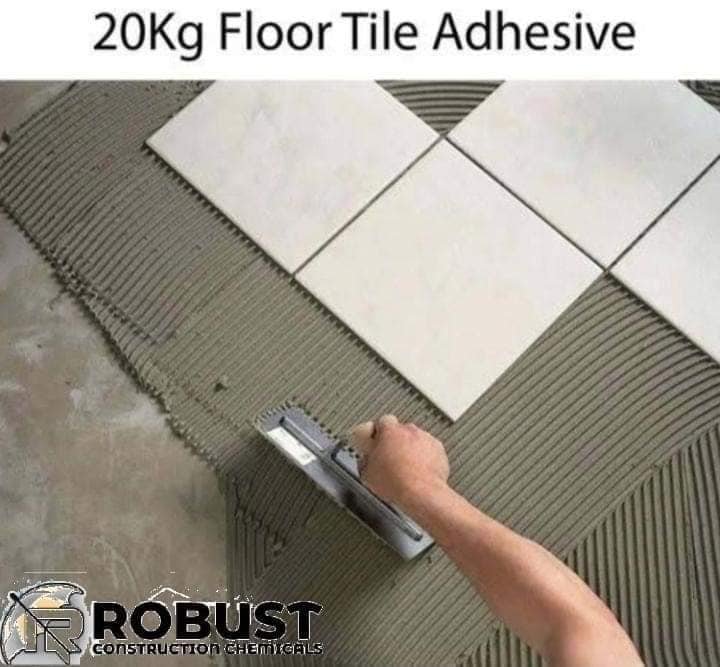
Robust Tile Bond
Robust Tile Bond is a high-performance polymer-modified adhesive designed for fixing a wide range of tiles on interior and exterior surfaces. It provides superior bonding strength, flexibility, and water resistance, making it suitable for both wall and floor applications in residential, commercial, and industrial projects.
Product Overview
Robust Tile Bond is a cementitious, pre-mixed adhesive formulated with premium quality polymers, graded aggregates, and special additives. It only requires the addition of clean water at the site, ensuring consistent quality and easy application. Once cured, it forms a strong, durable bond that resists thermal movement, moisture penetration, and impact stresses.
Types of Robust Tile Bond
Robust Construction Chemicals offers different grades to match project needs:
-
Robust Tile Bond – Standard (Type-1):
For ceramic, mosaic, and small-format wall tiles on plastered surfaces. -
Robust Tile Bond – High Strength (Type-2):
For vitrified, porcelain, and large-format tiles on concrete or cementitious surfaces. -
Robust Tile Bond – Flex (Type-3):
For areas exposed to thermal movement, vibrations, or heavy traffic—ideal for external facades, swimming pools, and industrial floors.
Key Features
-
Excellent Adhesion: Ensures long-lasting bond between tile and substrate.
-
Water Resistance: Protects against moisture, dampness, and efflorescence.
-
Crack Resistant: Flexible polymer modification prevents cracking and delamination.
-
Slip Resistant: Allows easy vertical tile application without tile slippage.
-
Heat and Weather Resistant: Suitable for both interior and exterior installations.
-
Ready to Use: Just mix with water—no extra additives needed.
-
Long Open Time: Provides adequate time for adjustment and tile placement.
Areas of Application
-
Ceramic, vitrified, mosaic, and marble tiles
-
Kitchen and bathroom walls and floors
-
External facades and terraces
-
Swimming pools, water tanks, and wet areas
-
Industrial and commercial flooring
-
Lightweight blocks and plastered walls
Surface Preparation
-
Ensure the surface is clean, level, and free from oil, dust, loose particles, or curing compounds.
-
Dampen the substrate slightly before applying adhesive (avoid standing water).
-
For smooth concrete, use a bonding agent or roughen the surface for better grip.
Mixing Instructions
-
Use 6.5–7.5 liters of clean water per 20 kg bag.
-
Slowly add powder into water while mixing mechanically or manually until a smooth, lump-free paste forms.
-
Allow the mix to stand for 5 minutes, then remix before application.
Application Method
-
Apply the adhesive evenly using a notched trowel (6 mm for wall tiles, 10 mm for floor tiles).
-
Spread adhesive on an area that can be tiled within 15–20 minutes.
-
Press the tiles firmly into position with slight twisting motion.
-
Check bonding by occasionally lifting a tile to ensure full adhesive contact.
-
Allow 24 hours of curing before grouting.
Coverage
Approximately 4–5 m² per 20 kg bag depending on surface condition and trowel size.
Technical Data
| Property | Typical Value |
|---|---|
| Appearance | Grey/White powder |
| Open time | 20–30 minutes |
| Pot life | 3–4 hours |
| Tensile Adhesion Strength | >1.0 N/mm² |
| Slip resistance | <0.5 mm |
| Setting time | Approx. 24 hours |
Packaging
-
20 kg and 40 kg HDPE laminated bags
Storage & Shelf Life
Store in a cool, dry place away from direct sunlight. Shelf life is 12 months in original sealed packaging.
Health & Safety
-
Avoid contact with skin and eyes.
-
Use gloves and a mask during mixing and application.
-
Wash with clean water in case of contact.
Advantages for Professionals
-
Consistent and reliable bonding performance
-
Reduces maintenance and tile popping issues
-
Suitable for multiple substrates and tile types
-
Ideal for high-end architectural finishes
Conclusion
Robust Tile Bond is a trusted solution for durable, flexible, and water-resistant tile installation. Whether you are fixing ceramic wall tiles in bathrooms or large-format vitrified tiles on commercial floors, Robust Tile Bond guarantees professional results and long-term adhesion even under challenging conditions.
Robust Tile Bond – Advanced Technical Details and Application Guide
1. Advanced Installation Techniques
Robust Tile Bond is formulated to deliver professional-grade performance in tile installation, whether in residential bathrooms or large industrial floors. To achieve superior adhesion, durability, and finish, installers should follow advanced laying techniques that go beyond conventional tiling practices.
1.1 Substrate Inspection
Before tiling, inspect the substrate for stability, soundness, and level. The base surface should be:
-
Structurally stable and free from movement.
-
Clean, dry, and free of dust, grease, curing compounds, or laitance.
-
Absorbent enough to allow proper bonding of adhesive.
Any cracks, undulations, or defects must be repaired with a cementitious repair mortar before tiling begins.
1.2 Surface Priming and Damping
For highly porous or dusty surfaces, use a Robust Bonding Primer diluted with water in a 1:1 ratio. Priming ensures even absorption and strengthens adhesion. Slightly dampen concrete or plastered substrates before applying the adhesive — but avoid water puddles.
1.3 Correct Notched Trowel Usage
Selecting the right notched trowel ensures uniform adhesive thickness:
-
3–6 mm notch: Small wall tiles or mosaics
-
8–10 mm notch: Floor tiles up to 600×600 mm
-
12–15 mm notch: Large format or vitrified tiles
Hold the trowel at a 45° angle and apply adhesive evenly in straight lines to eliminate air pockets beneath the tiles.
1.4 Back Buttering
For heavy or large-format tiles, apply a thin layer of adhesive (1–2 mm) on the back of the tile before pressing it onto the substrate. This ensures 100% contact bonding, prevents hollow sounds, and increases shear strength.
1.5 Laying and Alignment
Press tiles firmly with a slight twisting motion into the adhesive bed. Check alignment using spacers for consistent grout lines. Always tap the tile surface gently with a rubber mallet for even contact.
1.6 Expansion Joints
For large areas, provide movement joints at every 4–5 meters or as per architectural design. Fill expansion joints with Robust Flexible Sealant to absorb thermal expansion and prevent tile lifting or cracking.
2. Tile Bond Testing and Performance Parameters
Robust Tile Bond is tested under strict laboratory conditions to ensure superior and consistent performance according to EN 12004 and ASTM C482 standards.
2.1 Adhesion Strength
| Test Type | Condition | Result |
|---|---|---|
| Initial Adhesion | 28 days curing | >1.0 N/mm² |
| After Water Immersion | 7 days | >0.8 N/mm² |
| After Heat Aging | 14 days | >1.0 N/mm² |
| After Freeze-Thaw Cycle | 20 cycles | >0.9 N/mm² |
These values confirm that Robust Tile Bond maintains excellent bond strength under different climatic and service conditions.
2.2 Shear Bond Strength
Measured according to ASTM C482, Robust Tile Bond shows a shear bond strength exceeding 15 kg/cm², ensuring reliable adhesion under load-bearing conditions.
2.3 Slip Resistance
The slip resistance is <0.5 mm as per EN 1308, allowing vertical application without tile slippage — essential for wall tiling and façade works.
2.4 Open Time and Adjustment Time
-
Open Time: 20–30 minutes
-
Adjustability Time: 10–15 minutes
These working parameters enable flexibility during installation without premature setting.
2.5 Water Absorption and Durability
The polymer modification reduces capillary water absorption, making the adhesive ideal for wet areas such as bathrooms, swimming pools, and water tanks.
3. Substrate Compatibility
Robust Tile Bond exhibits strong adhesion on a wide range of substrates:
| Substrate Type | Suitability | Preparation Requirement |
|---|---|---|
| Cement mortar screed | Excellent | Clean and moisten before tiling |
| Concrete (old/new) | Excellent | Ensure 28-day curing for new concrete |
| Plaster (cement/lime) | Excellent | Roughen smooth surfaces |
| AAC blocks | Good | Apply bonding primer before tiling |
| Gypsum boards | Good | Use Robust Tile Bond Flex or apply primer |
| Existing tiles | Very Good | Roughen surface + degrease before tiling |
| Metal/wood | Not suitable | Use epoxy-based adhesive |
Proper substrate compatibility ensures long-lasting adhesion and reduces the risk of detachment or tile failure.
4. Troubleshooting and Common Installation Issues
Even with high-quality adhesive, poor site practices can cause tile failures. Below are common issues and their solutions:
4.1 Tile Popping
Cause: Inadequate surface preparation, air pockets, or insufficient adhesive coverage.
Solution: Ensure full trowel coverage and back-buttering for large tiles. Avoid applying adhesive on dusty or oily surfaces.
4.2 Uneven Bonding
Cause: Improper leveling of the substrate or inconsistent adhesive thickness.
Solution: Level the substrate using a self-leveling compound. Apply uniform trowel pressure.
4.3 Hollow Sound Under Tiles
Cause: Air voids or insufficient adhesive transfer.
Solution: Use a notched trowel with appropriate size and ensure complete coverage. Lift a few tiles during installation to check coverage.
4.4 Tile Slippage (Sagging)
Cause: Using an unsuitable adhesive for vertical applications.
Solution: Use Robust Tile Bond Flex, which has anti-sag properties suitable for wall tiling.
4.5 Efflorescence or White Marks
Cause: Moisture migration and poor waterproofing beneath tiles.
Solution: Apply waterproofing with Robust PU or Cementitious Coating before tiling, especially in wet areas.
4.6 Premature Setting
Cause: Mixing adhesive in direct sunlight or using excessive water.
Solution: Mix under shade and follow the recommended water ratio. Use the mixture within 3–4 hours.
5. Advantages Over Traditional Cement Mortar
While traditional cement-sand mortar is still used for tile fixing, it has significant drawbacks compared to polymer-modified adhesives like Robust Tile Bond.
| Property | Cement Mortar | Robust Tile Bond |
|---|---|---|
| Adhesion Strength | 0.2–0.3 N/mm² | >1.0 N/mm² |
| Water Resistance | Poor | Excellent |
| Flexibility | Rigid, cracks easily | Highly flexible |
| Slip Resistance | Low | High |
| Workability | Short pot life | Long pot life (3–4 hrs) |
| Coverage | High material usage | 30–40% saving |
| Finish | Uneven surface | Smooth professional finish |
| Curing Required | Yes (water curing) | No curing needed |
| Tile Popping | Common | Rare |
Additional Advantages
-
Reduced installation time and labor cost.
-
Excellent adhesion to non-porous surfaces (vitrified or porcelain).
-
No shrinkage or cracks after drying.
-
Better resistance to moisture, chemicals, and heat.
6. Curing and Maintenance
Unlike cement mortar, Robust Tile Bond does not require traditional water curing. However, proper handling after application is essential.
6.1 Curing
-
Allow adhesive to set for 24 hours before grouting.
-
Avoid foot traffic or water exposure during this period.
-
For external works, protect freshly laid tiles from rain or direct sun for 24–48 hours.
6.2 Maintenance
Once cured, tiles installed with Robust Tile Bond require minimal maintenance. Regular cleaning with mild detergent is sufficient. Avoid using acid-based cleaners for at least 14 days after installation.
7. Storage, Handling, and Safety
7.1 Storage
-
Store bags in a dry, shaded area away from direct sunlight or moisture.
-
Keep on pallets, not directly on floors.
-
Shelf life: 12 months from the date of manufacture if unopened.
7.2 Handling
-
Use protective gloves, masks, and eyewear during mixing and application.
-
Avoid inhaling dust.
-
In case of contact with eyes, rinse immediately with clean water.
-
Keep out of reach of children and animals.
7.3 Waste Disposal
Dispose of unused adhesive according to local environmental regulations. Avoid releasing material into drains or soil.
8. Environmental Benefits and Sustainability
Robust Construction Chemicals is committed to developing environmentally responsible products that reduce carbon impact and material wastage.
8.1 Low VOC and Eco-Friendly Composition
Robust Tile Bond is free from harmful solvents and emits low volatile organic compounds (VOC), contributing to safer indoor air quality and compliance with LEED® Green Building standards.
8.2 Resource Efficiency
-
Requires less water during mixing.
-
Eliminates the need for post-curing water, saving thousands of liters in large projects.
-
Pre-mixed formulation minimizes site wastage and ensures consistent quality.
8.3 Durability and Longevity
By providing long-term adhesion, Robust Tile Bond extends the service life of tiled surfaces, reducing the frequency of repair and replacement — a key factor in sustainable construction.
8.4 Recyclable Packaging
The HDPE laminated bags used for Robust Tile Bond are recyclable and designed for moisture protection, ensuring both environmental and product safety.
9. Recommended Product Combinations
To achieve the best results, use Robust Tile Bond in combination with other Robust Construction Chemical products:
-
Robust Waterproofing Coating: For wet areas before tiling.
-
Robust Grout (Epoxy or Cementitious): For long-lasting joint filling.
-
Robust Primer: To enhance adhesion on smooth surfaces.
-
Robust Sealant: For flexible joint sealing in expansion areas.
10. Conclusion
Robust Tile Bond stands as a new-generation adhesive solution that outperforms traditional cement mortar in strength, flexibility, and durability. Its polymer-modified formula ensures perfect bonding even in challenging conditions — from wet areas to exterior façades.
With advanced performance parameters, environmental compliance, and ease of application, Robust Tile Bond is the professional’s choice for modern tiling projects. Whether you are a contractor, architect, or builder, choosing Robust Tile Bond ensures your installation remains strong, stable, and beautiful for decades.
Robust Tile Bond
Robust Tile Bond is a high-performance polymer-modified adhesive designed for fixing a wide range of tiles on interior and exterior surfaces. It provides superior bonding strength, flexibility, and water resistance, making it suitable for both wall and floor applications in residential, commercial, and industrial projects.
Product Overview
Robust Tile Bond is a cementitious, pre-mixed adhesive formulated with premium quality polymers, graded aggregates, and special additives. It only requires the addition of clean water at the site, ensuring consistent quality and easy application. Once cured, it forms a strong, durable bond that resists thermal movement, moisture penetration, and impact stresses.
Types of Robust Tile Bond
Robust Construction Chemicals offers different grades to match project needs:
-
Robust Tile Bond – Standard (Type-1):
For ceramic, mosaic, and small-format wall tiles on plastered surfaces. -
Robust Tile Bond – High Strength (Type-2):
For vitrified, porcelain, and large-format tiles on concrete or cementitious surfaces. -
Robust Tile Bond – Flex (Type-3):
For areas exposed to thermal movement, vibrations, or heavy traffic—ideal for external facades, swimming pools, and industrial floors.
Key Features
-
Excellent Adhesion: Ensures long-lasting bond between tile and substrate.
-
Water Resistance: Protects against moisture, dampness, and efflorescence.
-
Crack Resistant: Flexible polymer modification prevents cracking and delamination.
-
Slip Resistant: Allows easy vertical tile application without tile slippage.
-
Heat and Weather Resistant: Suitable for both interior and exterior installations.
-
Ready to Use: Just mix with water—no extra additives needed.
-
Long Open Time: Provides adequate time for adjustment and tile placement.
Areas of Application
-
Ceramic, vitrified, mosaic, and marble tiles
-
Kitchen and bathroom walls and floors
-
External facades and terraces
-
Swimming pools, water tanks, and wet areas
-
Industrial and commercial flooring
-
Lightweight blocks and plastered walls
Surface Preparation
-
Ensure the surface is clean, level, and free from oil, dust, loose particles, or curing compounds.
-
Dampen the substrate slightly before applying adhesive (avoid standing water).
-
For smooth concrete, use a bonding agent or roughen the surface for better grip.
Robust Tile Bond – The Smart Choice for Modern Construction
In today’s fast-moving construction world, Robust Tile Bond stands out as a symbol of innovation, reliability, and long-lasting performance. As building designs evolve, so do the materials and methods required to ensure perfect results. Whether you are a contractor, architect, or homeowner, choosing the right tile adhesive is one of the most crucial decisions that affects both durability and aesthetics.
Robust Construction Chemicals has become a trusted name in the construction industry by combining advanced chemical engineering, international standards, and local environmental adaptability. Among its most widely used products, Robust Tile Bond remains the preferred choice for professional tile fixing across Pakistan and international markets.
Why Choose Robust Tile Bond?
When selecting a tile adhesive, most people consider only strength. However, true performance depends on a combination of adhesion, flexibility, water resistance, and workability. Robust Tile Bond was developed to meet all these parameters — and more.
1. Proven Durability
Engineered with polymer modification and high-quality fillers, Robust Tile Bond forms a permanent bond that resists stress, vibration, and impact. Once cured, it withstands environmental factors like humidity, thermal expansion, and heavy loads without cracking or debonding.
2. Versatility Across Applications
From small ceramic wall tiles to large-format porcelain slabs, Robust Tile Bond provides consistent performance across different tile types. It works perfectly on plaster, concrete, AAC blocks, and even previously tiled surfaces when used with a bonding primer.
3. Water and Heat Resistant
Traditional cement mortar often fails in areas exposed to constant moisture or temperature changes. Robust Tile Bond’s polymer modification gives it superior water and heat resistance, making it ideal for:
-
Bathrooms and kitchens
-
Swimming pools and fountains
-
External façades and terraces
-
Hot and cold climates
4. Professional Finish Every Time
The fine texture and smooth spreadability of Robust Tile Bond make it easy to achieve a uniform surface without lumps or gaps. This ensures even contact under every tile — the secret to preventing hollow sounds and uneven finishes.
Robust Tile Bond vs. Imported Adhesives
Imported adhesives can be effective but often come at higher costs, limited availability, and compatibility issues with local construction materials. Robust Construction Chemicals formulates its products to match the climatic conditions, cement types, and sand qualities found in Pakistan and the surrounding regions.
| Feature | Imported Adhesives | Robust Tile Bond |
|---|---|---|
| Cost | High | Affordable |
| Availability | Limited / Delayed | Easily available nationwide |
| Climate Suitability | Designed for temperate climates | Designed for South Asian conditions |
| Setting Time | Often too fast in hot weather | Controlled open time for local heat |
| Support | Difficult after-sales service | On-site technical support available |
The Local Advantage
Because Robust Construction Chemicals manufactures locally, it ensures:
-
Consistent supply for large projects
-
Quick technical assistance for site teams
-
Fresh batches for maximum performance
-
Eco-friendly logistics with reduced transport emissions
This combination of affordability, technical precision, and local expertise makes Robust Tile Bond not only a match for imported brands but often a better-performing alternative.
Real-World Applications of Robust Tile Bond
Robust Tile Bond has been successfully used in thousands of projects across residential, commercial, and industrial sectors. Here are just a few key examples of where it excels:
1. Residential Interiors
For home builders and renovators, Robust Tile Bond provides the ideal balance between quality and cost. It ensures smooth finishes, perfect leveling, and long-term adhesion for:
-
Kitchen backsplashes
-
Bathroom floors and walls
-
Living room feature walls
-
Staircase risers and landings
2. Commercial Complexes
In high-traffic environments such as shopping malls, offices, and hotels, flooring must withstand foot impact, vibration, and cleaning chemicals. Robust Tile Bond’s high bonding strength and flexibility make it perfect for these applications.
3. Industrial Facilities
Factories and warehouses often have heavy-duty flooring demands. Robust Tile Bond (Type-3 Flex) is suitable for fixing tiles on large concrete bases where high load resistance and temperature variations are common.
4. Outdoor & Architectural Projects
Exterior walls, terraces, and facades face continuous exposure to sunlight and rain. Robust Tile Bond’s weather-resistant formula ensures tiles remain firmly attached even under harsh environmental cycles.
5. Wet Areas
From swimming pools to water tanks, Robust Tile Bond offers unmatched waterproof bonding performance, ensuring that tiles remain intact even when submerged or constantly exposed to moisture.
Robust Construction Chemicals – Quality Assurance
Every bag of Robust Tile Bond goes through multiple quality control checks before reaching the customer. The manufacturing process adheres to ISO 9001:2015 standards, ensuring:
-
Accurate chemical proportions
-
Consistent particle size and uniform blending
-
Controlled moisture content for extended shelf life
-
Batch traceability for accountability
Lab Testing and Verification
Each batch is tested for:
-
Adhesion strength
-
Setting time
-
Compressive and shear bond strength
-
Slip resistance
-
Consistency and workability
The company’s R&D division continually updates formulations to match modern construction trends and international building codes such as ASTM and EN standards.
Customer-Centric Support
Robust Construction Chemicals not only delivers premium-quality products but also provides complete technical support for site engineers, applicators, and contractors.
1. On-Site Demonstrations
Technical representatives conduct on-site demonstrations to ensure correct mixing, trowel selection, and installation procedures.
2. Application Training
Workshops and training sessions are offered for masons and tiling professionals, improving product handling and installation efficiency.
3. After-Sales Service
If challenges arise during installation, the company offers free consultation and problem diagnosis to ensure customer satisfaction and project success.
Top Benefits of Using Robust Tile Bond
-
Superior Polymer Adhesion – Bonds firmly to both absorbent and non-absorbent surfaces.
-
Long Working Time – Enables tile adjustments without loss of adhesion.
-
Shrinkage Control – Prevents tile lifting or cracking after curing.
-
Compatibility – Works well with both cementitious and gypsum-based plasters.
-
Easy to Mix and Apply – Requires only clean water, no additional admixtures.
-
Weather Endurance – Stable in extreme temperatures and humidity.
-
Eco-Safe – Low VOC content makes it suitable for green building projects.
FAQs – Frequently Asked Questions
Q1: Can Robust Tile Bond be used for large-format tiles?
Yes. Robust Tile Bond Flex (Type-3) is specially designed for large tiles and heavy-duty applications. It ensures zero slippage and full contact bonding.
Q2: Does it require curing after installation?
No. Unlike traditional mortar, Robust Tile Bond does not need water curing. Simply allow 24 hours of setting before grouting or exposing to moisture.
Q3: Is it suitable for exterior wall tiling?
Absolutely. Its weather-resistant properties make it ideal for exterior applications, including facades and terrace walls.
Q4: What is the pot life after mixing?
Approximately 3–4 hours, depending on temperature. Avoid mixing more material than can be used within this time.
Q5: Can it bond to old tiles or marble floors?
Yes. Clean and roughen the surface, then use a Robust Primer before applying Robust Tile Bond.
Sustainability and Environmental Commitment
As part of its green construction initiative, Robust Construction Chemicals ensures all products, including Robust Tile Bond, contribute to environmental sustainability.
1. Reduced Carbon Footprint
Local manufacturing minimizes transportation emissions, reducing the environmental impact compared to imported adhesives.
2. Low VOC Emissions
Robust Tile Bond emits almost zero volatile organic compounds, making it safe for indoor air quality and suitable for eco-certified buildings.
3. Efficient Resource Usage
The pre-mixed formula minimizes material waste and requires less water, aligning with sustainable building practices.
4. Long-Term Durability
Durable tile installations reduce repair and renovation frequency, indirectly saving materials and energy over the building’s lifetime.
The Science Behind Robust Tile Bond
Unlike simple cement-sand mixtures, Robust Tile Bond contains advanced polymer additives that enhance performance.
Polymer Function:
-
Improves elasticity and tensile adhesion.
-
Enhances bonding between dissimilar materials.
-
Reduces brittleness and cracking.
Additives and Fillers:
Special mineral fillers control consistency and provide anti-slip behavior. Additives regulate setting time and prevent shrinkage.
Result:
A high-performance, flexible adhesive that adheres tightly even under thermal and moisture stresses — ensuring your tiles stay in place for decades.
Brand Trust and Recognition
Robust Construction Chemicals has built a strong reputation across Pakistan and abroad through years of dedicated research, consistent product quality, and customer satisfaction.
Key Values:
-
Innovation: Adapting to modern architectural demands.
-
Integrity: Transparent manufacturing and quality control.
-
Reliability: Consistent results from small homes to mega projects.
-
Customer Service: Technical and logistical support at every stage.
This focus on performance and trust makes Robust Tile Bond not just an adhesive — but a complete bonding solution for modern construction.
How to Select the Right Robust Tile Bond Grade
| Project Type | Recommended Grade | Application Area |
|---|---|---|
| Wall Tiles (Ceramic/Mosaic) | Tile Bond Type-1 | Interior walls, bathrooms |
| Floor Tiles (Vitrified/Porcelain) | Tile Bond Type-2 | Floors, kitchens, terraces |
| Large Format/Outdoor Tiles | Tile Bond Flex Type-3 | Exterior façades, industrial floors |
| Wet Areas (Pools/Tanks) | Tile Bond Flex + Waterproofing Primer | Immersed applications |
Choosing the right grade ensures maximum adhesion and long-term durability, reducing maintenance costs.
Testimonials from Professionals
“Robust Tile Bond has transformed our tiling work. No more hollow sounds or cracks. It’s easy to mix and gives perfect coverage.”
— Arif Builders, Lahore
“We use Robust Construction Chemicals for all our high-end residential projects. Their Tile Bond offers reliable adhesion, even for large-format tiles.”
— DesignPro Interiors, Karachi
“Compared to imported adhesives, Robust Tile Bond delivers equal strength at a fraction of the cost. Plus, the technical team is always available.”
— Civil Consultant, Islamabad
Call to Action – Build with Confidence
Whether you are a contractor handling a large commercial project or a homeowner renovating your bathroom, Robust Tile Bond ensures professional quality results every time.
Long-lasting adhesion
No tile popping or cracks
Easy to use and economical
Backed by technical support
For best results, use Robust Tile Bond with Robust Grout, Robust Primer, and Robust Waterproofing Systems — a complete solution from one trusted brand.