Fiber Mesh 160GSM | Best Reinforcement Mesh for Plaster, Concrete & Waterproofing in Pakistan
1. Introduction: The Evolution of Construction Reinforcement in Pakistan
-
The Problem: Why traditional plaster in Pakistan cracks due to extreme heat (up to 50°C) and structural settling.
-
The Solution: Introduction of 160GSM (Grams per Square Meter) Fiber Mesh as the “modern rebar” for surface finishes.
-
Key Value: How it replaces traditional chicken wire (jali) with a rust-free, alkali-resistant alternative.
2. What is 160GSM Fiber Mesh?
-
Material Composition: Explain the use of C-glass or E-glass yarns.1
-
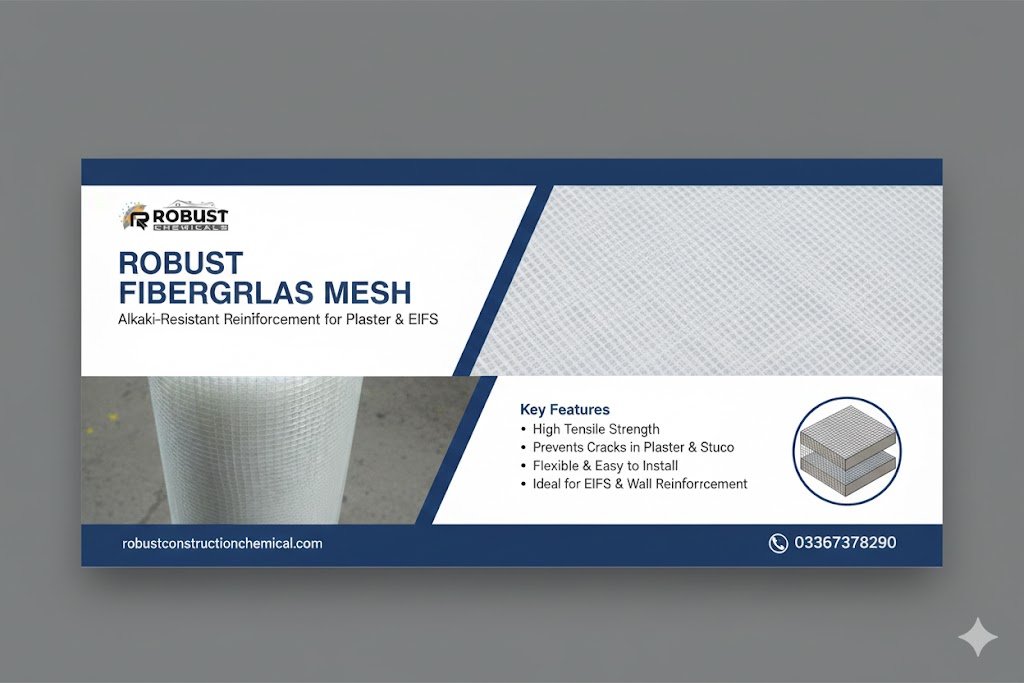
The “Alkali-Resistant” (AR) Coating: This is the most important technical point. Standard glass dissolves in the high-pH environment of cement; 160GSM mesh is treated with an acrylic acid copolymer liquid to resist this.
-
Technical Specifications: * Mesh Size: Typically $4 \text{mm} \times 4 \text{mm}$ or $5 \text{mm} \times 5 \text{mm}$.
-
Weight: 160g per square meter.2
-
Tensile Strength: High resistance to pulling (Warp/Weft).3
-
3. Core Applications in Pakistan’s Real Estate Sector
A. Exterior Insulation and Finish Systems (EIFS)
Explain how 160GSM is the industry standard for EIFS/ETICS in modern commercial buildings in Bahria Town or DHA projects.
B. Plaster & Stucco Reinforcement
Discuss the prevention of “hairline cracks” in internal and external plastering.
C. Roof Waterproofing & Bitumen
Detail its role in “sandwiching” between layers of liquid bitumen or acrylic waterproofing membranes to prevent leakage during the monsoon season.
D. Concrete Screeds & Floor Leveling
How it adds impact resistance to thin-layer floor screeds.
4. Why 160GSM? Comparing Weights (75g vs 145g vs 160g)
-
75GSM: Best for indoor drywall joints and small repairs.
-
145GSM: Standard for indoor plastering.
-
160GSM (The Gold Standard): Necessary for exterior walls, areas of high thermal expansion, and structural joints.
5. Benefits Specific to the Pakistani Climate
-
Heat Resistance: Managing the expansion and contraction of concrete in cities like Jacobabad or Multan.
-
Corrosion/Rust Proof: Unlike metal “jali,” fiber mesh will never rust, making it ideal for coastal cities like Karachi and Gwadar.4
-
Ease of Use: Lightweight rolls that are easy to transport to high-rise construction sites.5
6. Installation Guide: Step-by-Step for Contractors
-
Surface Preparation: Cleaning the substrate.
-
Base Coat Application: Applying the first layer of mortar/waterproofing.
-
Embedding the Mesh: Rolling the 160GSM mesh into the wet layer (no wrinkles!).
-
Overlapping: Ensure at least 10cm of overlap between sheets to prevent joint cracks.
-
Final Coat: The finishing layer of plaster or paint.
7. Buying Guide: Fiber Mesh Price in Pakistan 2025
-
Discuss factors affecting price: Roll length (usually 50m), brand (e.g., Terraco, Monex, or Chinese imports), and coating quality.
-
Current Market Trends: How global shipping costs affect the price of imported fiberglass in local markets like Lahore’s Brandreth Road or Karachi’s Timber Market.
8. Frequently Asked Questions (FAQ)
-
Can I use fiber mesh instead of steel for structural beams? (Answer: No, it’s for surface reinforcement).
-
Is it fireproof? (Answer: Fiberglass is naturally non-combustible).6
1. Introduction: The Evolution of Construction Reinforcement in Pakistan
-
The Problem: Why traditional plaster in Pakistan cracks due to extreme heat (up to 50°C) and structural settling.
-
The Solution: Introduction of 160GSM (Grams per Square Meter) Fiber Mesh as the “modern rebar” for surface finishes.
-
Key Value: How it replaces traditional chicken wire (jali) with a rust-free, alkali-resistant alternative.
2. What is 160GSM Fiber Mesh?
-
Material Composition: Explain the use of C-glass or E-glass yarns.1
-
The “Alkali-Resistant” (AR) Coating: This is the most important technical point. Standard glass dissolves in the high-pH environment of cement; 160GSM mesh is treated with an acrylic acid copolymer liquid to resist this.
-
Technical Specifications: * Mesh Size: Typically $4 \text{mm} \times 4 \text{mm}$ or $5 \text{mm} \times 5 \text{mm}$.
-
Weight: 160g per square meter.2
-
Tensile Strength: High resistance to pulling (Warp/Weft).3
-
3. Core Applications in Pakistan’s Real Estate Sector
A. Exterior Insulation and Finish Systems (EIFS)
Explain how 160GSM is the industry standard for EIFS/ETICS in modern commercial buildings in Bahria Town or DHA projects.
B. Plaster & Stucco Reinforcement
Discuss the prevention of “hairline cracks” in internal and external plastering.
C. Roof Waterproofing & Bitumen
Detail its role in “sandwiching” between layers of liquid bitumen or acrylic waterproofing membranes to prevent leakage during the monsoon season.
D. Concrete Screeds & Floor Leveling
How it adds impact resistance to thin-layer floor screeds.
4. Why 160GSM? Comparing Weights (75g vs 145g vs 160g)
-
75GSM: Best for indoor drywall joints and small repairs.
-
145GSM: Standard for indoor plastering.
-
160GSM (The Gold Standard): Necessary for exterior walls, areas of high thermal expansion, and structural joints.
5. Benefits Specific to the Pakistani Climate
-
Heat Resistance: Managing the expansion and contraction of concrete in cities like Jacobabad or Multan.
-
Corrosion/Rust Proof: Unlike metal “jali,” fiber mesh will never rust, making it ideal for coastal cities like Karachi and Gwadar.4
-
Ease of Use: Lightweight rolls that are easy to transport to high-rise construction sites.5
6. Installation Guide: Step-by-Step for Contractors
-
Surface Preparation: Cleaning the substrate.
-
Base Coat Application: Applying the first layer of mortar/waterproofing.
-
Embedding the Mesh: Rolling the 160GSM mesh into the wet layer (no wrinkles!).
-
Overlapping: Ensure at least 10cm of overlap between sheets to prevent joint cracks.
-
Final Coat: The finishing layer of plaster or paint.
7. Buying Guide: Fiber Mesh Price in Pakistan 2025
-
Discuss factors affecting price: Roll length (usually 50m), brand (e.g., Terraco, Monex, or Chinese imports), and coating quality.
-
Current Market Trends: How global shipping costs affect the price of imported fiberglass in local markets like Lahore’s Brandreth Road or Karachi’s Timber Market.
8. Frequently Asked Questions (FAQ)
-
Can I use fiber mesh instead of steel for structural beams? (Answer: No, it’s for surface reinforcement).
-
Is it fireproof? (Answer: Fiberglass is naturally non-combustible).6
-
-
1. Introduction: The Evolution of Construction Reinforcement in Pakistan
-
The Problem: Why traditional plaster in Pakistan cracks due to extreme heat (up to 50°C) and structural settling.
-
The Solution: Introduction of 160GSM (Grams per Square Meter) Fiber Mesh as the “modern rebar” for surface finishes.
-
Key Value: How it replaces traditional chicken wire (jali) with a rust-free, alkali-resistant alternative.
2. What is 160GSM Fiber Mesh?
-
Material Composition: Explain the use of C-glass or E-glass yarns.1
-
The “Alkali-Resistant” (AR) Coating: This is the most important technical point. Standard glass dissolves in the high-pH environment of cement; 160GSM mesh is treated with an acrylic acid copolymer liquid to resist this.
-
Technical Specifications: * Mesh Size: Typically $4 \text{mm} \times 4 \text{mm}$ or $5 \text{mm} \times 5 \text{mm}$.
-
Weight: 160g per square meter.2
-
Tensile Strength: High resistance to pulling (Warp/Weft).3
-
3. Core Applications in Pakistan’s Real Estate Sector
A. Exterior Insulation and Finish Systems (EIFS)
Explain how 160GSM is the industry standard for EIFS/ETICS in modern commercial buildings in Bahria Town or DHA projects.
B. Plaster & Stucco Reinforcement
Discuss the prevention of “hairline cracks” in internal and external plastering.
C. Roof Waterproofing & Bitumen
Detail its role in “sandwiching” between layers of liquid bitumen or acrylic waterproofing membranes to prevent leakage during the monsoon season.
D. Concrete Screeds & Floor Leveling
How it adds impact resistance to thin-layer floor screeds.
4. Why 160GSM? Comparing Weights (75g vs 145g vs 160g)
-
75GSM: Best for indoor drywall joints and small repairs.
-
145GSM: Standard for indoor plastering.
-
160GSM (The Gold Standard): Necessary for exterior walls, areas of high thermal expansion, and structural joints.
5. Benefits Specific to the Pakistani Climate
-
Heat Resistance: Managing the expansion and contraction of concrete in cities like Jacobabad or Multan.
-
Corrosion/Rust Proof: Unlike metal “jali,” fiber mesh will never rust, making it ideal for coastal cities like Karachi and Gwadar.4
-
Ease of Use: Lightweight rolls that are easy to transport to high-rise construction sites.5
6. Installation Guide: Step-by-Step for Contractors
-
Surface Preparation: Cleaning the substrate.
-
Base Coat Application: Applying the first layer of mortar/waterproofing.
-
Embedding the Mesh: Rolling the 160GSM mesh into the wet layer (no wrinkles!).
-
Overlapping: Ensure at least 10cm of overlap between sheets to prevent joint cracks.
-
Final Coat: The finishing layer of plaster or paint.
7. Buying Guide: Fiber Mesh Price in Pakistan 2025
-
Discuss factors affecting price: Roll length (usually 50m), brand (e.g., Terraco, Monex, or Chinese imports), and coating quality.
-
Current Market Trends: How global shipping costs affect the price of imported fiberglass in local markets like Lahore’s Brandreth Road or Karachi’s Timber Market.
8. Frequently Asked Questions (FAQ)
-
Can I use fiber mesh instead of steel for structural beams? (Answer: No, it’s for surface reinforcement).
-
Is it fireproof? (Answer: Fiberglass is naturally non-combustible).6
-
-
1. Introduction: The Evolution of Construction Reinforcement in Pakistan
-
The Problem: Why traditional plaster in Pakistan cracks due to extreme heat (up to 50°C) and structural settling.
-
The Solution: Introduction of 160GSM (Grams per Square Meter) Fiber Mesh as the “modern rebar” for surface finishes.
-
Key Value: How it replaces traditional chicken wire (jali) with a rust-free, alkali-resistant alternative.
2. What is 160GSM Fiber Mesh?
-
Material Composition: Explain the use of C-glass or E-glass yarns.1
-
The “Alkali-Resistant” (AR) Coating: This is the most important technical point. Standard glass dissolves in the high-pH environment of cement; 160GSM mesh is treated with an acrylic acid copolymer liquid to resist this.
-
Technical Specifications: * Mesh Size: Typically $4 \text{mm} \times 4 \text{mm}$ or $5 \text{mm} \times 5 \text{mm}$.
-
Weight: 160g per square meter.2
-
Tensile Strength: High resistance to pulling (Warp/Weft).3
-
3. Core Applications in Pakistan’s Real Estate Sector
A. Exterior Insulation and Finish Systems (EIFS)
Explain how 160GSM is the industry standard for EIFS/ETICS in modern commercial buildings in Bahria Town or DHA projects.
B. Plaster & Stucco Reinforcement
Discuss the prevention of “hairline cracks” in internal and external plastering.
C. Roof Waterproofing & Bitumen
Detail its role in “sandwiching” between layers of liquid bitumen or acrylic waterproofing membranes to prevent leakage during the monsoon season.
D. Concrete Screeds & Floor Leveling
How it adds impact resistance to thin-layer floor screeds.
4. Why 160GSM? Comparing Weights (75g vs 145g vs 160g)
-
75GSM: Best for indoor drywall joints and small repairs.
-
145GSM: Standard for indoor plastering.
-
160GSM (The Gold Standard): Necessary for exterior walls, areas of high thermal expansion, and structural joints.
5. Benefits Specific to the Pakistani Climate
-
Heat Resistance: Managing the expansion and contraction of concrete in cities like Jacobabad or Multan.
-
Corrosion/Rust Proof: Unlike metal “jali,” fiber mesh will never rust, making it ideal for coastal cities like Karachi and Gwadar.4
-
Ease of Use: Lightweight rolls that are easy to transport to high-rise construction sites.5
6. Installation Guide: Step-by-Step for Contractors
-
Surface Preparation: Cleaning the substrate.
-
Base Coat Application: Applying the first layer of mortar/waterproofing.
-
Embedding the Mesh: Rolling the 160GSM mesh into the wet layer (no wrinkles!).
-
Overlapping: Ensure at least 10cm of overlap between sheets to prevent joint cracks.
-
Final Coat: The finishing layer of plaster or paint.
7. Buying Guide: Fiber Mesh Price in Pakistan 2025
-
Discuss factors affecting price: Roll length (usually 50m), brand (e.g., Terraco, Monex, or Chinese imports), and coating quality.
-
Current Market Trends: How global shipping costs affect the price of imported fiberglass in local markets like Lahore’s Brandreth Road or Karachi’s Timber Market.
8. Frequently Asked Questions (FAQ)
-
Can I use fiber mesh instead of steel for structural beams? (Answer: No, it’s for surface reinforcement).
-
Is it fireproof? (Answer: Fiberglass is naturally non-combustible).6
-
-
1. Introduction: The Evolution of Construction Reinforcement in Pakistan
-
The Problem: Why traditional plaster in Pakistan cracks due to extreme heat (up to 50°C) and structural settling.
-
The Solution: Introduction of 160GSM (Grams per Square Meter) Fiber Mesh as the “modern rebar” for surface finishes.
-
Key Value: How it replaces traditional chicken wire (jali) with a rust-free, alkali-resistant alternative.
2. What is 160GSM Fiber Mesh?
-
Material Composition: Explain the use of C-glass or E-glass yarns.1
-
The “Alkali-Resistant” (AR) Coating: This is the most important technical point. Standard glass dissolves in the high-pH environment of cement; 160GSM mesh is treated with an acrylic acid copolymer liquid to resist this.
-
Technical Specifications: * Mesh Size: Typically $4 \text{mm} \times 4 \text{mm}$ or $5 \text{mm} \times 5 \text{mm}$.
-
Weight: 160g per square meter.2
-
Tensile Strength: High resistance to pulling (Warp/Weft).3
-
3. Core Applications in Pakistan’s Real Estate Sector
A. Exterior Insulation and Finish Systems (EIFS)
Explain how 160GSM is the industry standard for EIFS/ETICS in modern commercial buildings in Bahria Town or DHA projects.
B. Plaster & Stucco Reinforcement
Discuss the prevention of “hairline cracks” in internal and external plastering.
C. Roof Waterproofing & Bitumen
Detail its role in “sandwiching” between layers of liquid bitumen or acrylic waterproofing membranes to prevent leakage during the monsoon season.
D. Concrete Screeds & Floor Leveling
How it adds impact resistance to thin-layer floor screeds.
4. Why 160GSM? Comparing Weights (75g vs 145g vs 160g)
-
75GSM: Best for indoor drywall joints and small repairs.
-
145GSM: Standard for indoor plastering.
-
160GSM (The Gold Standard): Necessary for exterior walls, areas of high thermal expansion, and structural joints.
5. Benefits Specific to the Pakistani Climate
-
Heat Resistance: Managing the expansion and contraction of concrete in cities like Jacobabad or Multan.
-
Corrosion/Rust Proof: Unlike metal “jali,” fiber mesh will never rust, making it ideal for coastal cities like Karachi and Gwadar.4
-
Ease of Use: Lightweight rolls that are easy to transport to high-rise construction sites.5
6. Installation Guide: Step-by-Step for Contractors
-
Surface Preparation: Cleaning the substrate.
-
Base Coat Application: Applying the first layer of mortar/waterproofing.
-
Embedding the Mesh: Rolling the 160GSM mesh into the wet layer (no wrinkles!).
-
Overlapping: Ensure at least 10cm of overlap between sheets to prevent joint cracks.
-
Final Coat: The finishing layer of plaster or paint.
7. Buying Guide: Fiber Mesh Price in Pakistan 2025
-
Discuss factors affecting price: Roll length (usually 50m), brand (e.g., Terraco, Monex, or Chinese imports), and coating quality.
-
Current Market Trends: How global shipping costs affect the price of imported fiberglass in local markets like Lahore’s Brandreth Road or Karachi’s Timber Market.
8. Frequently Asked Questions (FAQ)
-
Can I use fiber mesh instead of steel for structural beams? (Answer: No, it’s for surface reinforcement).
-
Is it fireproof? (Answer: Fiberglass is naturally non-combustible).6
-
-
1. Introduction: The Evolution of Construction Reinforcement in Pakistan
-
The Problem: Why traditional plaster in Pakistan cracks due to extreme heat (up to 50°C) and structural settling.
-
The Solution: Introduction of 160GSM (Grams per Square Meter) Fiber Mesh as the “modern rebar” for surface finishes.
-
Key Value: How it replaces traditional chicken wire (jali) with a rust-free, alkali-resistant alternative.
2. What is 160GSM Fiber Mesh?
-
Material Composition: Explain the use of C-glass or E-glass yarns.1
-
The “Alkali-Resistant” (AR) Coating: This is the most important technical point. Standard glass dissolves in the high-pH environment of cement; 160GSM mesh is treated with an acrylic acid copolymer liquid to resist this.
-
Technical Specifications: * Mesh Size: Typically $4 \text{mm} \times 4 \text{mm}$ or $5 \text{mm} \times 5 \text{mm}$.
-
Weight: 160g per square meter.2
-
Tensile Strength: High resistance to pulling (Warp/Weft).3
-
3. Core Applications in Pakistan’s Real Estate Sector
A. Exterior Insulation and Finish Systems (EIFS)
Explain how 160GSM is the industry standard for EIFS/ETICS in modern commercial buildings in Bahria Town or DHA projects.
B. Plaster & Stucco Reinforcement
Discuss the prevention of “hairline cracks” in internal and external plastering.
C. Roof Waterproofing & Bitumen
Detail its role in “sandwiching” between layers of liquid bitumen or acrylic waterproofing membranes to prevent leakage during the monsoon season.
D. Concrete Screeds & Floor Leveling
How it adds impact resistance to thin-layer floor screeds.
4. Why 160GSM? Comparing Weights (75g vs 145g vs 160g)
-
75GSM: Best for indoor drywall joints and small repairs.
-
145GSM: Standard for indoor plastering.
-
160GSM (The Gold Standard): Necessary for exterior walls, areas of high thermal expansion, and structural joints.
5. Benefits Specific to the Pakistani Climate
-
Heat Resistance: Managing the expansion and contraction of concrete in cities like Jacobabad or Multan.
-
Corrosion/Rust Proof: Unlike metal “jali,” fiber mesh will never rust, making it ideal for coastal cities like Karachi and Gwadar.4
-
Ease of Use: Lightweight rolls that are easy to transport to high-rise construction sites.5
6. Installation Guide: Step-by-Step for Contractors
-
Surface Preparation: Cleaning the substrate.
-
Base Coat Application: Applying the first layer of mortar/waterproofing.
-
Embedding the Mesh: Rolling the 160GSM mesh into the wet layer (no wrinkles!).
-
Overlapping: Ensure at least 10cm of overlap between sheets to prevent joint cracks.
-
Final Coat: The finishing layer of plaster or paint.
7. Buying Guide: Fiber Mesh Price in Pakistan 2025
-
Discuss factors affecting price: Roll length (usually 50m), brand (e.g., Terraco, Monex, or Chinese imports), and coating quality.
-
Current Market Trends: How global shipping costs affect the price of imported fiberglass in local markets like Lahore’s Brandreth Road or Karachi’s Timber Market.
8. Frequently Asked Questions (FAQ)
-
Can I use fiber mesh instead of steel for structural beams? (Answer: No, it’s for surface reinforcement).
-
Is it fireproof? (Answer: Fiberglass is naturally non-combustible).6
-