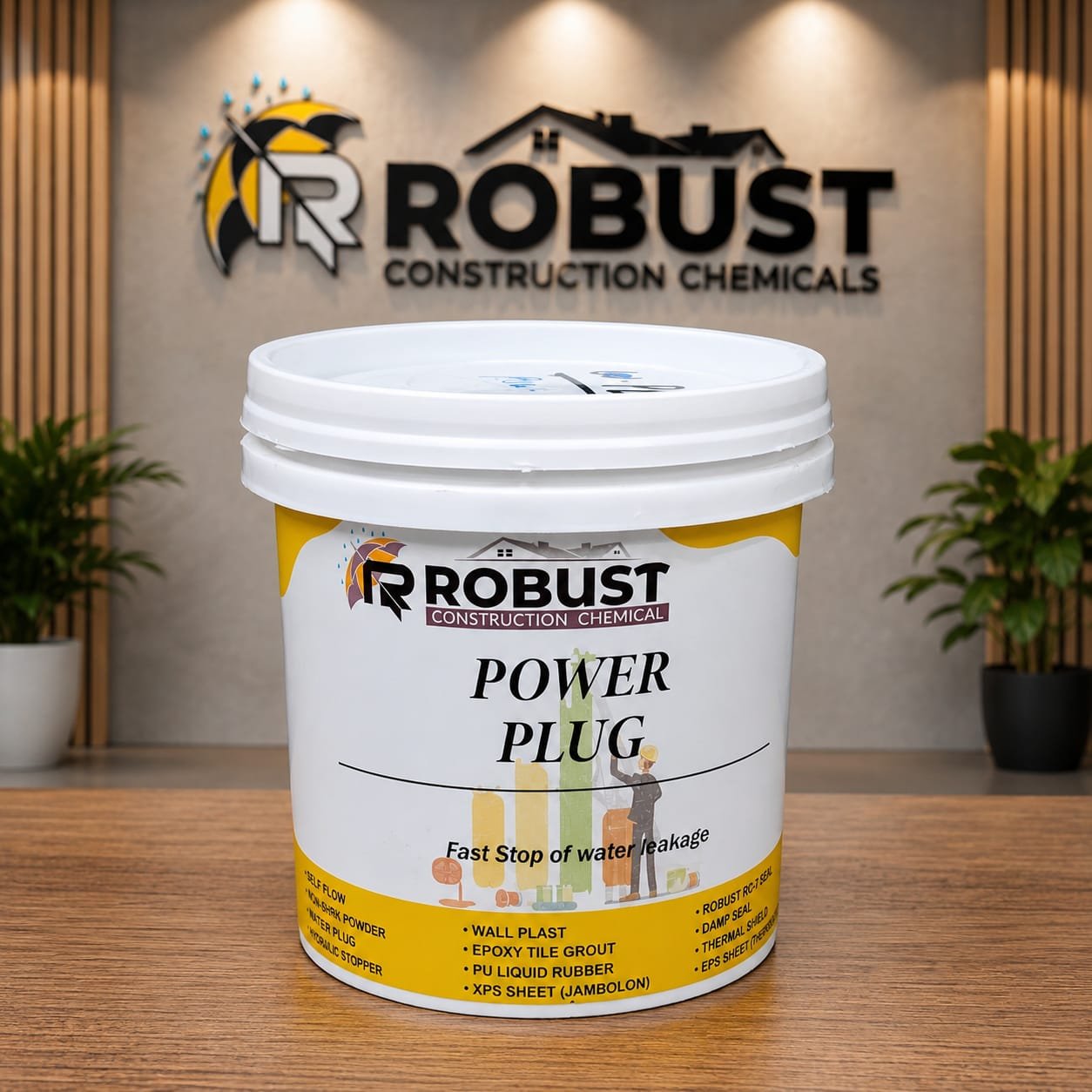
Robust Power Plug (also specified as Ultra-Rapid Setting Hydraulic Water-Plug Mortar or Instant Leak-Stop Hydraulic Cement) is a single-component, chloride-free, ultra-fast-setting dry powder compound engineered to stop active, pressurized water leaks and running seepage through concrete and masonry in 30 to 90 seconds—even underwater. Listed directly on your product packaging (Power Plug), it is specifically formulated for emergency leak plugging in underground water tanks (UGWT), overhead water tanks (OHWT), deep basements, lift pits, and leaking pipe penetrations without draining the tank.
1. Core Chemical & Hydraulic Plugging Characteristics
-
Ultra-Rapid Setting (30 – 90 Seconds): When gauged with clean water into a stiff putty, it initiates an exothermic hydraulic crystallization reaction that hardens within seconds—strong enough to hold back active water pressure immediately upon hand pressure release.
-
Controlled Slight Expansion (Non-Shrink Lock): Expands slightly (0.05% – 0.15%) as it sets, locking mechanically into dovetail-cut cracks and cavities to form a permanent, monolithic watertight seal that never shrinks or pulls away.
-
Sets Underwater & Against Hydrostatic Head: Continues curing and gaining high compressive strength even when submerged inside filled water tanks or exposed to continuous groundwater inflow.
-
Chloride-Free & Potable Water Safe: Contains zero calcium chloride or corrosive salts—100% non-toxic for drinking water reservoirs and safe against embedded steel reinforcement bars (rebar).
2. Technical Specifications & Performance Benchmarks
| Property / Metric | Typical Industrial & Construction Range | Standard Test Method | Functional Significance |
| Form & Appearance | Fine grey hydraulic cementitious powder | Visual / Lab Spec | Mixes quickly with water into a cohesive, non-slump putty |
| Mixing Ratio (By Volume) | ~3.5 to 4 parts Powder : 1 part Clean Water | Manufacturer Spec | Yields a stiff, zero-slump mortar plug (22%–26% water by weight) |
| Initial Setting Time (at 25°C) | 30 – 60 seconds | ASTM C191 / BS EN 196-3 | Stops running water instantly under manual pressure |
| Final Setting Time (at 25°C) | 60 – 120 seconds | ASTM C191 | Achieves immediate load-bearing structural rigidity |
| Compressive Strength (1 Hour) | ≥ 12 – 18 N/mm² (1,740 – 2,600 psi) | ASTM C109 | Rapid early strength resists sudden hydrostatic surges |
| Compressive Strength (24 Hours) | ≥ 28 – 35 N/mm² (4,060 – 5,075 psi) | ASTM C109 | Matches or exceeds structural RCC concrete strength |
| Compressive Strength (28 Days) | ≥ 42 – 50 N/mm² (6,090 – 7,250 psi) | ASTM C109 | Permanent structural durability for tank walls and slabs |
| Chloride Content | Nil / < 0.01% (Chloride-Free) | BS EN 480-10 | Non-corrosive to steel rebar and tie-rods |
| Standard Packaging | 1 kg Pouch/Tub, 5 kg Pail & 20 kg Moisture-Proof Bag | Industry Standard | Small batches prevent premature hardening on site |
3. Primary Water Tank & Subterranean Applications
-
Underground & Overhead Water Tank Leaks (UGWT / OHWT): Stops active water jets and weeping cracks at slab-to-wall kicker joints, vertical wall cracks, and porous concrete honeycombs—both from the inside (underwater) and outside.
-
Leaking Pipe Penetrations & Sleeves: Seals annular gaps around PVC, PPR, and GI inlet/outlet water pipes passing through concrete tank walls and basement slabs.
-
Formwork Tie-Rod Holes & Honeycombs: Permanently plugs leaking tie-rod cones and gravel pockets left behind after shuttering removal.
-
Basements, Lift Pits, Swimming Pools & Manholes: Arrests high-pressure groundwater ingress before applying crystalline or polymer waterproofing coatings.
4. Step-by-Step Water Tank Leak-Plugging Protocol
-
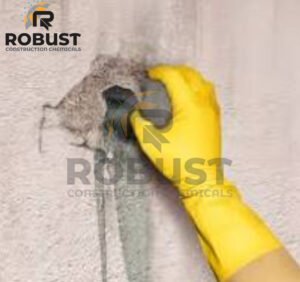
Chisel a Dovetail / Inverted-V Groove: Using a cold chisel and hammer, cut out the leaking crack or hole to a minimum width and depth of 20 mm × 25 mm (¾” × 1″). Always shape the cut wider at the back than at the surface (dovetail profile)—never leave a shallow V-groove, which water pressure can push out.
-
Flush Loose Debris: Rinse out loose concrete dust and gravel with clean water so the substrate is sound and wet.
-
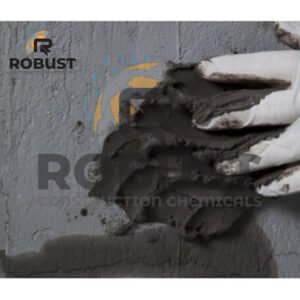
Mix Small Hand-Sized Batches: Wearing rubber gloves, mix only as much Robust Power Plug as you can apply in 20–30 seconds (roughly 0.5–1.0 kg at a time). Add clean water (3.5 parts powder : 1 part water) and knead rapidly into a stiff, zero-slump putty ball. (Note: Use cold water in peak Pakistani summer heat to slow setting to ~45 seconds; use lukewarm water in winter to speed setting).
-
Force-Press & Hold Firmly: As soon as the putty begins to feel slightly warm in your gloved hand, press it forcefully into the dovetail cavity from the perimeter toward the center—do not twist or rub. Hold steady pressure with your palm or a wooden block for 45 to 60 seconds until completely rock-hard.
-
Trim & Overcoat: Trim excess mortar flush with the wall using a scraper after 5–10 minutes. For long running cracks, plug from the edges toward the point of highest water pressure, leaving the main jet for the final plug. Once all active leaks stop, seal the entire tank interior with Robust Damp Seal / Crystalline Waterproofing for complete long-term protection.
-
Robust Power Plug (also specified as Ultra-Rapid Setting Hydraulic Water-Plug Mortar or Instant Leak-Stop Hydraulic Cement) is a single-component, chloride-free, ultra-fast-setting dry powder compound engineered to stop active, pressurized water leaks and running seepage through concrete and masonry in 30 to 90 seconds—even underwater. Listed directly on your product packaging (
Power Plug), it is specifically formulated for emergency leak plugging in underground water tanks (UGWT), overhead water tanks (OHWT), deep basements, lift pits, and leaking pipe penetrations without draining the tank.1. Core Chemical & Hydraulic Plugging Characteristics
-
Ultra-Rapid Setting (30 – 90 Seconds): When gauged with clean water into a stiff putty, it initiates an exothermic hydraulic crystallization reaction that hardens within seconds—strong enough to hold back active water pressure immediately upon hand pressure release.
-
Controlled Slight Expansion (Non-Shrink Lock): Expands slightly (0.05% – 0.15%) as it sets, locking mechanically into dovetail-cut cracks and cavities to form a permanent, monolithic watertight seal that never shrinks or pulls away.
-
Sets Underwater & Against Hydrostatic Head: Continues curing and gaining high compressive strength even when submerged inside filled water tanks or exposed to continuous groundwater inflow.
-
Chloride-Free & Potable Water Safe: Contains zero calcium chloride or corrosive salts—100% non-toxic for drinking water reservoirs and safe against embedded steel reinforcement bars (rebar).
2. Technical Specifications & Performance Benchmarks
Property / Metric Typical Industrial & Construction Range Standard Test Method Functional Significance Form & Appearance Fine grey hydraulic cementitious powder Visual / Lab Spec Mixes quickly with water into a cohesive, non-slump putty Mixing Ratio (By Volume) ~3.5 to 4 parts Powder : 1 part Clean Water Manufacturer Spec Yields a stiff, zero-slump mortar plug (22%–26% water by weight) Initial Setting Time (at 25°C) 30 – 60 seconds ASTM C191 / BS EN 196-3 Stops running water instantly under manual pressure Final Setting Time (at 25°C) 60 – 120 seconds ASTM C191 Achieves immediate load-bearing structural rigidity Compressive Strength (1 Hour) ≥ 12 – 18 N/mm² (1,740 – 2,600 psi) ASTM C109 Rapid early strength resists sudden hydrostatic surges Compressive Strength (24 Hours) ≥ 28 – 35 N/mm² (4,060 – 5,075 psi) ASTM C109 Matches or exceeds structural RCC concrete strength Compressive Strength (28 Days) ≥ 42 – 50 N/mm² (6,090 – 7,250 psi) ASTM C109 Permanent structural durability for tank walls and slabs Chloride Content Nil / < 0.01% (Chloride-Free) BS EN 480-10 Non-corrosive to steel rebar and tie-rods Standard Packaging 1 kg Pouch/Tub, 5 kg Pail & 20 kg Moisture-Proof Bag Industry Standard Small batches prevent premature hardening on site 3. Primary Water Tank & Subterranean Applications
-
Underground & Overhead Water Tank Leaks (UGWT / OHWT): Stops active water jets and weeping cracks at slab-to-wall kicker joints, vertical wall cracks, and porous concrete honeycombs—both from the inside (underwater) and outside.
-
Leaking Pipe Penetrations & Sleeves: Seals annular gaps around PVC, PPR, and GI inlet/outlet water pipes passing through concrete tank walls and basement slabs.
-
Formwork Tie-Rod Holes & Honeycombs: Permanently plugs leaking tie-rod cones and gravel pockets left behind after shuttering removal.
-
Basements, Lift Pits, Swimming Pools & Manholes: Arrests high-pressure groundwater ingress before applying crystalline or polymer waterproofing coatings.
4. Step-by-Step Water Tank Leak-Plugging Protocol
-
Chisel a Dovetail / Inverted-V Groove: Using a cold chisel and hammer, cut out the leaking crack or hole to a minimum width and depth of 20 mm × 25 mm (¾” × 1″). Always shape the cut wider at the back than at the surface (dovetail profile)—never leave a shallow V-groove, which water pressure can push out.
-
Flush Loose Debris: Rinse out loose concrete dust and gravel with clean water so the substrate is sound and wet.
-
Mix Small Hand-Sized Batches: Wearing rubber gloves, mix only as much Robust Power Plug as you can apply in 20–30 seconds (roughly 0.5–1.0 kg at a time). Add clean water (3.5 parts powder : 1 part water) and knead rapidly into a stiff, zero-slump putty ball. (Note: Use cold water in peak Pakistani summer heat to slow setting to ~45 seconds; use lukewarm water in winter to speed setting).
-
Force-Press & Hold Firmly: As soon as the putty begins to feel slightly warm in your gloved hand, press it forcefully into the dovetail cavity from the perimeter toward the center—do not twist or rub. Hold steady pressure with your palm or a wooden block for 45 to 60 seconds until completely rock-hard.
-
Trim & Overcoat: Trim excess mortar flush with the wall using a scraper after 5–10 minutes. For long running cracks, plug from the edges toward the point of highest water pressure, leaving the main jet for the final plug. Once all active leaks stop, seal the entire tank interior with Robust Damp Seal / Crystalline Waterproofing for complete long-term protection.

-
- robust
- robust
- robust
- robust
- robust
- robust
- robust
- robust
- robust
- robust
- robust
- robust
- robust
- robust
- robust
- robust
- robust
- robust
- robust
- robust
- robust
- robust
- robust
- robust
- robust
- robust
- robust
- robust
- robust
- robust
- robust
- robust
- robust
- robust
- robust
- robust
- robust
- robust
- robust
- robust
- robust
- robust
- robust
- robust
- robust
- robust
- robust
- robust
-
-
-