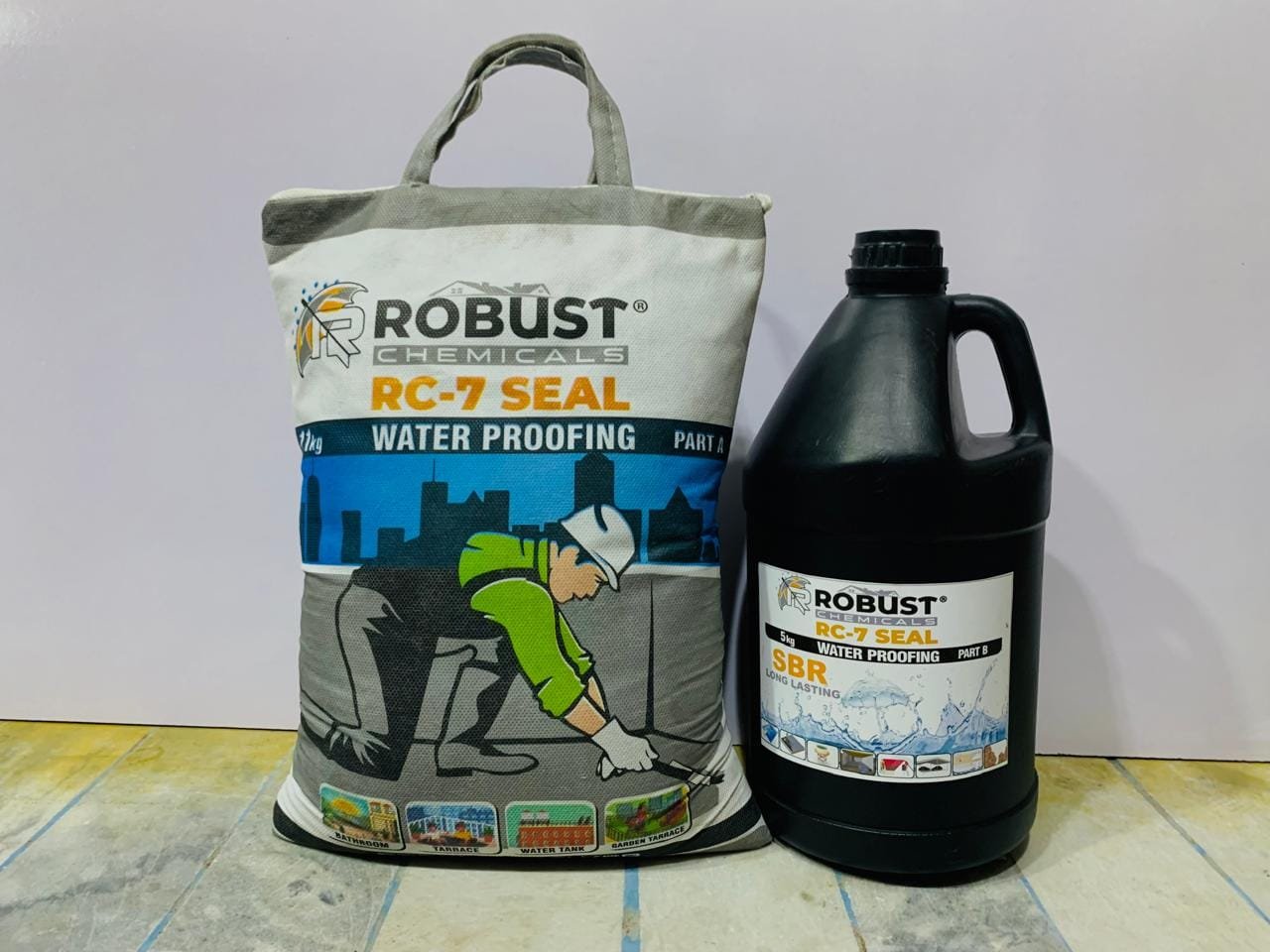
Robust RC-7 Seal Cementitious Coating: Complete Technical Specifications, BOQ Coverage, Installation Guide & 2026 Price in Pakistan
Robust RC-7 Seal is a heavy-duty, two-component, polymer-modified flexible cementitious waterproofing coating engineered to permanently seal concrete, brick masonry, and cement plaster against positive and negative hydrostatic water pressure. Formulated by combining a specialized liquid acrylic-polymer emulsion (Part A) with a graded portland-cement, crystalline-active, and micro-silica powder blend (Part B), Robust RC-7 Seal cures into a seamless, monolithic, semi-flexible membrane that bonds tenaciously to damp concrete substrates—making it the gold standard for underground and overhead water tanks, deep basements, sunken bathrooms, swimming pools, and roof slabs across Pakistan.
1. Core Engineering & Waterproofing Advantages
Unlike rigid plain cement slurries that crack under minor structural settlement or bituminous coatings that cannot be tiled over or used in drinking water tanks, Robust RC-7 Seal delivers multi-layered chemical and mechanical protection:
-
Positive & Negative Side Hydrostatic Resistance: Withstands direct positive water pressure inside water tanks and swimming pools (up to 5–7 bar / 50–70 meters of water head) as well as negative-side groundwater seepage pushing through basement retaining walls and lift pits.
-
Flexible Crack-Bridging Polymer Matrix: Acrylic-polymer modification imparts controlled flexibility and 30%–50% elongation at break, bridging static hairline shrinkage cracks up to 1.0 mm without splitting.
-
Potable Water Safe (100% Non-Toxic): Free from bitumen, coal tar, solvents, and chlorides—certified safe for potable drinking water reservoirs (UGWT & OHWT), fish farms, and food-processing wet zones.
-
Bonds Directly to Damp Concrete (SSD Substrate): Does not require bone-dry concrete; adheres chemically and mechanically to Saturated Surface Dry (SSD) masonry and concrete, ideal for active damp basements and monsoon-season repairs.
-
Breathable Vapor-Permeable Barrier: Blocks liquid water penetration while allowing trapped internal slab moisture vapor to breathe out, preventing osmotic blistering or delamination.
-
Directly Tileable & Plaster-Compatible: Creates a high-bond mineral surface that accepts polymer-modified tile adhesives, cement screeds, and protective plasters without needing bonding primers.
2. Technical Specifications & ASTM / EN Performance Benchmarks
| Property / Parameter | Specified Performance Range | Standard Test Method | Engineering Significance |
| System Composition | 2-Component Polymer-Modified Cementitious Slurry | EN 14891 / ASTM C1308 | Liquid polymer + reactive cementitious powder |
| Component Mixing Ratio | 1 : 2.5 to 1 : 3.0 (Liquid : Powder by weight) | Manufacturer Spec | Yields a smooth, lump-free brushable/trowelable slurry |
| Mixed Wet Density | 1.65 – 1.85 kg/L | ASTM D1475 | High-build density for void-free pinhole sealing |
| Recommended Dry Film Thickness | 1.5 mm – 2.0 mm (across 2 to 3 coats) | Wet/Dry Film Gauge | Optimal barrier thickness for tanks & basements |
| Tensile Adhesion / Pull-Off Strength | ≥ 1.2 – 1.8 N/mm² (175 – 260 psi) | ASTM D4541 / EN 1542 | Superior bond to concrete, brick & cement plaster |
| Elongation at Break | ≥ 30% – 50% | ASTM D412 / DIN 53504 | Absorbs minor thermal and structural micro-movement |
| Crack-Bridging Capability | Up to 0.75 – 1.0 mm static cracks | EN 14891 | Prevents hairline concrete shrinkage cracks from leaking |
| Positive Water Pressure Resistance | ≥ 5.0 Bar (50 meters water head — zero leakage) | DIN 1048 Part 5 | Engineered for deep water tanks & swimming pools |
| Negative Water Pressure Resistance | ≥ 1.5 – 2.5 Bar (15–25 meters water head) | Lab Hydrostatic Test | Stops dampness & weeping through basement walls |
| Chloride Ion Content | Nil / < 0.01% (Chloride-Free) | BS EN 480-10 | 100% non-corrosive to embedded steel rebar |
| Potable Water Compatibility | Non-toxic, odorless, taint-free after cure | BS 6920 / NSF 61 | Safe for residential & municipal drinking water tanks |
| Pot Life / Working Time (at 25°C) | 45 – 60 minutes | Lab Standard | Generous working window per mixed batch |
| Cure Schedule (at 25°C, 50% RH) | Recoat: 4–6 hrs | Foot Traffic: 24 hrs | Water Filling: 7 days | Lab Standard | Ready for water immersion or tiling after 7 days |
| Standard Packaging Kits | 5 kg, 15 kg, 20 kg & 25 kg Pre-Proportioned Kits | Industry Standard | Eliminates on-site dosing errors |
3. Primary Applications in Residential, Commercial & Civil Construction
-
Underground & Overhead Water Tanks (UGWT & OHWT): Waterproofs interior concrete and plastered brick walls, base slabs, and roof tank ceilings against water loss and external groundwater contamination.
-
Deep Basements, Retaining Walls & Lift Pits: Applied on both the exterior positive face (before backfilling) and interior negative face to stop groundwater seepage and efflorescence (shora).
-
Sunken Bathrooms, Kitchens, Balconies & Wet Areas: Forms a flexible, tile-ready waterproof pan beneath ceramic/porcelain floor tiles and shower walls.
-
Swimming Pools, Fountains & Water Features: Provides a continuous, hydrostatic-pressure-resistant waterproofing layer beneath pool plaster or mosaic tiles.
-
Flat RCC Roofs & Parapet Wall Junctions: Seals porous roof screeds and masonry parapet bases prior to laying protective screed, insulation, or tiles.
-
Sewage Treatment Plants (STP), Canals & Culverts: Protects concrete walls from mild wastewater chemicals and continuous water saturation.
4. BOQ Material Consumption & Coverage Calculator
Consumption of Robust RC-7 Seal varies according to hydrostatic pressure severity and surface roughness:
| Application Severity | Recommended Coats & Thickness | Consumption Rate (kg / m²) | Coverage per 20 kg Kit |
| Damp-Proofing & Bathroom Wet Areas | 2 Coats (~1.2 – 1.5 mm DFT) | 1.5 – 1.8 kg/m² | ~11.0 – 13.3 m² (120 – 143 sq. ft.) |
| Water Tanks (UGWT/OHWT) & Roof Slabs | 2 Coats + Mesh (~1.5 – 1.8 mm DFT) | 2.0 – 2.2 kg/m² | ~9.0 – 10.0 m² (97 – 108 sq. ft.) |
| Deep Basements, Pools & High Head (> 5m) | 3 Coats + Full Mesh (~2.0 – 2.5 mm DFT) | 2.5 – 3.0 kg/m² | ~6.6 – 8.0 m² (71 – 86 sq. ft.) |
(Rule of Thumb: 1 kg of mixed Robust RC-7 Seal covers approximately 5.0 to 6.5 sq. ft. across two full coats on smooth cement-plastered surfaces.)
5. Step-by-Step Professional Application Protocol
Step 1: Surface Preparation & Defect Repair
-
Remove all loose concrete laitance, dust, oil, grease, curing compounds, and old flaky paint using a wire brush, grinding disc, or high-pressure water jet.
-
Plug Active Leaks First: If water is actively spurting or weeping through cracks or tie-rod holes, chisel a dovetail groove and arrest the flow immediately using Robust Power Plug hydraulic cement before coating.
-
Fillet / Cove Corners (Gola): Round off all sharp 90° internal wall-to-floor and wall-to-wall corners using a polymer-modified cement mortar fillet (25 mm × 25 mm radius) so the coating never cracks at stress angles.
Step 2: Pre-Wetting to Saturated Surface Dry (SSD)
-
Thoroughly saturate the cleaned concrete or plaster surface with clean water for 1–2 hours prior to application.
-
Wipe away any standing puddles so the substrate is damp and cool to the touch (SSD)—never apply Robust RC-7 Seal onto hot, bone-dry concrete, which sucks moisture out of the slurry and weakens curing.
Step 3: Mechanical Mixing (Part A + Part B)
-
Pour Part A (Liquid Polymer) into a clean mixing pail first.
-
Slowly add Part B (Cementitious Powder) while mixing continuously with a slow-speed electric paddle mixer (300–400 RPM) for 3 to 4 minutes until a smooth, creamy, lump-free batter is achieved.
-
Let the mixture rest (“slake”) for 2–3 minutes, then stir briefly again before applying. Never add extra water to thin the mix.
Step 4: First Coat & Fiber Mesh Reinforcement
-
Apply the first coat generously at ~1.0 kg/m² using a stiff-bristled masonry brush, broom, or notch trowel, working the slurry deeply into surface pores in one direction.
-
Immediately embed Robust Alkali-Resistant Fiber Mesh (60–75 GSM) wet-on-wet across all wall-to-floor coves, pipe penetrations, construction joints, and cracks (or across the entire surface in deep water tanks and basements), overlapping mesh edges by 100 mm.
Step 5: Second & Third Coats (Cross-Hatch Method)
-
Allow the first coat to become firm and tack-free (4 to 6 hours depending on temperature and humidity).
-
Apply the second coat perpendicular (at 90°) to the first coat at ~1.0 kg/m² to achieve pinhole-free coverage and completely encapsulate the fiber mesh. Apply a third coat if specified for deep basements or swimming pools.
Step 6: Curing & Commissioning
-
Protect freshly coated surfaces from direct scorching sun, strong winds, and rain for at least 24 hours.
-
Mist lightly with clean water after 24 hours for 2–3 days to optimize cement hydration.
-
Wait 7 full days before filling water tanks/swimming pools (flush once with clean water before potable use) or laying protective floor screeds and ceramic tiles.
-
Here is the comprehensive, field-level Usage & Curing Protocol for Robust RC-7 Seal Cementitious Coating, specifically calibrated for site engineers, applicators, and hot-weather construction conditions in Pakistan, formatted for direct copy-pasting into your CMS:
1. Application Methods by Structure Type (Usage Guide)
Because Robust RC-7 Seal is a thixotropic two-component polymer-cement slurry, the application tool and coat build-up vary depending on whether you are waterproofing vertical walls, horizontal floor slabs, or complex water-retaining corners:
-
Stiff Masonry Brush / Soft Broom Application (Water Tanks, Basements & Wet Walls):
-
Best for working the slurry deeply into microscopic concrete pores, bug holes, and brick-mortar joints.
-
Apply Coat 1 in a firm horizontal brushing motion; apply Coat 2 in a vertical brushing motion (90° cross-hatch) so brush grooves cross each other and eliminate pinholes.
-
-
Notched / Flat Steel Trowel Application (Horizontal Roof Slabs, Sunken Bathrooms & Heavy Floors):
-
Use a 3 mm × 3 mm V-notched trowel to gauge an exact, uniform 1.5–2.0 mm wet film thickness across floors, followed immediately by smoothing with the flat side of the steel trowel.
-
-
Roller Application (Large Smooth Plastered Walls & Parapets):
-
Use a medium-nap solvent-resistant roller only after brushing a thin prime-slurry coat into surface pores; roll in overlapping cross-passes to maintain a minimum 0.75–1.0 mm wet film per coat (never roll below 0.75 mm per coat, as thin films dry out too quickly and craze).
-
-
Hopper-Gun / Airless Spray Application (Large Industrial Basements, Canals & STP Tanks):
-
Spray at 3–4 bar air pressure using a 4–6 mm nozzle, followed immediately by back-brushing the first sprayed pass to close any air voids and push the slurry into concrete capillaries.
-
2. Mandatory Reinforcement & Detailing Rules (High-Stress Zones)
Never rely on unreinforced slurry alone across structural junctions. Reinforce these critical zones using Robust Alkali-Resistant Fiber Mesh (60–75 GSM):
-
Wall-to-Floor Kicker Junctions (Gola / Fillet): Form a 25 mm × 25 mm polymer-modified cement mortar cove along the entire perimeter where vertical walls meet the base slab. Embed a 200 mm (8-inch) wide strip of Robust Fiber Mesh wet-on-wet into Coat 1 centered over the cove.
-
Pipe Penetrations & Drain Sleeves: Cut a square collar of fiber mesh with an X-slit in the center, slide it snugly around every PVC/GI pipe sleeve, embed it into Coat 1, and seal the pipe-to-concrete collar perimeter with Robust PU Tube Sealant after curing.
-
Construction Cold Joints & Static Cracks (> 0.5 mm): Chase out static cracks into a 10 mm × 10 mm groove, fill flush with polymer-modified repair mortar, and reinforce with a 150 mm wide strip of fiber mesh embedded between Coats 1 and 2.
-
Full-Surface Reinforcement (Deep Tanks & Swimming Pools): On water tanks deeper than 3 meters or swimming pools, embed Robust Fiber Mesh across 100% of the floor and wall area with 100 mm overlaps to maximize crack-bridging and tensile resistance.
3. Hot-Weather Usage Precautions (Pakistan Summer Conditions: 35°C – 45°C+)
In peak Pakistani summer heat (Lahore, Multan, Karachi, Faisalabad, Islamabad), rapid moisture evaporation can weaken cement hydration and cause spiderweb crazing cracks if standard precautions are skipped:
-
Shade Storage Prior to Mixing: Store both Part A (Liquid Polymer) and Part B (Powder) pails/bags in a cool shaded room (below 25°C–30°C) before mixing—hot materials cut pot life from 45–60 minutes down to 20–25 minutes.
-
Aggressive Pre-Wetting (SSD Condition): Saturate hot concrete walls and slabs with clean water repeatedly for 1–2 hours before coating so the slab cools down and absorbs water internally, leaving the surface damp with zero standing puddles.
-
Avoid Peak Afternoon Sun & Hot Winds: Schedule exterior roof, parapet, and open tank applications for early morning (before 10:30 AM) or late afternoon/evening (after 4:30 PM), and erect temporary shade tarpaulins or windbreaks against hot dry winds (loo).
-
Never Re-Temper with Water: Once mixed slurry begins to stiffen inside the bucket, discard it—never add water to “revive” stiffening mortar, as water breaks the polymer-cement cross-link and destroys waterproof integrity.
4. Step-by-Step Curing & Commissioning Timeline (0 to 28 Days)
Proper curing is the single most critical factor for Robust RC-7 Seal because the coating contains hydraulic cement that requires controlled moisture and time to crystallize into a dense, impermeable barrier:
5. Common Usage & Curing Mistakes to Avoid
-
Applying Too Thick in a Single Coat (> 1.5 mm): Piling 2.5–3.0 mm in one heavy pass traps moisture beneath a fast-drying surface skin, causing mud-cracking. Rule: Always apply two or three thin, even coats of 0.75–1.0 mm each.
-
Filling a Water Tank Too Early (< 7 Days): Filling a tank after 24–48 hours before polymer coalescence completes causes the water to turn milky/cloudy and softens the uncured coating. Rule: Always wait at least 7 full days at 25°C+ before water immersion.
-
Leaving Exterior Roof Coatings Permanently Unprotected Under UV & Foot Traffic: While Robust RC-7 Seal is UV-resistant, horizontal roof floors subject to foot traffic, furniture, or solar panel maintenance must be protected with a 25–38 mm cement-sand screed, roof tiles, or overcoated with Robust PU Liquid Rubber / Thermal Shield for long-term mechanical
-
protection.
-
Here is the comprehensive, field-level Usage & Curing Protocol for Robust RC-7 Seal Cementitious Coating, specifically calibrated for site engineers, applicators, and hot-weather construction conditions in Pakistan, formatted for direct copy-pasting into your CMS:
1. Application Methods by Structure Type (Usage Guide)
Because Robust RC-7 Seal is a thixotropic two-component polymer-cement slurry, the application tool and coat build-up vary depending on whether you are waterproofing vertical walls, horizontal floor slabs, or complex water-retaining corners:
-
Stiff Masonry Brush / Soft Broom Application (Water Tanks, Basements & Wet Walls):
-
Best for working the slurry deeply into microscopic concrete pores, bug holes, and brick-mortar joints.
-
Apply Coat 1 in a firm horizontal brushing motion; apply Coat 2 in a vertical brushing motion (90° cross-hatch) so brush grooves cross each other and eliminate pinholes.
-
-
Notched / Flat Steel Trowel Application (Horizontal Roof Slabs, Sunken Bathrooms & Heavy Floors):
-
Use a 3 mm × 3 mm V-notched trowel to gauge an exact, uniform 1.5–2.0 mm wet film thickness across floors, followed immediately by smoothing with the flat side of the steel trowel.
-
-
Roller Application (Large Smooth Plastered Walls & Parapets):
-
Use a medium-nap solvent-resistant roller only after brushing a thin prime-slurry coat into surface pores; roll in overlapping cross-passes to maintain a minimum 0.75–1.0 mm wet film per coat (never roll below 0.75 mm per coat, as thin films dry out too quickly and craze).
-
-
Hopper-Gun / Airless Spray Application (Large Industrial Basements, Canals & STP Tanks):
-
Spray at 3–4 bar air pressure using a 4–6 mm nozzle, followed immediately by back-brushing the first sprayed pass to close any air voids and push the slurry into concrete capillaries.
-
2. Mandatory Reinforcement & Detailing Rules (High-Stress Zones)
Never rely on unreinforced slurry alone across structural junctions. Reinforce these critical zones using Robust Alkali-Resistant Fiber Mesh (60–75 GSM):
-
Wall-to-Floor Kicker Junctions (Gola / Fillet): Form a 25 mm × 25 mm polymer-modified cement mortar cove along the entire perimeter where vertical walls meet the base slab. Embed a 200 mm (8-inch) wide strip of Robust Fiber Mesh wet-on-wet into Coat 1 centered over the cove.
-
Pipe Penetrations & Drain Sleeves: Cut a square collar of fiber mesh with an X-slit in the center, slide it snugly around every PVC/GI pipe sleeve, embed it into Coat 1, and seal the pipe-to-concrete collar perimeter with Robust PU Tube Sealant after curing.
-
Construction Cold Joints & Static Cracks (> 0.5 mm): Chase out static cracks into a 10 mm × 10 mm groove, fill flush with polymer-modified repair mortar, and reinforce with a 150 mm wide strip of fiber mesh embedded between Coats 1 and 2.
-
Full-Surface Reinforcement (Deep Tanks & Swimming Pools): On water tanks deeper than 3 meters or swimming pools, embed Robust Fiber Mesh across 100% of the floor and wall area with 100 mm overlaps to maximize crack-bridging and tensile resistance.
3. Hot-Weather Usage Precautions (Pakistan Summer Conditions: 35°C – 45°C+)
In peak Pakistani summer heat (Lahore, Multan, Karachi, Faisalabad, Islamabad), rapid moisture evaporation can weaken cement hydration and cause spiderweb crazing cracks if standard precautions are skipped:
-
Shade Storage Prior to Mixing: Store both Part A (Liquid Polymer) and Part B (Powder) pails/bags in a cool shaded room (below 25°C–30°C) before mixing—hot materials cut pot life from 45–60 minutes down to 20–25 minutes.
-
Aggressive Pre-Wetting (SSD Condition): Saturate hot concrete walls and slabs with clean water repeatedly for 1–2 hours before coating so the slab cools down and absorbs water internally, leaving the surface damp with zero standing puddles.
-
Avoid Peak Afternoon Sun & Hot Winds: Schedule exterior roof, parapet, and open tank applications for early morning (before 10:30 AM) or late afternoon/evening (after 4:30 PM), and erect temporary shade tarpaulins or windbreaks against hot dry winds (loo).
-
Never Re-Temper with Water: Once mixed slurry begins to stiffen inside the bucket, discard it—never add water to “revive” stiffening mortar, as water breaks the polymer-cement cross-link and destroys waterproof integrity.
4. Step-by-Step Curing & Commissioning Timeline (0 to 28 Days)
Proper curing is the single most critical factor for Robust RC-7 Seal because the coating contains hydraulic cement that requires controlled moisture and time to crystallize into a dense, impermeable barrier:
5. Common Usage & Curing Mistakes to Avoid
-
Applying Too Thick in a Single Coat (> 1.5 mm): Piling 2.5–3.0 mm in one heavy pass traps moisture beneath a fast-drying surface skin, causing mud-cracking. Rule: Always apply two or three thin, even coats of 0.75–1.0 mm each.
-
Filling a Water Tank Too Early (< 7 Days): Filling a tank after 24–48 hours before polymer coalescence completes causes the water to turn milky/cloudy and softens the uncured coating. Rule: Always wait at least 7 full days at 25°C+ before water immersion.
-
Leaving Exterior Roof Coatings Permanently Unprotected Under UV & Foot Traffic: While Robust RC-7 Seal is UV-resistant, horizontal roof floors subject to foot traffic, furniture, or solar panel maintenance must be protected with a 25–38 mm cement-sand screed, roof tiles, or overcoated with Robust PU Liquid Rubber / Thermal Shield for long-term mechanical protection.
-
Here is the comprehensive, field-level Usage & Curing Protocol for Robust RC-7 Seal Cementitious Coating, specifically calibrated for site engineers, applicators, and hot-weather construction conditions in Pakistan, formatted for direct copy-pasting into your CMS:
1. Application Methods by Structure Type (Usage Guide)
Because Robust RC-7 Seal is a thixotropic two-component polymer-cement slurry, the application tool and coat build-up vary depending on whether you are waterproofing vertical walls, horizontal floor slabs, or complex water-retaining corners:
-
Stiff Masonry Brush / Soft Broom Application (Water Tanks, Basements & Wet Walls):
-
Best for working the slurry deeply into microscopic concrete pores, bug holes, and brick-mortar joints.
-
Apply Coat 1 in a firm horizontal brushing motion; apply Coat 2 in a vertical brushing motion (90° cross-hatch) so brush grooves cross each other and eliminate pinholes.
-
-
Notched / Flat Steel Trowel Application (Horizontal Roof Slabs, Sunken Bathrooms & Heavy Floors):
-
Use a 3 mm × 3 mm V-notched trowel to gauge an exact, uniform 1.5–2.0 mm wet film thickness across floors, followed immediately by smoothing with the flat side of the steel trowel.
-
-
Roller Application (Large Smooth Plastered Walls & Parapets):
-
Use a medium-nap solvent-resistant roller only after brushing a thin prime-slurry coat into surface pores; roll in overlapping cross-passes to maintain a minimum 0.75–1.0 mm wet film per coat (never roll below 0.75 mm per coat, as thin films dry out too quickly and craze).
-
-
Hopper-Gun / Airless Spray Application (Large Industrial Basements, Canals & STP Tanks):
-
Spray at 3–4 bar air pressure using a 4–6 mm nozzle, followed immediately by back-brushing the first sprayed pass to close any air voids and push the slurry into concrete capillaries.
-
2. Mandatory Reinforcement & Detailing Rules (High-Stress Zones)
Never rely on unreinforced slurry alone across structural junctions. Reinforce these critical zones using Robust Alkali-Resistant Fiber Mesh (60–75 GSM):
-
Wall-to-Floor Kicker Junctions (Gola / Fillet): Form a 25 mm × 25 mm polymer-modified cement mortar cove along the entire perimeter where vertical walls meet the base slab. Embed a 200 mm (8-inch) wide strip of Robust Fiber Mesh wet-on-wet into Coat 1 centered over the cove.
-
Pipe Penetrations & Drain Sleeves: Cut a square collar of fiber mesh with an X-slit in the center, slide it snugly around every PVC/GI pipe sleeve, embed it into Coat 1, and seal the pipe-to-concrete collar perimeter with Robust PU Tube Sealant after curing.
-
Construction Cold Joints & Static Cracks (> 0.5 mm): Chase out static cracks into a 10 mm × 10 mm groove, fill flush with polymer-modified repair mortar, and reinforce with a 150 mm wide strip of fiber mesh embedded between Coats 1 and 2.
-
Full-Surface Reinforcement (Deep Tanks & Swimming Pools): On water tanks deeper than 3 meters or swimming pools, embed Robust Fiber Mesh across 100% of the floor and wall area with 100 mm overlaps to maximize crack-bridging and tensile resistance.
3. Hot-Weather Usage Precautions (Pakistan Summer Conditions: 35°C – 45°C+)
In peak Pakistani summer heat (Lahore, Multan, Karachi, Faisalabad, Islamabad), rapid moisture evaporation can weaken cement hydration and cause spiderweb crazing cracks if standard precautions are skipped:
-
Shade Storage Prior to Mixing: Store both Part A (Liquid Polymer) and Part B (Powder) pails/bags in a cool shaded room (below 25°C–30°C) before mixing—hot materials cut pot life from 45–60 minutes down to 20–25 minutes.
-
Aggressive Pre-Wetting (SSD Condition): Saturate hot concrete walls and slabs with clean water repeatedly for 1–2 hours before coating so the slab cools down and absorbs water internally, leaving the surface damp with zero standing puddles.
-
Avoid Peak Afternoon Sun & Hot Winds: Schedule exterior roof, parapet, and open tank applications for early morning (before 10:30 AM) or late afternoon/evening (after 4:30 PM), and erect temporary shade tarpaulins or windbreaks against hot dry winds (loo).
-
Never Re-Temper with Water: Once mixed slurry begins to stiffen inside the bucket, discard it—never add water to “revive” stiffening mortar, as water breaks the polymer-cement cross-link and destroys waterproof integrity.
4. Step-by-Step Curing & Commissioning Timeline (0 to 28 Days)
Proper curing is the single most critical factor for Robust RC-7 Seal because the coating contains hydraulic cement that requires controlled moisture and time to crystallize into a dense, impermeable barrier:
5. Common Usage & Curing Mistakes to Avoid
-
Applying Too Thick in a Single Coat (> 1.5 mm): Piling 2.5–3.0 mm in one heavy pass traps moisture beneath a fast-drying surface skin, causing mud-cracking. Rule: Always apply two or three thin, even coats of 0.75–1.0 mm each.
-
Filling a Water Tank Too Early (< 7 Days): Filling a tank after 24–48 hours before polymer coalescence completes causes the water to turn milky/cloudy and softens the uncured coating. Rule: Always wait at least 7 full days at 25°C+ before water immersion.
-
Leaving Exterior Roof Coatings Permanently Unprotected Under UV & Foot Traffic: While Robust RC-7 Seal is UV-resistant, horizontal roof floors subject to foot traffic, furniture, or solar panel maintenance must be protected with a 25–38 mm cement-sand screed, roof tiles, or overcoated with Robust PU Liquid Rubber / Thermal Shield for long-term mechanical protection.
- robust
- robust
- robust
- robust
- robust
- robust
- robust
- robust
- robust
- robust
- robust
- robust
- robust
- robust
- robust
- robust
- robust
- robust
- robust
- robust
- robust
- robust
- robust
- robust
- robust
- robust
- robust
- robust
- robust
- robust
- robust
- robust
- robust
- robust
- robust
- robust
- robust
-
-
-