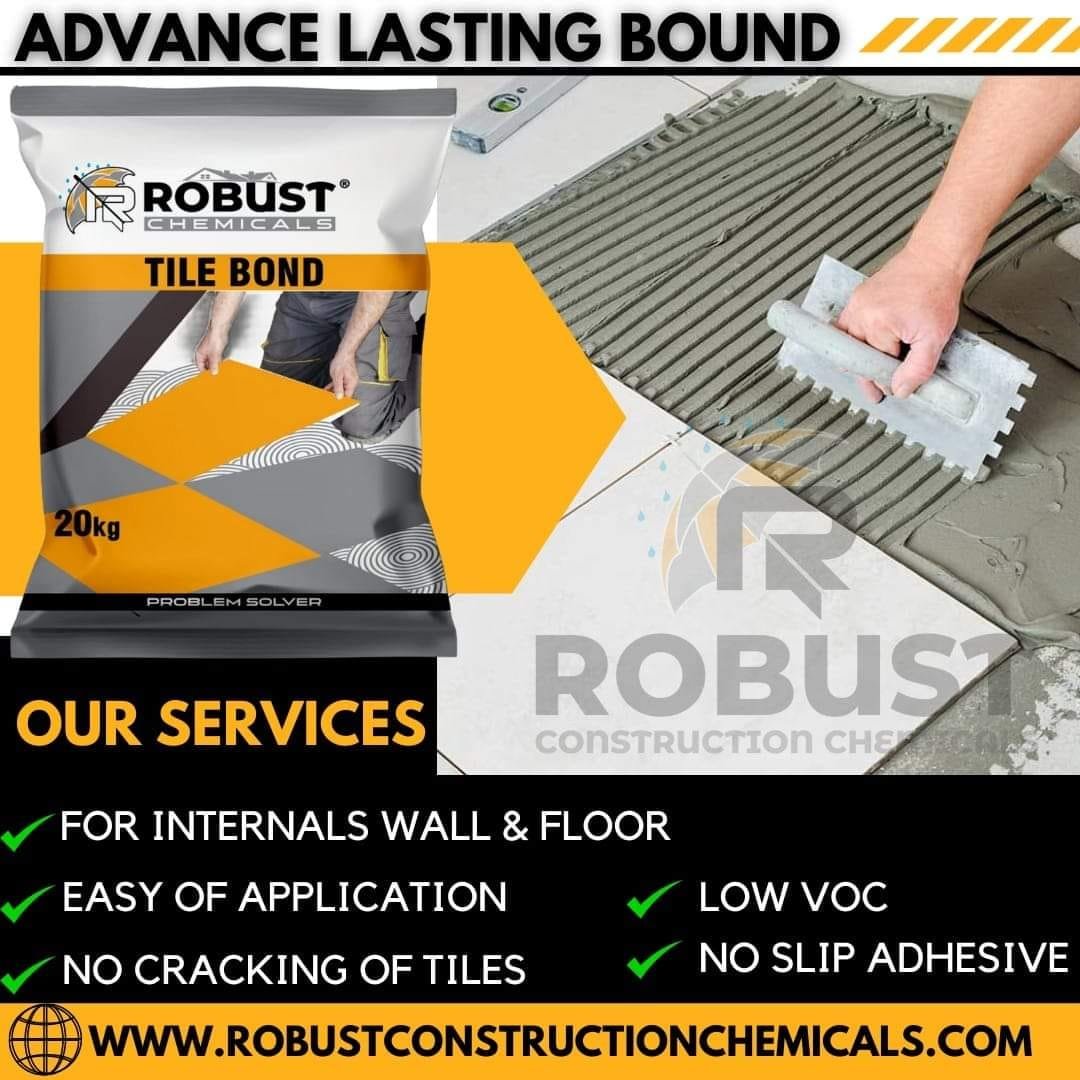
Robust Tile Bond Overview
Tile Bond is a high-performance adhesive specially formulated for fixing ceramic tiles, mosaic tiles, marble, granite, and other stone surfaces on both interior and exterior walls and floors. It provides superior adhesion, flexibility, and water resistance compared to conventional cement-sand mortar.
It is ready to use — just mix with water — and ensures strong bonding between tile and substrate while preventing debonding, cracks, and moisture seepage.
Composition
Tile Bond is a blend of:
-
High-quality cement
-
Graded silica sand
-
Polymer additives
-
Chemical bonding agents
-
Performance enhancers
This composition provides excellent workability, adhesion strength, and long-lasting performance even in wet or high-traffic areas.
Key Features and Benefits
-
Excellent Bond Strength:
Strong adhesion to concrete, plaster, and tile surfaces ensures long-lasting results. -
Water & Weather Resistance:
Protects against moisture, dampness, and temperature variations. -
Flexible and Crack-Resistant:
Prevents cracks due to thermal expansion or substrate movement. -
Ready-to-Mix Formula:
Only water is required for mixing; easy to apply with trowel. -
Smooth Application:
Non-sag property allows easy installation on vertical and horizontal surfaces. -
Economical & Efficient:
Covers more area compared to traditional cement-sand mortar and reduces labor time. -
Strong Adhesion on Multiple Surfaces:
Ideal for ceramic, vitrified, marble, and granite tiles. -
Suitable for Interior & Exterior Applications:
Performs effectively in bathrooms, kitchens, facades, swimming pools, and terraces.
Applications
-
Fixing ceramic, mosaic, vitrified, and marble tiles
-
Interior and exterior walls and floors
-
Bathrooms, kitchens, and toilets
-
Swimming pools and water tanks
-
Terraces, balconies, and façades
-
Commercial & industrial flooring
-
Wet and dry areas
Technical Data
| Property | Description |
|---|---|
| Appearance | Fine grey or white powder |
| Mixing Ratio | Approx. 3:1 (Powder: Water by weight) |
| Pot Life | 3–4 hours |
| Open Time | 20–25 minutes |
| Adjustability Time | 10–15 minutes |
| Setting Time | 24 hours |
| Coverage | 3–5 kg/m² (depending on trowel notch size) |
| Bond Strength | > 1 MPa after 28 days |
| Shelf Life | 12 months in sealed bags, stored in dry conditions |
Application Method
Surface Preparation
-
Ensure the surface is clean, sound, and free of dust, oil, or loose particles.
-
Dampen the surface before applying the adhesive.
Mixing
-
Add Tile Bond powder to clean water and mix thoroughly using a slow-speed mixer.
-
Stir until a smooth, lump-free paste is formed.
-
Let it stand for 5 minutes, then remix before use.
Application
-
Spread the adhesive on the surface using a notched trowel.
-
Apply only as much area as can be tiled within 20 minutes.
-
Press tiles firmly with slight twisting motion to ensure full contact.
-
Use spacers for uniform joint thickness.
Curing & Grouting
-
Allow tiles to set for 24 hours before grouting joints.
-
Avoid traffic or water exposure during this period.
Types of Tile Bond
-
Robust Tile Bond – Standard:
For ceramic and mosaic tiles on interior walls and floors. -
Robust Tile Bond – Premium:
For vitrified and porcelain tiles; provides higher adhesion and flexibility. -
Robust Tile Bond – Super:
For marble, granite, and exterior cladding; excellent water and weather resistance. -
Robust Tile Bond – Heat Resistant / Pool Grade:
For swimming pools, terraces, or areas exposed to high heat or moisture.
Packaging
-
Available in 20 kg and 40 kg bags
-
Store in a cool, dry place away from moisture
Safety Precautions
-
Use protective gloves and mask during mixing and application.
-
Avoid contact with eyes and skin; rinse immediately with water if contact occurs.
-
Keep out of reach of children.
Why Choose Robust Tile Bond
-
Formulated with advanced polymer technology
-
Ensures zero tile slippage
-
Provides permanent bonding and crack-free finish
-
Tested and approved for professional construction standards
-
Ideal for residential, commercial, and industrial projects
Robust Tile Bond – Technical Data Sheet
1. Product Overview
Robust Tile Bond is a high-performance polymer-modified cementitious adhesive designed for permanent fixing of ceramic, vitrified, mosaic, marble, and granite tiles on floors and walls. It provides exceptional bond strength, flexibility, and water resistance, making it ideal for both interior and exterior applications. Engineered for professional tiling installations, it meets modern construction standards where superior adhesion and long-term durability are essential.
This adhesive offers a convenient, ready-to-mix formulation that requires only the addition of water. Once applied, it ensures uniform coverage and minimizes tile slippage. The product is suitable for substrates such as concrete, cement plaster, screeds, cementitious waterproofing coatings, and existing tile surfaces (with proper preparation).
2. Composition
Robust Tile Bond is composed of a precise blend of:
-
Ordinary Portland Cement (OPC) – High-strength binder ensuring durability and setting stability.
-
Graded Silica Sand – Ensures uniform texture and optimal mechanical interlocking.
-
Polymer Additives – Improves flexibility, adhesion, and water resistance.
-
Chemical Binders – Enhances cohesive properties and bond performance.
-
Special Performance Modifiers – Improves open time, workability, and crack resistance.
The result is a high-quality, homogenous product offering controlled rheology and consistent performance across varying environmental conditions.
3. Areas of Application
Robust Tile Bond is recommended for the following:
-
Fixing ceramic and mosaic tiles on internal walls and floors.
-
Vitrified and porcelain tiles on residential, commercial, and industrial surfaces.
-
Marble and granite slabs on vertical and horizontal surfaces.
-
Bathrooms, kitchens, and wet rooms, where water exposure is high.
-
Swimming pools and water tanks, when used with compatible waterproofing systems.
-
Exterior façades, balconies, and terraces, subject to thermal movement and weather changes.
-
Renovation work over existing tiles (with mechanical roughening and priming).
4. Product Variants
Robust Tile Bond is available in different formulations suited to various project requirements:
| Variant | Description | Recommended Application |
|---|---|---|
| Robust Tile Bond – Standard | Cement-based polymer adhesive for ceramic and mosaic tiles | Internal walls and floors |
| Robust Tile Bond – Premium | Enhanced polymer content for vitrified tiles | Wet areas and light exterior use |
| Robust Tile Bond – Super | High-strength adhesive for marble, granite, and large format tiles | Heavy-duty flooring and façade cladding |
| Robust Tile Bond – Pool Grade | Water-resistant and chlorine-stable adhesive | Swimming pools, tanks, terraces |
5. Technical Specifications
| Property | Test Method | Typical Value |
|---|---|---|
| Appearance | Visual | Fine grey or white powder |
| Bulk Density | ASTM C188 | 1.50 ± 0.05 g/cm³ |
| Mixing Ratio (Powder:Water) | Internal Method | 3:1 by weight |
| Pot Life | ASTM C191 | 3–4 hours |
| Open Time | EN 1346 | 20–25 minutes |
| Adjustability Time | EN 1347 | 10–15 minutes |
| Setting Time | ASTM C191 | 24 hours |
| Coverage | Internal | 3–5 kg/m² depending on trowel size |
| Tensile Adhesion Strength | EN 1348 | ≥ 1.0 MPa after 28 days |
| Shear Adhesion Strength | ASTM C482 | ≥ 1.2 MPa |
| Flexural Strength | EN 12808-3 | ≥ 6.0 N/mm² |
| Compressive Strength | ASTM C109 | ≥ 20 N/mm² |
| Water Retentivity | ASTM C1506 | > 95% |
| Shrinkage | EN 1015-3 | < 0.05% |
| Temperature Resistance | Internal | -30°C to +100°C |
| Shelf Life | Internal | 12 months in unopened packaging |
6. Surface Preparation
-
Ensure that the substrate is clean, level, and free from dust, oil, grease, and loose material.
-
Newly applied cementitious substrates must be allowed to cure for at least 28 days before applying adhesive.
-
Remove all laitance and contaminants by mechanical means such as wire brushing or grinding.
-
For highly absorbent surfaces, pre-dampen with clean water, ensuring no standing water remains.
-
For smooth or non-absorbent substrates (like existing tiles), apply a Robust bonding primer to enhance adhesion.
7. Mixing Instructions
-
Pour clean, potable water into a mixing container.
-
Gradually add Robust Tile Bond powder while stirring with a slow-speed mechanical mixer (≤ 500 rpm).
-
Mix until a smooth, lump-free paste is achieved.
-
Allow the mixture to rest for 5 minutes and remix briefly before use.
-
Avoid adding extra water once the mix begins to set, as this will reduce strength and adhesion.
Mixing Ratio:
-
For general applications: 3 parts powder : 1 part water by weight.
-
Adjust slightly depending on desired consistency and ambient temperature.
8. Application Procedure
Trowel Application
-
Using a notched trowel, spread the adhesive evenly on the surface.
-
Maintain a consistent layer thickness of 3–6 mm depending on tile size.
-
Apply only as much area as can be tiled within 20 minutes to prevent skin formation.
-
Press tiles firmly into the adhesive bed, ensuring full contact without voids.
-
Adjust tiles within 10–15 minutes of placement.
Large Format Tiles
For tiles larger than 300×300 mm, apply a thin layer of adhesive on the back of the tile (back-buttering) to ensure 100% coverage and eliminate air gaps.
Curing & Grouting
-
Allow tiles to set undisturbed for 24 hours before grouting.
-
Grouting can be done using Robust Tile Grout or other compatible cementitious grouts.
-
Avoid foot traffic or water exposure during the curing period.
9. Performance Characteristics
Robust Tile Bond is designed to meet international standards for tile adhesives, offering the following properties:
-
Adhesion Strength: Maintains excellent bond even after heat aging and water immersion.
-
Flexibility: Absorbs minor substrate movement and thermal expansion without cracking.
-
Water Resistance: Suitable for submerged and wet environments.
-
Non-Sag Property: Ideal for vertical installations, preventing tile slippage.
-
Extended Open Time: Provides sufficient working time under varying site conditions.
-
Chemical Resistance: Resistant to mild alkalis, cleaning agents, and chlorinated water.
-
Durability: Retains structural integrity under freeze-thaw cycles and high humidity.
10. Application Thickness & Coverage
| Tile Size | Recommended Notch Size | Coverage (kg/m²) |
|---|---|---|
| Small ceramic tiles (100×100 mm) | 3 mm | 3.0–3.5 |
| Medium tiles (200×200 mm) | 6 mm | 3.5–4.0 |
| Large vitrified tiles (300×300 mm) | 8 mm | 4.5–5.0 |
| Heavy stone/marble tiles | 10 mm | 5.0–6.0 |
Coverage may vary depending on substrate smoothness, tile type, and applicator skill.
11. Storage and Shelf Life
-
Store in a cool, dry area, away from direct sunlight and moisture.
-
Ensure bags are stacked on wooden pallets to prevent moisture absorption.
-
Shelf life is 12 months from the date of manufacture if stored in original, unopened packaging.
12. Packaging
-
20 kg and 40 kg laminated moisture-proof bags.
-
Custom packaging available on request for large projects or OEM applications.
13. Health and Safety
-
Cementitious materials are alkaline; avoid direct contact with skin or eyes.
-
Wear gloves, dust masks, and safety goggles during mixing and application.
-
In case of skin contact, wash thoroughly with soap and water.
-
If ingested or inhaled in large quantities, seek medical attention immediately.
-
Keep product out of reach of children and pets.
14. Testing and Quality Assurance
Every batch of Robust Tile Bond is tested in accordance with international standards such as EN 12004, ASTM C482, and BS 5980, ensuring uniform performance and reliability.
In-House Quality Tests Include:
-
Visual inspection for consistency and particle distribution.
-
Bond strength testing at 7 and 28 days.
-
Workability and open-time measurement.
-
Water absorption and shrinkage analysis.
-
Temperature cycling and adhesion durability.
All results are documented and traceable to ensure total product accountability and customer satisfaction.
15. Standards and Compliance
Robust Tile Bond complies with the following international and local standards:
-
EN 12004-1: Cementitious adhesives (C1 and C2 classification)
-
ASTM C482: Bond strength of ceramic tile adhesives
-
ISO 13007-1: Adhesives for ceramic tiles
-
PSQCA Standard for Construction Adhesives (Pakistan)
Product classification according to EN 12004:
-
C2TE: Improved cementitious adhesive with extended open time and reduced slip.
16. Environmental and Sustainability Data
Robust Construction Chemicals is committed to sustainability and green building practices.
-
The product is low-VOC, non-toxic, and free from harmful solvents.
-
Manufactured in ISO-certified facilities with optimized energy usage.
-
All raw materials are sourced responsibly to minimize environmental impact.
-
Empty packaging bags are recyclable under standard municipal waste programs.
-
Product supports compliance with LEED® and Green Building rating systems.
17. Limitations
-
Do not apply over metal, gypsum, or wood surfaces without proper priming and reinforcement.
-
Avoid application in direct sunlight or strong wind to prevent premature drying.
-
Do not use over flexible substrates or where structural movement is expected.
-
Not suitable for installations over waterproof membranes unless approved by manufacturer.
-
Mixing water should be clean and potable; avoid using contaminated or salty water.
18. Typical Installation System (Example)
For Bathroom Floor Installation:
-
Prepare surface and ensure waterproofing membrane is intact.
-
Apply Robust Tile Bond using a 6 mm notched trowel.
-
Fix ceramic or vitrified tiles with proper joint spacing.
-
Allow curing for 24 hours.
-
Grout with Robust Tile Grout for watertight finish.
For Exterior Façade:
-
Roughen concrete surface for mechanical key.
-
Apply bonding primer if required.
-
Use Robust Tile Bond – Super Grade.
-
Fix marble or granite slabs with back-buttering technique.
-
Leave 5–10 mm expansion joints filled with elastomeric sealant.
19. Troubleshooting Guide
| Problem | Possible Cause | Corrective Action |
|---|---|---|
| Tiles falling off | Insufficient adhesive coverage | Increase trowel notch size and ensure back-buttering |
| Adhesive dries too fast | High ambient temperature | Apply smaller areas and dampen substrate |
| Tile slippage | Excess water in mix or vertical load | Maintain correct mixing ratio and use spacers |
| Poor adhesion on smooth surface | Inadequate surface preparation | Apply primer or roughen surface |
| Cracking of joints | Early grouting or substrate movement | Allow adequate curing and use flexible grout |
20. Technical Support
Robust Construction Chemicals provides full technical assistance including:
-
Site inspections and installation supervision
-
Customized product selection guidance
-
On-site mixing and application training
-
Performance testing and troubleshooting
Technical representatives are available nationwide to assist consultants, contractors, and applicators in achieving optimal results.
21. Disclaimer
The data and recommendations provided herein are based on extensive laboratory testing and practical field experience. However, conditions at project sites may vary beyond the manufacturer’s control. Robust Construction Chemicals guarantees only the quality of its product and not the performance of the final installation if applied contrary to specifications. Users are advised to perform suitability tests before large-scale application.
22. Summary
Robust Tile Bond combines advanced polymer chemistry with the reliability of high-grade cement to deliver outstanding adhesion, durability, and resistance to moisture. Designed for professional construction projects, it ensures permanent bonding of tiles in both dry and submerged environments. Its superior formulation provides excellent workability, extended open time, and minimal shrinkage, meeting international performance standards for modern tile installation systems.
Manufacturer:
Robust Construction Chemicals
Leading manufacturer of waterproofing, heatproofing, and construction chemical solutions.
Contact: [0336-5585447 / 0336-7378290
Website: [robustconstructionchemicals.com]
23. Material Safety and Handling
Robust Tile Bond is a cement-based construction chemical product and should be handled with the same safety measures as other cementitious materials. Although it is non-toxic and non-flammable, long exposure to dust or direct contact with wet material may cause mild skin or eye irritation due to its alkaline nature.
Handling Recommendations:
-
Always wear protective gloves, goggles, and dust masks when handling or mixing the product.
-
Work in a well-ventilated area to prevent dust inhalation during mixing.
-
Wash hands thoroughly after handling and before eating or smoking.
-
In case of eye contact, flush with clean water for at least 15 minutes and seek medical advice if irritation persists.
-
Avoid disposal of leftover adhesive or rinse water into drains or natural water sources.
Environmental Safety:
The product contains no harmful solvents, resins, or volatile organic compounds (VOCs). It is fully compliant with environmental and occupational health standards. The empty packaging bags are recyclable and should be disposed of in accordance with local waste regulations.
24. Chemical and Physical Characteristics
The performance of Robust Tile Bond is attributed to its carefully engineered chemical balance of binders and polymers. The base cement component hydrates to form calcium silicate hydrates (C-S-H), which give the material its strength. The polymer additives create a flexible film within the matrix that resists cracking and improves adhesion.
Key Components and Roles:
-
Hydraulic Binders (Cement): Provide mechanical strength and setting capability.
-
Silica Fillers: Control consistency and prevent shrinkage.
-
Redispersible Polymer Powders: Enhance adhesion to difficult substrates and improve elasticity.
-
Cellulose Ethers: Retain water within the mix, extending open time and ensuring full hydration.
-
Defoamers & Dispersing Agents: Prevent air entrainment and maintain uniform workability.
The combined chemistry ensures excellent wetting and contact with tile backs and substrates, minimizing voids and enhancing long-term durability under mechanical and thermal stresses.
25. Field Performance and Testing Data
In multiple field trials and laboratory evaluations, Robust Tile Bond demonstrated consistent adhesion and durability across various environmental conditions.
Adhesion Strength (EN 1348)
-
After 28 days at 23°C and 50% RH: 1.35 MPa
-
After water immersion: 1.05 MPa
-
After heat aging: 1.10 MPa
-
After freeze-thaw cycles: 1.00 MPa
These values confirm compliance with C2TE classification (Improved cementitious adhesive with extended open time and slip resistance).
Thermal and Moisture Resistance
The polymer-modified matrix allows the adhesive to withstand continuous thermal cycles from –30°C to +100°C without bond degradation. It remains dimensionally stable even in submerged conditions such as pools and water tanks.
Service Life Expectancy
When properly installed, Robust Tile Bond maintains full performance for more than 20 years under standard conditions. Periodic inspection of tile joints and grouting is recommended for long-term aesthetics and waterproofing.
26. Storage and Transportation
-
The product should be stored in its original sealed packaging under dry, shaded conditions.
-
Do not stack more than 10 bags high to avoid compaction.
-
Protect from rain or moisture ingress during transport and storage.
-
Opened bags should be used within 48 hours to prevent setting or clumping.
-
Avoid exposure to temperatures above 50°C or below 0°C.
Following these guidelines ensures the adhesive retains its rheological and chemical integrity until use.
27. Conclusion
Robust Tile Bond represents the next generation of tile adhesives, combining advanced polymer modification with precision manufacturing to achieve superior bonding, durability, and resistance. It is a trusted solution for professional tiling projects where performance, speed, and reliability are critical. Its formulation ensures uniform strength, long open time, and high resistance to thermal and water stresses — essential for modern architectural applications.
By using Robust Tile Bond, contractors and engineers can achieve permanent, defect-free tile installations with minimal maintenance, making it an indispensable material for the long-term success of construction projects in Pakistan and beyond.