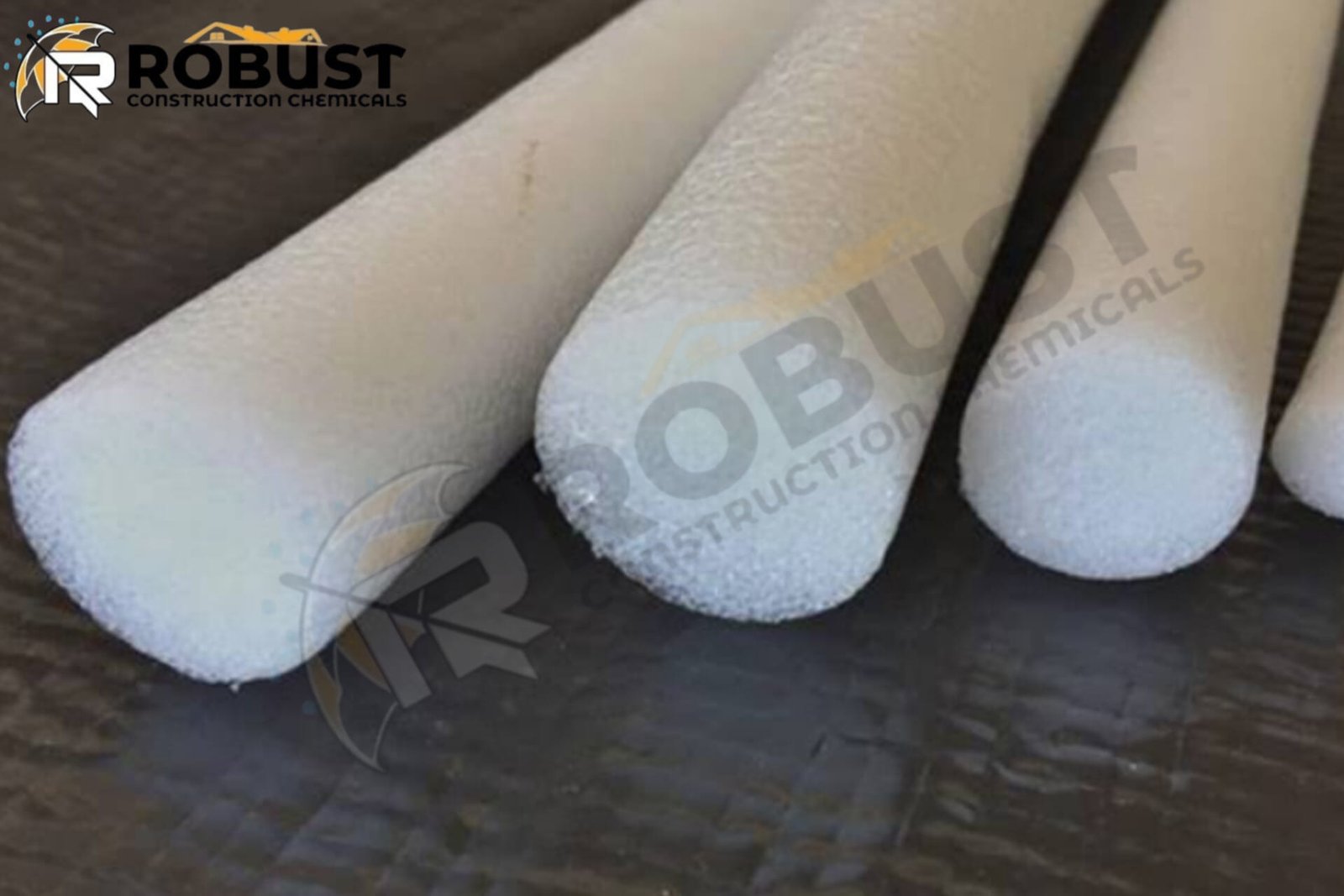
Robust Backer Rod – Complete Details
Introduction
Robust Backer Rod is a flexible, compressible, and lightweight foam material designed to fill construction joints and gaps before applying sealants. It is an essential joint-filling accessory used to control the depth of sealant, prevent three-sided adhesion, and ensure proper joint performance. Backer rod helps in reducing sealant consumption, improving durability, and maintaining the flexibility and integrity of sealed joints.
Product Description
The backer rod is a cylindrical foam profile available in various diameters. It is made from closed-cell, non-absorbent polyethylene foam that is chemically inert and non-staining. Its flexibility allows it to be easily compressed and inserted into joints of varying widths, providing a firm yet flexible base for sealants.
The closed-cell structure of the foam prevents moisture penetration and resists water absorption, making it suitable for interior and exterior applications. The backer rod ensures proper adhesion of sealants only to the joint sides, preventing adhesion at the base, which allows the sealant to expand and contract freely during temperature or structural movements.
Purpose and Function
-
Control Sealant Depth:
The backer rod helps maintain the correct sealant depth-to-width ratio for optimum performance. -
Prevent Three-Sided Adhesion:
It acts as a bond breaker at the bottom of the joint, ensuring that the sealant adheres only to the two sidewalls. -
Provide Support to Sealant:
It offers a firm base that supports the wet sealant during application and curing. -
Reduce Sealant Consumption:
Since part of the joint volume is filled with the rod, less sealant material is required, reducing cost and waste. -
Allow Joint Flexibility:
By enabling proper sealant movement, it helps absorb expansion and contraction caused by thermal or structural changes.
Material Characteristics
-
Material: Closed-cell polyethylene foam
-
Shape: Cylindrical (round)
-
Density: Approximately 40–50 kg/m³
-
Color: Grey or dark grey (varies by size)
-
Surface: Smooth, non-porous, and flexible
-
Service Temperature Range: –40°C to +90°C
-
Water Absorption: Negligible (non-wicking and non-absorbent)
-
Chemical Resistance: Resistant to most solvents, paints, and chemicals used in construction sealants
-
Compatibility: Suitable for use with polyurethane, polysulfide, silicone, acrylic, and other sealant types
Sizes Available
Robust Backer Rod is manufactured in multiple diameters to suit a variety of joint widths:
| Diameter (mm) | Typical Joint Width (mm) | Coil Length (m) |
|---|---|---|
| 6 mm | 4–6 mm | 150–200 m |
| 10 mm | 6–9 mm | 100–150 m |
| 15 mm | 10–14 mm | 80–100 m |
| 20 mm | 15–18 mm | 60–80 m |
| 25 mm | 20–24 mm | 50–60 m |
| 30 mm | 25–28 mm | 40–50 m |
| 40 mm and above | 30 mm and above | Custom lengths |
Note: The backer rod diameter should generally be 20–30% larger than the joint width to ensure a tight fit.
Applications
Robust Backer Rod is suitable for a wide range of construction and industrial uses, including:
-
Expansion joints in concrete floors and pavements
-
Control joints in masonry walls and slabs
-
Perimeter joints around windows, doors, and glazing panels
-
Precast concrete panel joints
-
Curtain walls, claddings, and metal panels
-
Horizontal and vertical movement joints
-
Parking decks, bridges, runways, and roofing gaps
-
Interior floor and wall joints that require flexible sealing
Installation Instructions
-
Surface Preparation:
Ensure that the joint is clean, dry, and free from dust, oil, grease, old sealant, or other loose material. -
Select the Correct Size:
Choose a backer rod with a diameter 20–30% larger than the joint width to ensure firm compression and a snug fit. -
Insertion:
Gently press the backer rod into the joint using a blunt tool or roller, taking care not to puncture or stretch the foam. The rod should sit uniformly at the desired depth. -
Depth Control:
The depth of the rod should be adjusted so that the sealant depth is approximately half the joint width (depending on sealant manufacturer guidelines). -
Sealant Application:
Apply the sealant over the backer rod. The sealant should adhere only to the joint sides, not to the rod, ensuring a two-sided bond. -
Finishing:
Tool the sealant surface smoothly and allow it to cure as per the sealant manufacturer’s instructions.
Advantages
-
Easy to install and cut to desired lengths
-
Lightweight, flexible, and non-toxic
-
Prevents moisture intrusion and air leakage
-
Provides uniform joint geometry for sealant performance
-
Cost-effective by reducing sealant usage
-
Excellent resilience and recovery after compression
-
Chemically inert and non-staining
-
Weather-resistant and durable under varying temperature conditions
-
Suitable for indoor and outdoor use
Technical Properties
| Property | Typical Value |
|---|---|
| Material Type | Closed-cell polyethylene foam |
| Density | 40–50 kg/m³ |
| Water Absorption | Less than 1% by volume |
| Service Temperature Range | –40°C to +90°C |
| Compression Recovery | Excellent |
| Chemical Resistance | High |
| Tensile Strength | 150–200 kPa (approx.) |
| Elongation at Break | 100–200% |
| Odor | Odorless |
| Color | Grey or charcoal |
Storage and Handling
-
Store in a dry and cool area, away from direct sunlight.
-
Keep away from sharp objects to prevent puncturing.
-
Rolls or coils should remain packed until use to prevent contamination.
-
Do not use damaged or deformed rods, as this may affect sealing performance.
Safety Precautions
-
The material is non-toxic and safe to handle.
-
Use protective gloves when inserting to avoid injury from rough joint edges.
-
Avoid excessive stretching or compressing to maintain dimensional integrity.
-
Dispose of waste material in accordance with local regulations.
Summary
Robust Backer Rod is an essential joint filler for modern construction, designed to enhance the performance of sealants by providing the correct joint geometry and preventing adhesion failure. Its closed-cell structure ensures excellent water resistance, flexibility, and compatibility with a wide range of sealants. Whether used in building facades, flooring systems, or expansion joints, it ensures durable, watertight, and flexible sealing for long-term structural integrity.
Robust Backer Rod – Advanced Joint Filler and Sealant Support Material
Overview
Robust Backer Rod is a highly efficient and versatile joint-filling foam material designed to improve sealant performance in all types of construction joints. It is the preferred solution for engineers, architects, and builders who want durable, long-lasting, and watertight joints. The product is made from closed-cell, non-absorbent polyethylene foam that resists moisture, chemicals, and temperature fluctuations, making it ideal for both indoor and outdoor sealing applications.
In modern construction, durability and flexibility are key. Structures expand and contract due to temperature changes, vibrations, and settlement. Sealants play a vital role in accommodating these movements, but to perform properly, they need a well-prepared joint base. That’s where Robust Backer Rod comes in — it ensures the correct joint geometry, minimizes sealant waste, and enhances the overall performance of any sealing system.
Why Robust Backer Rod is Essential for Every Project
Every professional knows that the strength of a seal is only as good as its foundation. Robust Backer Rod provides that foundation by offering multiple technical and practical benefits:
-
Optimizes Sealant Performance
By controlling joint depth, the backer rod ensures that sealant adhesion occurs only on the side walls — creating a two-sided bond that allows flexibility and prevents early sealant failure. -
Reduces Material Cost
Filling deep joints entirely with sealant is both expensive and inefficient. Robust Backer Rod fills most of the joint space, reducing the quantity of sealant required while improving performance. -
Prevents Moisture Infiltration
The closed-cell polyethylene foam structure prevents water absorption, protecting the joint from moisture penetration, mildew, and damage. -
Improves Flexibility and Movement Capacity
By shaping the sealant profile correctly, the rod allows sealant to move freely during thermal expansion and contraction cycles. -
Easy and Fast Installation
The flexible foam cylinder can be cut, shaped, and installed manually or with basic tools, saving labor and installation time. -
Enhances Joint Aesthetics
Proper use of backer rod ensures uniform sealant thickness, neat edges, and a professional finish — especially in visible joints such as façades, floors, and decorative cladding.
SEO Keywords for Targeted Search Visibility
(integrated naturally throughout the text)
Focus Keyword: Robust Backer Rod
Related Keywords: backer rod for sealant, foam backer rod, joint filler rod, expansion joint filler, sealant support foam, polyethylene backer rod, construction joint backing material, closed-cell backer rod, concrete joint filler, sealant joint support.
How Robust Backer Rod Improves Joint Integrity
In any structure — whether it’s a high-rise tower, bridge, shopping complex, or residential villa — joints are critical points of movement. Improper sealing leads to cracks, leaks, and long-term deterioration. Robust Backer Rod serves as the perfect sealant backing material, ensuring that the sealant maintains its designed shape factor.
The backer rod ensures that:
-
The sealant adheres only to the side walls (not to the bottom), preventing three-sided adhesion which causes cracking.
-
The sealant thickness is kept consistent, typically half the joint width, allowing maximum elongation without stress.
-
The joint remains flexible even after repeated movement cycles, temperature fluctuations, or heavy loading.
By maintaining correct geometry, Robust Backer Rod guarantees longer life and reduced maintenance costs for sealant systems.
Key Features and Benefits
| Feature | Benefit |
|---|---|
| Closed-cell polyethylene foam | Resists water and moisture infiltration |
| Flexible and compressible | Easily adapts to variable joint widths |
| Lightweight and easy to handle | Quick and simple installation |
| Chemically inert | Safe with all major sealant types |
| Non-staining surface | Ensures clean and aesthetic sealant lines |
| Wide size range | Suitable for all small and large joints |
| Temperature resistant | Performs from –40°C to +90°C |
| Cost-effective | Reduces sealant consumption and labor time |
Each of these features adds measurable value to a project, from cost reduction and performance enhancement to improved longevity and aesthetics.
Where to Use Robust Backer Rod
Robust Backer Rod can be applied across multiple sectors of construction, including industrial, commercial, residential, and infrastructure projects. Some of its most common applications include:
-
Expansion and contraction joints in concrete slabs, highways, and bridges
-
Control joints in precast and cast-in-situ concrete structures
-
Perimeter joints around windows, doors, curtain walls, and frames
-
Floor joints in warehouses, shopping malls, and industrial facilities
-
Facade and cladding joints where flexible sealing is essential
-
Waterproofing joints in basements, retaining walls, and rooftops
-
Glazing joints where clean, precise sealant lines are required
-
Parking decks, airports, and tunnels exposed to heavy loads and temperature changes
In short, wherever there’s a joint that requires sealant, there’s a role for Robust Backer Rod.
How to Choose the Right Backer Rod Size
The correct selection of backer rod diameter is critical for joint performance.
Follow these general guidelines:
-
Measure the joint width accurately.
-
Select a backer rod 25% larger than the joint width.
-
Example: For a 10 mm joint, use a 12–13 mm diameter rod.
-
-
Ensure the rod fits snugly without over-stretching or deforming.
-
For very deep joints, insert two layers or use foam boards as spacers.
This sizing method ensures the backer rod stays in place during sealant application and movement cycles.
Step-by-Step Installation Procedure
-
Clean the Joint
Remove all dust, debris, oil, or old sealant. Clean surfaces ensure strong adhesion. -
Check the Width and Depth
Verify that the joint size matches the backer rod diameter. -
Insert the Rod
Press or roll the foam rod gently into the joint with a blunt tool to avoid tearing. It should be at a uniform depth throughout. -
Sealant Application
Apply the sealant over the rod, making sure it bonds only to the sidewalls. The top of the sealant should be slightly concave for better elasticity. -
Finishing and Curing
Smooth the surface using a spatula or trowel. Allow curing as per sealant manufacturer recommendations.
This simple procedure ensures reliable and long-lasting sealing with minimal effort.
Marketing Message: The Smart Choice for Modern Construction
In today’s competitive construction environment, efficiency and reliability matter. Robust Backer Rod combines both by ensuring:
-
Lower material costs
-
Faster installation
-
Longer-lasting joints
-
Reduced maintenance
Whether for high-end commercial buildings or infrastructure projects, it provides the ideal base for any sealant, ensuring quality, durability, and professional finish.
Technical Highlights
-
Material: Closed-cell polyethylene foam
-
Density: 40–50 kg/m³
-
Tensile Strength: Approx. 150–200 kPa
-
Elongation: 100–200%
-
Temperature Range: –40°C to +90°C
-
Water Absorption: < 1% by volume
-
Chemical Stability: Resistant to acids, bases, oils, and solvents
-
Color: Grey or dark grey
These properties make the product suitable for use in both tropical and cold climates, including high-temperature regions and humid environments.
Extended Benefits for Project Owners
-
Longevity and Protection: Prevents moisture ingress and joint cracking that often lead to costly repairs.
-
Aesthetic Finish: Provides a smooth, clean joint surface, enhancing architectural appeal.
-
Sustainability: Reduces material wastage and supports eco-friendly building practices.
-
Time Efficiency: Simplifies the sealing process, allowing faster project completion.
-
Versatility: Compatible with most commercial and industrial sealants.
Application Tips for Maximum Performance
-
Avoid using a backer rod smaller than the joint width — it may slip or fail under pressure.
-
For exterior use, ensure the joint is completely dry before installation.
-
Do not puncture or over-compress the rod; it should recover after compression.
-
Always follow recommended width-to-depth ratios for sealants (commonly 2:1).
-
In vertical joints, start inserting the rod from the top downward to avoid air pockets.
Environmental and Safety Advantages
Robust Backer Rod is non-toxic, odorless, and free from CFCs or harmful chemicals. It can be safely used in food-processing plants, hospitals, and residential projects. Being inert and recyclable, it supports sustainable construction standards such as LEED and green building certification requirements.
Its closed-cell structure also prevents fungal or bacterial growth — a key advantage in humid climates.
Performance in Harsh Conditions
Extreme weather doesn’t affect its stability. The polyethylene foam retains flexibility even under:
-
Direct sunlight
-
High humidity
-
Sub-zero temperatures
-
Chemical exposure (road salts, detergents, etc.)
This reliability makes it ideal for infrastructure projects such as bridges, airports, and roadways, where durability is non-negotiable.
Comparing Robust Backer Rod with Alternatives
| Parameter | Robust Backer Rod (Closed-Cell) | Open-Cell Foam Rod | No Backer Rod |
|---|---|---|---|
| Water Absorption | Nil | High | High |
| Sealant Bond Control | Excellent | Poor | Uncontrolled |
| Installation Speed | Fast | Moderate | Slow |
| Durability | High | Moderate | Low |
| Cost Efficiency | Excellent | Moderate | Low |
| Weather Resistance | Excellent | Low | Poor |
This comparison clearly shows why using a high-quality closed-cell backer rod is a must for professional sealing works.
Typical Construction Sectors Using Robust Backer Rod
-
Commercial Buildings: Office towers, malls, hospitals, hotels
-
Infrastructure: Highways, flyovers, bridges, tunnels
-
Industrial Projects: Factories, warehouses, energy plants
-
Residential Buildings: Villas, apartments, basements
-
Marine and Coastal Structures: Piers, docks, water tanks
-
Restoration Works: Repair of old joints and sealing replacements
Each sector benefits from its ability to maintain watertight, flexible, and durable joints in different environmental conditions.
Maintenance and Inspection
Although backer rods are maintenance-free once installed, regular joint inspections are recommended:
-
Inspect sealant condition every 12–18 months.
-
Replace the rod and reseal if cracks or separations appear.
-
Keep expansion joints clean to allow free movement.
Proper maintenance ensures the life of the sealant and the structure itself.
Frequently Asked Questions
1. Can Robust Backer Rod be used with any type of sealant?
Yes, it is compatible with most polyurethane, polysulfide, silicone, and hybrid sealants.
2. Is it suitable for submerged conditions?
Closed-cell rods resist moisture but should not be used permanently underwater unless protected by a suitable waterproof sealant system.
3. How is it supplied?
It is supplied in rolls or coils of various diameters, allowing easy handling and installation.
4. Does it degrade under sunlight?
No, it has excellent UV resistance for outdoor use.
5. Is it safe for indoor environments?
Yes, it is non-toxic, odorless, and free of harmful additives.
SEO-Optimized Meta Elements
Meta Title:
Robust Backer Rod – Foam Joint Filler for Sealant Support and Expansion Joints
Meta Description:
Robust Backer Rod is a closed-cell polyethylene foam used for sealing and expansion joints. It prevents moisture entry, reduces sealant usage, and ensures long-lasting flexible joints in all construction projects.
Focus Keyword: Robust Backer Rod
LSI / Secondary Keywords: foam backer rod, expansion joint filler, backer rod for sealant, joint filler foam, polyethylene backer rod, concrete joint backing material.
Hashtags (for social media):
#BackerRod #SealantSupport #JointFiller #ConstructionFoam #ExpansionJoint #BuildingSealant #ConcreteProtection #PolyethyleneFoam #RobustConstruction #JointSealing
Conclusion
Robust Backer Rod is more than a gap filler — it’s a professional solution engineered to enhance the life and performance of sealants in every construction joint. Its closed-cell polyethylene structure ensures watertight protection, flexibility, and strength. Easy to install, cost-effective, and environmentally safe, it meets the demands of modern architecture and infrastructure.
Whether you’re sealing joints in concrete floors, façades, or expansion systems, Robust Backer Rod provides the dependable foundation your sealant needs. It is the smart, durable, and efficient choice for builders, contractors, and engineers committed to quality construction.