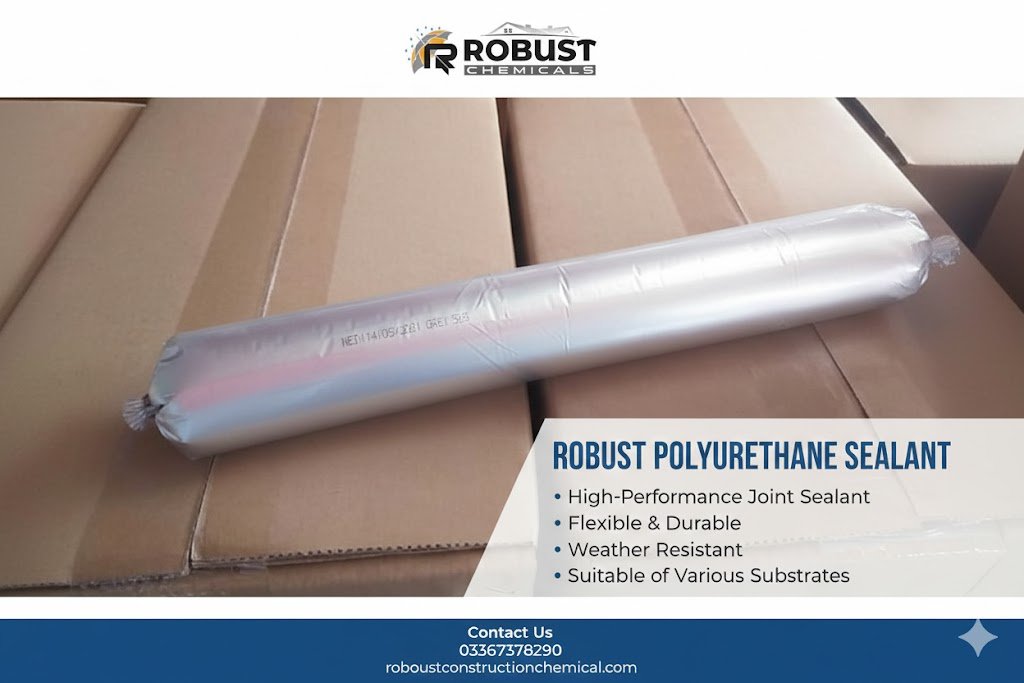
Robust Polyurethane (PU) Tube Sealant (commonly supplied in 300 ml / 310 ml rigid cartridges and 600 ml foil sausages) is a single-component, moisture-curing elastomeric joint sealant engineered for high-movement structural expansion joints, heavy-duty industrial floor saw-cuts, precast concrete panels, and automotive/marine seam bonding. Unlike standard silicone sealants that tear easily under mechanical abrasion or cannot be painted, PU Sealant cures into a tough, tear-resistant, flexible rubber that bonds tenaciously to porous masonry, concrete, and primed metals—and can be overpainted once cured.
1. Core Chemical & Mechanical Characteristics
-
High Movement Accommodation (±25% to ±50%): Absorbs severe thermal expansion, concrete slab shrinkage, and building vibration without splitting or pulling away from joint edges.
-
Superior Tear & Abrasion Resistance: Tough polyurethane elastomer withstands pedestrian foot traffic, pallet jacks, and forklift wheel crossings in industrial warehouse floor joints where soft silicone would shred.
-
Primerless Adhesion to Most Construction Substrates: Bonds strongly to concrete, cement mortar, brick, AAC blocks, fiber-cement boards, anodized/powder-coated aluminum, galvanized steel, wood, and rigid uPVC.
-
100% Paintable After Curing: Compatible with water-based acrylic, elastomeric, and polyurethane architectural coatings (unlike silicone, which repels paint).
-
Bubble-Free Moisture Cure: Reacts cleanly with atmospheric humidity without releasing corrosive acetic acid vapors or shrinking inside deep joints.
2. Technical Specifications & Performance Benchmarks
| Property / Metric | Typical Industrial & Construction Range | Standard Test Method | Functional Significance |
| Chemical Base | One-Component Moisture-Curing Polyurethane | ASTM C920 / ISO 11600 | Ready-to-gun from cartridge/sausage; zero mixing errors |
| Classification Grade | Type S, Grade NS, Class 25 / Class 35 / Class 50 | ASTM C920 / ISO 11600 F-25LM | Certified for dynamic structural expansion joints |
| Shore A Hardness | 25 – 35 (Low-Modulus) | 40 – 50 (High-Modulus) | ASTM C661 / DIN 53505 | Low-modulus for building facades; high-modulus for floor joints |
| Elongation at Break | ≥ 500% – 700% | ASTM D412 / DIN 53504 | Stretches dramatically without cohesive tearing |
| Tensile Strength | 1.2 – 2.5 N/mm² (175 – 360 psi) | ASTM D412 | High mechanical toughness under shear and traffic |
| Skin-Over / Tack-Free Time | 45 – 90 minutes (at 25°C, 50% RH) | Lab Standard | Ample tooling window before surface skin forms |
| Curing Rate | ~2.5 – 3.5 mm per 24 hours | Lab Standard | Standard 10 mm deep joint cures in 3–4 days |
| Service Temperature | -40°C to +80°C (short peaks up to +90°C) | Thermal Cycling | Stable across extreme Pakistani summer heat and winter cold |
| Packaging Formats | 300 ml / 310 ml Cartridge (24/ctn) & 600 ml Sausage (20/ctn) | Industry Standard | Fits standard skeleton or barrel caulking guns |
3. Low-Modulus (Facade) vs. High-Modulus (Floor & Structural) PU Sealant
-
Low-Modulus PU Sealant (Shore A 25–30):
-
Behavior: Soft, high-stretch elastomer that exerts minimal pull force on weak or porous joint walls.
-
Best For: Exterior precast concrete facade joints, brick/block expansion joints, EIFS cladding, window/door perimeter sealing, and roof parapet flashings.
-
-
High-Modulus / Traffic-Grade PU Sealant (Shore A 40–50):
-
Behavior: Firm, puncture-resistant elastomer engineered to resist wheel deflection and sharp debris.
-
Best For: Industrial warehouse concrete floor control joints (saw-cuts), epoxy floor expansion joints, basement parking decks, and automotive/container body seam bonding.
-
4. Cartridge & Sausage Consumption Calculator (Linear Meters per Pack)
Use this BOQ estimation chart to calculate exact 300 ml cartridge or 600 ml foil sausage quantities (maintaining the recommended 2:1 width-to-depth ratio):
| Joint Width (mm) | Recommended Sealant Depth (mm) | Yield per 300 ml Cartridge | Yield per 600 ml Sausage |
| 6 mm | 6 mm | ~8.3 linear meters (27 ft) | ~16.6 linear meters (54 ft) |
| 10 mm | 6 mm | ~5.0 linear meters (16 ft) | ~10.0 linear meters (33 ft) |
| 12 mm | 6 mm | ~4.1 linear meters (13.5 ft) | ~8.3 linear meters (27 ft) |
| 15 mm | 8 mm | ~2.5 linear meters (8.2 ft) | ~5.0 linear meters (16.4 ft) |
| 20 mm | 10 mm | ~1.5 linear meters (4.9 ft) | ~3.0 linear meters (9.8 ft) |
| 25 mm | 12 mm | ~1.0 linear meter (3.3 ft) | ~2.0 linear meters (6.6 ft) |
Note: Always add 10% to 15% wastage allowance for nozzle trimming, gun residual, and tooling wipe-off.
5. Step-by-Step Professional Application Protocol
-
Joint Cleaning & Preparation: Remove all dust, loose concrete laitance, old sealant, oil, and curing compounds from joint walls using a wire brush, diamond joint-cleaning blade, and oil-free compressed air. Joint walls must be completely dry.
-
Backer Rod Insertion: Insert a closed-cell polyethylene (PE) backer rod (25% wider than the joint gap) to the exact required depth. This prevents three-sided adhesion (allowing the PU rubber to stretch freely across two opposing walls) and controls sealant consumption.
-
Masking & Priming: Apply low-tack masking tape along both joint edges for crisp lines. On dusty, chalky, or porous concrete/stone—or joints subject to intermittent water immersion—apply a thin coat of PU Primer and allow 30–60 minutes flash-off before gunning.
-
Nozzle Cutting & Gunning: Cut the nozzle at a 45° angle to match the joint width. Extrude the PU sealant steadily from the bottom of the joint upward, keeping the nozzle immersed in the bead to avoid trapping air pockets.
-
Tooling & Tape Removal: Within 15–20 minutes (before skin formation), tool the bead firmly into a smooth concave profile using a rounded spatula dipped in mild soapy water, then peel off masking tape immediately.
6. Indicative Pricing in Pakistan (2026 Market Benchmarks)
In Pakistan’s construction chemical market (Lahore, Karachi, Islamabad, Faisalabad), PU Tube & Sausage Sealants are priced per unit or per linear foot installed:
-
300 ml / 310 ml PU Sealant Cartridge (Material Only): PKR 750 – 1,350 per tube (depending on Shore A grade and imported/local formulation).
-
600 ml PU Sealant Foil Sausage (Material Only): PKR 1,250 – 2,100 per sausage (most economical for warehouse floor joints and high-rise facades).
-
Turnkey Installed Expansion Joint Sealing (Including Backer Rod, Grinding & PU Sealant): PKR 65 – 140 per linear foot (for standard 10 mm × 6 mm to 15 mm × 8 mm joints).
-
Robust Polyurethane (PU) Tube Sealant (commonly supplied in 300 ml / 310 ml rigid cartridges and 600 ml foil sausages) is a single-component, moisture-curing elastomeric joint sealant engineered for high-movement structural expansion joints, heavy-duty industrial floor saw-cuts, precast concrete panels, and automotive/marine seam bonding. Unlike standard silicone sealants that tear easily under mechanical abrasion or cannot be painted, PU Sealant cures into a tough, tear-resistant, flexible rubber that bonds tenaciously to porous masonry, concrete, and primed metals—and can be overpainted once cured.
1. Core Chemical & Mechanical Characteristics
-
High Movement Accommodation (±25% to ±50%): Absorbs severe thermal expansion, concrete slab shrinkage, and building vibration without splitting or pulling away from joint edges.
-
Superior Tear & Abrasion Resistance: Tough polyurethane elastomer withstands pedestrian foot traffic, pallet jacks, and forklift wheel crossings in industrial warehouse floor joints where soft silicone would shred.
-
Primerless Adhesion to Most Construction Substrates: Bonds strongly to concrete, cement mortar, brick, AAC blocks, fiber-cement boards, anodized/powder-coated aluminum, galvanized steel, wood, and rigid uPVC.
-
100% Paintable After Curing: Compatible with water-based acrylic, elastomeric, and polyurethane architectural coatings (unlike silicone, which repels paint).
-
Bubble-Free Moisture Cure: Reacts cleanly with atmospheric humidity without releasing corrosive acetic acid vapors or shrinking inside deep joints.
2. Technical Specifications & Performance Benchmarks
Property / Metric Typical Industrial & Construction Range Standard Test Method Functional Significance Chemical Base One-Component Moisture-Curing Polyurethane ASTM C920 / ISO 11600 Ready-to-gun from cartridge/sausage; zero mixing errors Classification Grade Type S, Grade NS, Class 25 / Class 35 / Class 50 ASTM C920 / ISO 11600 F-25LM Certified for dynamic structural expansion joints Shore A Hardness 25 – 35 (Low-Modulus) | 40 – 50 (High-Modulus) ASTM C661 / DIN 53505 Low-modulus for building facades; high-modulus for floor joints Elongation at Break ≥ 500% – 700% ASTM D412 / DIN 53504 Stretches dramatically without cohesive tearing Tensile Strength 1.2 – 2.5 N/mm² (175 – 360 psi) ASTM D412 High mechanical toughness under shear and traffic Skin-Over / Tack-Free Time 45 – 90 minutes (at 25°C, 50% RH) Lab Standard Ample tooling window before surface skin forms Curing Rate ~2.5 – 3.5 mm per 24 hours Lab Standard Standard 10 mm deep joint cures in 3–4 days Service Temperature -40°C to +80°C (short peaks up to +90°C) Thermal Cycling Stable across extreme Pakistani summer heat and winter cold Packaging Formats 300 ml / 310 ml Cartridge (24/ctn) & 600 ml Sausage (20/ctn) Industry Standard Fits standard skeleton or barrel caulking guns 3. Low-Modulus (Facade) vs. High-Modulus (Floor & Structural) PU Sealant
-
Low-Modulus PU Sealant (Shore A 25–30):
-
Behavior: Soft, high-stretch elastomer that exerts minimal pull force on weak or porous joint walls.
-
Best For: Exterior precast concrete facade joints, brick/block expansion joints, EIFS cladding, window/door perimeter sealing, and roof parapet flashings.
-
-
High-Modulus / Traffic-Grade PU Sealant (Shore A 40–50):
-
Behavior: Firm, puncture-resistant elastomer engineered to resist wheel deflection and sharp debris.
-
Best For: Industrial warehouse concrete floor control joints (saw-cuts), epoxy floor expansion joints, basement parking decks, and automotive/container body seam bonding.
-
4. Cartridge & Sausage Consumption Calculator (Linear Meters per Pack)
Use this BOQ estimation chart to calculate exact 300 ml cartridge or 600 ml foil sausage quantities (maintaining the recommended 2:1 width-to-depth ratio):
Joint Width (mm) Recommended Sealant Depth (mm) Yield per 300 ml Cartridge Yield per 600 ml Sausage 6 mm 6 mm ~8.3 linear meters (27 ft) ~16.6 linear meters (54 ft) 10 mm 6 mm ~5.0 linear meters (16 ft) ~10.0 linear meters (33 ft) 12 mm 6 mm ~4.1 linear meters (13.5 ft) ~8.3 linear meters (27 ft) 15 mm 8 mm ~2.5 linear meters (8.2 ft) ~5.0 linear meters (16.4 ft) 20 mm 10 mm ~1.5 linear meters (4.9 ft) ~3.0 linear meters (9.8 ft) 25 mm 12 mm ~1.0 linear meter (3.3 ft) ~2.0 linear meters (6.6 ft) Note: Always add 10% to 15% wastage allowance for nozzle trimming, gun residual, and tooling wipe-off.
5. Step-by-Step Professional Application Protocol
-
Joint Cleaning & Preparation: Remove all dust, loose concrete laitance, old sealant, oil, and curing compounds from joint walls using a wire brush, diamond joint-cleaning blade, and oil-free compressed air. Joint walls must be completely dry.
-
Backer Rod Insertion: Insert a closed-cell polyethylene (PE) backer rod (25% wider than the joint gap) to the exact required depth. This prevents three-sided adhesion (allowing the PU rubber to stretch freely across two opposing walls) and controls sealant consumption.
-
Masking & Priming: Apply low-tack masking tape along both joint edges for crisp lines. On dusty, chalky, or porous concrete/stone—or joints subject to intermittent water immersion—apply a thin coat of PU Primer and allow 30–60 minutes flash-off before gunning.
-
Nozzle Cutting & Gunning: Cut the nozzle at a 45° angle to match the joint width. Extrude the PU sealant steadily from the bottom of the joint upward, keeping the nozzle immersed in the bead to avoid trapping air pockets.
-
Tooling & Tape Removal: Within 15–20 minutes (before skin formation), tool the bead firmly into a smooth concave profile using a rounded spatula dipped in mild soapy water, then peel off masking tape immediately.
6. Indicative Pricing in Pakistan (2026 Market Benchmarks)
In Pakistan’s construction chemical market (Lahore, Karachi, Islamabad, Faisalabad), PU Tube & Sausage Sealants are priced per unit or per linear foot installed:
-
300 ml / 310 ml PU Sealant Cartridge (Material Only): PKR 750 – 1,350 per tube (depending on Shore A grade and imported/local formulation).
-
600 ml PU Sealant Foil Sausage (Material Only): PKR 1,250 – 2,100 per sausage (most economical for warehouse floor joints and high-rise facades).
-
Turnkey Installed Expansion Joint Sealing (Including Backer Rod, Grinding & PU Sealant): PKR 65 – 140 per linear foot (for standard 10 mm × 6 mm to 15 mm × 8 mm joints).

-
Best waterproofing solutions in Lahore PU Tube 
- Robust
- Robust
- Robust
- Robust
- Robust
- Robust
- Robust
- Robust
- Robust
- Robust
- Robust
- Robust
- Robust
- Robust
- Robust
- Robust
- Robust
- Robust
- Robust
- Robust
- Robust
- Robust
- Robust
- Robust
- Robust
- Robust
- Robust
- Robust
-
-
-