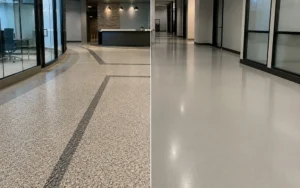
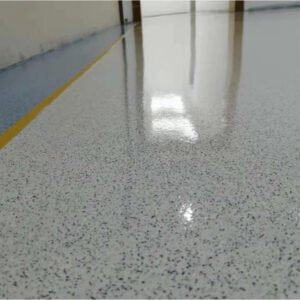
Robust Granular epoxy flooring (commonly specified as Broadcast Quartz Epoxy, Sand-Broadcast Epoxy, or Anti-Slip Aggregate Epoxy) is a heavy-duty, multi-layered resin flooring system engineered by broadcasting hard, kiln-dried mineral or colored quartz granules to excess into a wet, 100%-solids epoxy base coat, then locking them beneath a high-wear seal coat. Unlike smooth self-leveling epoxy, granular epoxy builds a micro-textured, high-traction surface designed for extreme mechanical abrasion, wet-process slip safety, and heavy industrial traffic.
1. System Architecture (4-Layer Build)
A standard heavy-duty granular epoxy floor is built in four distinct stages, typically achieving a final thickness of 2.0 mm to 5.0 mm:
-
Penetrating Epoxy Primer (150–200 microns): Low-viscosity two-component epoxy resin that soaks into diamond-ground concrete pores, sealing outgassing air pockets and establishing a chemical/mechanical bond.
-
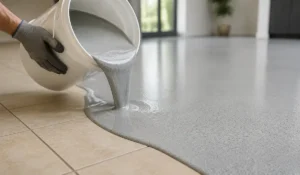
High-Build Epoxy Base / Body Coat (0.8–1.5 mm): A 100%-solids pigmented or clear epoxy resin applied via notched squeegee to hold the mineral aggregate firmly in place.
-
Granular Aggregate Broadcast (Broadcast to Excess): Kiln-dried silica quartz, ceramic-coated color quartz, corundum, or aluminum oxide granules are scattered evenly into the wet base coat until the surface appears completely dry and saturated. Once cured, loose excess granules are swept and vacuumed away.
-
Protective Grout & Seal Topcoat (250–500 microns): One or two coats of clear cycloaliphatic epoxy, aliphatic polyurethane (PU), or polyaspartic resin are squeegeed and back-rolled over the locked granules to encapsulate them, control surface roughness, and provide UV and chemical resistance.
2. Types of Granules Used & Their Functional Roles
The choice of mineral granule determines the floor’s slip resistance, wear life, and aesthetic appearance:
-
Natural Silica Quartz Sand (0.3 mm – 0.8 mm): High-purity angular quartz sand used for industrial factories, warehouses, and loading bays where maximum mechanical strength and low cost are priorities.
-
Color-Coated Ceramic Quartz Granules: Rounded or sub-angular quartz grains coated with durable ceramic pigments, blended into multi-color speckles (granite or terrazzo look) for commercial kitchens, locker rooms, laboratories, and retail corridors.
-
Aluminum Oxide / Silicon Carbide (Carborundum): Ultra-hard synthetic mineral grit (Mohs hardness 9+) used in extreme heavy-wear zones, steel fabrication plants, and steep oily ramps where standard quartz would eventually polish smooth.
-
Polymer / Vinyl Flakes (Decorative Broadcast): Thin, flat acrylic/vinyl chips broadcast for aesthetic garage and showroom floors (lighter mechanical duty than true mineral granular epoxy).
3. Technical Specifications & Performance Benchmarks
4. Single Broadcast vs. Double Broadcast Systems
-
Single-Broadcast Granular Epoxy (2.0 mm – 3.0 mm): One base coat + one full granule broadcast + topcoat. Ideal for light-to-medium manufacturing, parking ramps, workshops, and wet corridors.
-
Double-Broadcast Granular Epoxy (3.5 mm – 5.0 mm): Repeats the body coat and granule broadcast twice before final sealing. Engineered for severe heavy-duty environments—such as bottling plants, slaughterhouses, chemical processing units, and heavy-forklift distribution hubs—where maximum impact dissipation and structural build are required.
5. Key Advantages & Trade-Offs
Advantages
-
Superior Wet & Oily Traction: By adjusting the topcoat thickness over the granules, installers can dial in exact slip resistance—from mild orange-peel texture (easy to mop) to aggressive sandpaper grip (R12/R13) for steep ramps.
-
Hides Concrete Imperfections: The thick, speckled granular matrix camouflages minor subfloor waves, patch repairs, and daily scuff marks far better than solid-color glossy epoxy.
-
Extreme Impact & Scratch Durability: Because the surface load rides directly on hard mineral quartz or aluminum oxide grains rather than soft resin, dragged pallets and dropped tools rarely gouge the floor.
Trade-Offs to Consider
-
Cleaning Effort: Heavily textured R12/R13 profiles require mechanical rotary scrubbers or stiff-bristle deck brushes rather than standard flat string mops (which can snag on coarse grit).
-
Higher Material Consumption: Broadcasting to excess requires roughly 2.5 to 4.5 kg/m² of aggregate plus extra seal resin to fill the interstitial voids between grains.
6. Primary Industrial & Commercial Applications
-
Food & Beverage Processing Plants: Breweries, dairies, meat/poultry processing, and commercial kitchens where wet floors require sanitary, non-slip, seamless surfaces with integrated wall coving.
-
Automotive Workshops & Multi-Level Parking Ramps: Prevents tire squeal and skidding on inclined ramps while resisting motor oil, brake fluid, and hot-tire pickup.
-
Pharmaceutical & Chemical Facilities: Provides chemical containment and worker traction in wet washdown and formulation bays.
-
Heavy Engineering & Warehousing: Protects concrete slabs from steel-wheeled carts, pallet jacks, and continuous forklift traffic.
-
Here are the extended engineering, consumption, pricing, and installation details for Granular Epoxy Flooring (Broadcast Quartz / Anti-Slip Aggregate Epoxy), structured with clear headings and bullet points for direct use:
1. Material Consumption & BOQ Estimation Guide (Per m²)
Accurate Bill of Quantities (BOQ) planning for granular epoxy depends on whether a single-broadcast (2–3 mm) or double-broadcast (3.5–5 mm) specification is used:
2. Granule Mesh Size vs. Slip Resistance & Cleanability
Selecting the right granule sieve fraction controls the balance between worker traction and daily floor cleaning effort:
-
Fine Fraction (0.1 mm – 0.3 mm / 50–100 Mesh):
-
Profile: Mild orange-peel texture (R10 slip rating).
-
Best For: Dry warehouses, pharmaceutical corridors, laboratories, and retail aisles where easy mopping is prioritized alongside light slip protection.
-
-
Medium / Standard Fraction (0.3 mm – 0.6 mm / 30–50 Mesh):
-
Profile: Calibrated sandy grip (R11 slip rating).
-
Best For: Commercial kitchens, bottling lines, automotive service bays, and general manufacturing floors exposed to intermittent water or oil.
-
-
Coarse Fraction (0.6 mm – 1.0 mm+ / 16–30 Mesh):
-
Profile: Aggressive sandpaper traction (R12–R13 slip rating).
-
Best For: Steep basement parking ramps, outdoor loading docks, slaughterhouses, and heavy washdown bays requiring maximum underfoot and tire grip.
-
3. Indicative Turnkey Installed Rates in Pakistan (2026 Benchmarks)
In Pakistan’s industrial and commercial flooring market (Lahore, Karachi, Faisalabad, and Islamabad), granular quartz broadcast systems are priced per square foot based on aggregate grade, thickness, and slab prep requirements:
-
Standard Anti-Slip Silica Quartz Broadcast (2.0 – 3.0 mm): PKR 320 – 550 per sq. ft. (Ideal for parking ramps, workshops, and wet factory bays).
-
Decorative Color-Quartz Broadcast System (2.5 – 3.5 mm): PKR 450 – 700 per sq. ft. (Used in commercial kitchens, hospitals, locker rooms, and showrooms).
-
Heavy-Duty Double-Broadcast Industrial System (4.0 – 5.0 mm): PKR 600 – 950+ per sq. ft. (Engineered for heavy forklift aisles, chemical bays, and high-impact plants).
4. Step-by-Step Professional Installation Protocol
-
Concrete Testing & Profiling: Verify concrete cure (≥ 28 days), compressive strength (≥ 25 MPa), and moisture content (< 4%–5% or < 75% RH). Diamond-grind or shot-blast the slab to a Concrete Surface Profile (CSP) of 3 to 4 to remove laitance, curing membranes, and grease.
-
Crack & Cove Detailing: Route and fill static cracks with rigid epoxy mortar; install 50 mm – 100 mm radius epoxy mortar coving along perimeter walls in food, pharma, and wet facilities.
-
Priming: Apply penetrating epoxy primer at 0.25–0.35 kg/m². If the slab is highly porous, apply a second primer coat to prevent air bubbles from rising through the base coat.
-
Base Coat & Broadcasting to Excess: Spread the 100%-solids epoxy body coat evenly, then immediately throw kiln-dried granules upward so they rain down vertically into the wet resin (never throw horizontally, which creates ripples and bald spots). Continue broadcasting until no wet resin sheen remains visible.
-
Sweep, Vacuum & Sand Lightly: Once cured (12–24 hours), sweep up all loose unbonded granules with stiff brooms, vacuum thoroughly with an industrial HEPA vacuum, and lightly screen/rub the surface with a rubbing stone or sanding screen to knock down sharp vertical spikes.
-
Grout & Seal Topcoating: Squeegee a tight lock coat of clear epoxy or UV-stable aliphatic polyurethane (PU) across the granules and back-roll immediately to prevent resin pooling in low spots.
5. Common Installation Defects & How to Prevent Them
-
Bald / Glossy Patches (Under-Broadcasting): Occurs when insufficient granules are thrown into the wet base coat, leaving slick resin islands. Prevention: Always broadcast to full excess so surplus dry sand sits atop the cured layer before sweeping.
-
White Clouding / Blushing in Clear Topcoat: Happens when clear epoxy topcoats are applied in high humidity (> 80%) or over damp aggregate. Prevention: Use only sealed bags of kiln-dried quartz and verify slab temperature is at least 3°C above the dew point.
-
Rapid Topcoat Wear on Grain Tips: If the final seal coat is applied too thinly (< 200 microns), traffic quickly wears the resin off the top of the quartz grains. Prevention: Apply two balanced topcoat passes—one tight grout coat to fill voids between grains, followed by a uniform wear seal coat.
6. Recommended Cleaning & Maintenance Protocol
-
Daily / Routine Cleaning: Use an automatic walk-behind scrubber fitted with medium-stiff nylon rotary brushes (not soft foam pads, which shred on textured quartz) and a neutral pH industrial detergent.
-
Deep Degreasing: For oily machine shops or food plants, pre-treat with an alkaline industrial degreaser, allow 10 minutes of dwell time, agitate with a rotary deck brush, and wet-vacuum clean.
-
Preventative Maintenance: Inspect high-traffic turning zones every 3 to 5 years; when the topcoat shows wear over the quartz peaks, lightly scrub, solvent-wipe, and apply a fresh single refresh coat of clear polyurethane or epoxy to restore full protection.
-
To rank a Granular Epoxy Flooring page at the top of Google—especially for high-intent commercial and industrial buyers in Pakistan (Lahore, Karachi, Faisalabad, Islamabad)—you need a structured SEO blueprint covering high-volume keyword clusters, click-optimized meta tags, semantic H1–H3 page architecture, schema markup, and internal linking.
Below is the complete, ready-to-deploy SEO Strategy & On-Page Optimization Blueprint for Granular Epoxy Flooring, formatted with clear headings and bullet points with zero external links:
1. High-Intent Keyword Clusters for Granular Epoxy Flooring
Targeting a single keyword is no longer enough. Group your content around four search-intent clusters so a single page ranks for dozens of buyer queries:
-
Primary Commercial & Service Keywords (High Conversion):
-
granular epoxy flooring -
broadcast quartz epoxy flooring -
anti-slip granular epoxy floor coating -
granular epoxy flooring contractors in Pakistan / Lahore -
industrial non-slip epoxy flooring services
-
-
Price & Cost Keywords (Bottom-of-Funnel Buyers):
-
granular epoxy flooring price in Pakistan -
quartz broadcast epoxy cost per sq ft -
anti-slip epoxy floor rate in Lahore -
heavy-duty warehouse epoxy flooring cost
-
-
Technical & Specification Keywords (Engineers & Procurement):
-
double broadcast quartz epoxy system -
3mm to 5mm granular epoxy screed -
R11 / R12 anti-slip epoxy flooring -
silica quartz aggregate epoxy specifications -
carborundum / aluminum oxide anti-slip epoxy
-
-
Application-Specific Long-Tail Keywords:
-
non-slip epoxy flooring for parking ramps -
granular epoxy floor for commercial kitchens & food plants -
heavy-duty epoxy for wet factory floors -
oil-resistant anti-slip workshop flooring
-
2. Click-Optimized SEO Titles & Meta Descriptions
Best SEO Titles (Under 60 Characters)
-
Pillar Guide + Buyer Intent:
Granular Epoxy Flooring: Cost, Specs & Complete Guide(53 characters) -
Pakistan / Lahore Service Page:
Granular Epoxy Flooring in Pakistan | 2026 Rates & Guide(56 characters) -
Anti-Slip Industrial Focus:
Anti-Slip Granular Quartz Epoxy Flooring | Heavy-Duty(53 characters)
Best Meta Descriptions (Under 155 Characters)
-
Informational + Cost (149 chars):
Discover granular epoxy flooring (broadcast quartz) for heavy-duty, non-slip industrial floors. Compare 2026 PKR rates, thickness specs & benefits. -
Local Lead Generation (146 chars):
Upgrade wet factory floors and parking ramps with seamless granular epoxy flooring in Lahore & Pakistan. View R11–R13 slip specs and get a quote.
Recommended URL Slug
-
/granular-epoxy-flooring-pakistan-cost-specs-guide/
3. Winning Page Structure (H1, H2 & H3 Outline for 2,500–3,500 Words)
Search engines reward clear topical hierarchy. Structure your pillar article or service page using these exact headings:
-
H1: Granular Epoxy Flooring in Pakistan: 2026 Cost, Specs & Complete Guide
-
Introduction (120–150 words): Define granular epoxy flooring (broadcast quartz / anti-slip aggregate epoxy), mention PKR 320–950/sq. ft. pricing early, and name target cities (Lahore, Karachi, Faisalabad, Islamabad).
-
H2: What Is Granular Epoxy Flooring & How Does Broadcast Quartz Work?
-
H3: The 4-Layer Granular Epoxy System Architecture (Primer, Base, Broadcast, Topcoat)
-
H3: Single-Broadcast (2–3 mm) vs. Double-Broadcast (3.5–5 mm) Systems
-
-
H2: Granular Epoxy Flooring Price in Pakistan (2026 Rate Chart)
-
H3: Cost Breakdown per Sq. Ft. by Thickness & Aggregate Type
-
H3: 5 Factors That Impact Your Project Quotation (Slab Prep, Moisture, UV Topcoat)
-
-
H2: Types of Granules Used & Slip Resistance Ratings (R10 to R13)
-
H3: Natural Silica Quartz vs. Color-Coated Ceramic Quartz vs. Aluminum Oxide
-
H3: Choosing the Right Mesh Size (Fine, Medium, Coarse) for Your Facility
-
-
H2: Technical Specifications & BOQ Material Consumption (Per m²)
-
H2: Granular Epoxy vs. Self-Leveling Epoxy vs. Epoxy Mortar Screed
-
H2: Step-by-Step Installation Protocol & Common Defects to Avoid
-
H2: Industrial & Commercial Applications Across Pakistan
-
H2: Frequently Asked Questions About Granular Epoxy Flooring
-
4. On-Page SEO & Semantic Entities to Include
To pass Google’s E-E-A-T (Experience, Expertise, Authoritativeness, Trustworthiness) signals for industrial construction, naturally include these technical entities and local markers in your copy:
-
Testing & Industry Standards:
ASTM C579(compressive strength),ASTM D4541(pull-off adhesion),DIN 51130(R10–R13 ramp slip ratings),ICRI CSP 3–4(concrete surface profile),cGMP / ISOcleanroom compliance. -
Material & Resin Terms:
100%-solids epoxy,kiln-dried silica quartz,broadcast to excess,aliphatic polyurethane UV topcoat,moisture-vapor-barrier primer,radius epoxy coving. -
Local Industrial Hubs (Geo-Relevance):
Sundar Industrial Estate Lahore,Kot Lakhpat,Quaid-e-Azam Industrial Estate,SITE & Korangi Karachi,M-3 Industrial City Faisalabad,I-9 & Rawat Islamabad,Sialkot.
5. Image SEO & Conversion Rate Optimization (CRO) Checklist
Industrial buyers convert faster when technical text is paired with visual proof and clear calls-to-action:
-
File Naming & Alt Text: Never upload
IMG_1024.jpg. Rename files togranular-quartz-epoxy-flooring-lahore-warehouse.webpand write descriptive alt text (Close-up of anti-slip R12 granular quartz epoxy floor in a Lahore food processing factory). -
Required Visual Proof (4–6 Photos):
-
Close-up macro shot showing the textured quartz granule surface.
-
Wide-angle shot of a completed parking ramp or wet factory floor.
-
Process photo showing diamond grinding and aggregate broadcasting.
-
Color-quartz sample chart (grey, blue, terracotta, granite blends).
-
-
Above-the-Fold CTA: Place a high-contrast “Get a Free Site Inspection & Sq. Ft. Estimate” button and WhatsApp quote link within the first screen on mobile and desktop.
6. Internal Linking & Schema Markup Strategy
-
Hub-and-Spoke Internal Links: Link your Granular Epoxy Flooring page directly to and from your other pillar pages using keyword-rich anchor text:
-
Anchor
"self-leveling epoxy flooring in Lahore"-> links to your SL Epoxy page. -
Anchor
"Sand Epoxy SL flooring rates"-> links to your Sand Epoxy SL guide. -
Anchor
"robust industrial epoxy flooring specifications"-> links to your heavy-duty epoxy BOQ page. -
Anchor
"polyurethane roof waterproofing"-> links to your PU roof coating page.
-
- Robust
- Robust
- Robust
- Robust
- Robust
- Robust
- Robust
- Robust
- Robust
- Robust
- Robust
- Robust
- Robust
- Robust
- Robust
- Robust
- Robust
- Robust
- Robust
- Robust
- Robust
- Robust
- Robust
- Robust
- Robust
- Robust
- Robust
- Robust
-
-