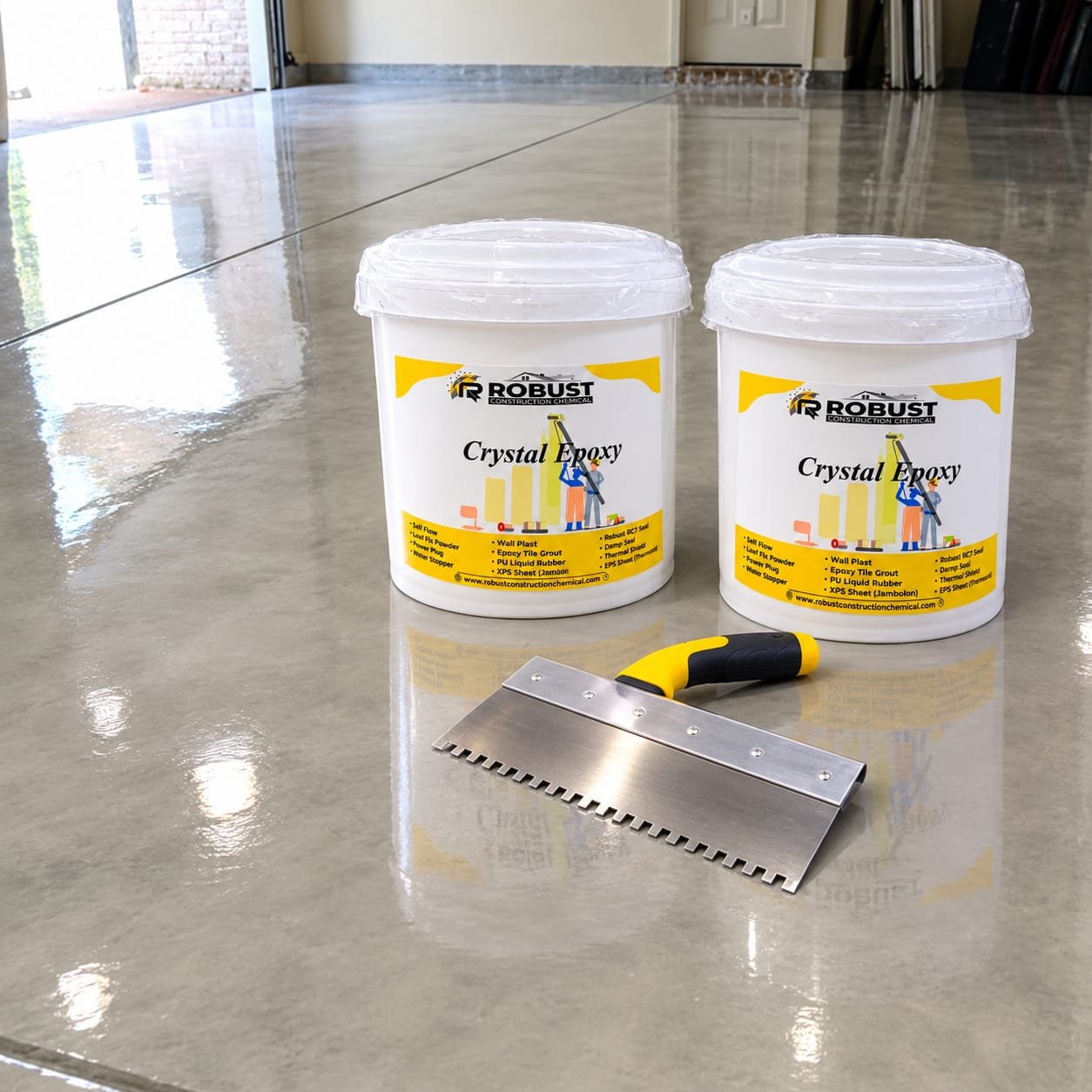
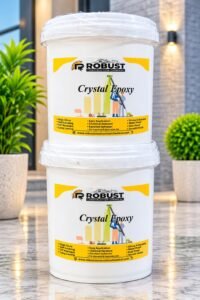
Robust Crystal Epoxy (also specified as Ultra-Clear Self-Leveling Crystal Epoxy or Water-Clear 100%-Solids Epoxy Resin) is a high-purity, two-component, solvent-free liquid polymer system engineered to cure into a glass-like, optically transparent, high-gloss protective finish. Formulated with modified bisphenol-A/F resins, cycloaliphatic amine hardeners, and UV-stabilizing optical brighteners, it provides maximum clarity, bubble-free leveling, and high mechanical resistance for both architectural clear-coat flooring and heavy-duty decorative casting.
1. Core Chemical & Optical Characteristics
Unlike standard pigmented industrial epoxies that contain opaque mineral fillers, Robust Crystal Epoxy is an unfilled, water-clear resin matrix designed for visual depth and surface protection:
-
Optical Water-Clear Transparency: Cures to a crystal-clear, distortion-free finish (Gardner Color Scale ≤ 1) that magnifies underlying substrates—such as 3D printed vinyl floors, metallic pigments, terrazzo aggregates, natural stone, wood grain, and embedded brand logos.
-
Self-Leveling & Self-Deaerating Rheology: Low mixed viscosity allows trapped micro-bubbles to rise and pop naturally during pouring, producing a seamless, mirror-flat glass surface without brush or roller marks.
-
Enhanced UV & Non-Yellowing Stability: Fortified with Hindered Amine Light Stabilizers (HALS) and UV absorbers to resist ambering or chalking under indoor lighting and indirect sunlight far longer than conventional bisphenol epoxies.
-
100% Solids / Zero-VOC Formulation: Contains zero evaporative solvents, ensuring virtually zero shrinkage during curing, high film build per pass, and safe indoor installation with minimal odor.
2. Technical Specifications & Mechanical Properties
3. Primary Applications
-
3D Designer & Metallic Epoxy Floors: Acts as the crystal-clear protective wear layer (1.5 mm – 3.0 mm thick) over 3D floor murals, metallic pigment swirls, and decorative color-flake systems in luxury homes, hotels, and retail showrooms.
-
Clear Protective Topcoat Over Stone, Terrazzo & Concrete: Seals polished concrete, mosaic chips, and river-stone carpets with a non-porous, stain-proof, easy-to-clean glossy barrier.
-
Deep-Pour River Tables, Countertops & Bar Tops: Casts up to 5 mm – 25 mm+ per layer (depending on casting vs. coating grade) over live-edge wood slabs, retail counters, and restaurant tabletops with heat and scratch resistance.
-
Commercial Galleries, Salons & Corporate Lobbies: Delivers a seamless, dust-free, mirror-like aesthetic that amplifies ambient lighting while resisting daily commercial foot traffic.
4. Step-by-Step Application & Bubble-Free Installation Protocol
-
Substrate Preparation & Sealing: Ensure concrete, wood, or base-coat surfaces are clean, dry (< 4% moisture), and completely sealed with a clear epoxy primer. Unsealed porous substrates release air bubbles (“outgassing”) into the clear crystal layer as temperatures rise.
-
Accurate Weighing & Slow Mixing: Measure Part A and Part B on a digital scale to exact ratio specifications. Mix with a low-speed paddle mixer (300–400 RPM) for 3 minutes, scraping container sides and bottom thoroughly without whipping air into the resin.
-
Pouring & Gauge Raking: Pour mixed resin in ribbons across the floor and spread evenly using a notched squeegee or gauge rake to the target thickness (typically 1.5 mm to 3.0 mm for floor topcoats).
-
De-Aeration (Spiked Roller / Heat Pass): Within 10–15 minutes of pouring, pass a clean spiked de-airing roller across the wet surface (or lightly sweep with a heat gun/propane torch on tabletops) to pop micro-bubbles before gelation begins.
-
Dust-Free Curing Protection: Close doors, windows, and HVAC air vents during the first 8–12 hours to prevent airborne dust, insects, or lint from settling into the wet glass finish.
5. Key Maintenance & Scratch-Prevention Guidelines
-
Add a Sacrificial Polyurethane Matte/Gloss Topcoat (Optional): In high-traffic commercial showrooms, applying a thin 100-micron aliphatic polyurethane (PU) or polyaspartic wear coat over cured crystal epoxy dramatically boosts micro-scratch resistance and blocks UV rays.
-
Routine Cleaning: Sweep with a soft microfiber dust mop daily and clean with a neutral pH floor cleaner and soft mop; avoid abrasive scouring pads, steel wool, or harsh bleach/acid cleaners that can dull the optical gloss.
-
Here are the extended technical, consumption, pricing, comparison, and troubleshooting details for Robust Crystal Epoxy, structured with clear headings and bullet points for direct copy-pasting:
1. Coating Grade vs. Deep-Pour Casting Grade (How to Choose)
Not all crystal clear epoxies are formulated the same. Selecting the wrong viscosity and reactivity speed leads to overheating, cracking, or uneven leveling:
-
Coating & Flooring Grade (Fast-to-Medium Cure, 1.0 mm – 3.0 mm per pass):
-
Viscosity: Medium-low (~1,200 – 2,200 mPa·s mixed) so it builds film thickness over 3D floor murals, metallic pigments, and countertops without running off edges.
-
Working / Pot Life: 30 – 45 minutes; sets tack-free in 6 – 8 hours.
-
Max Pour Depth: Do not exceed 3 mm – 5 mm in a single pour, or rapid exothermic heat buildup can cause yellowing, rippling, or shrinkage stress.
-
-
Deep-Pour Casting Grade (Slow Cure, 10 mm – 50 mm+ per pass):
-
Viscosity: Ultra-low water-thin viscosity (~300 – 600 mPa·s mixed) to allow air bubbles to escape naturally from deep molds.
-
Working / Pot Life: 90 – 180 minutes; cures slowly over 48 to 72 hours to dissipate exothermic heat safely.
-
Best For: Live-edge river tables, embedded objects, thick bar tops, and architectural resin blocks.
-
2. Material Coverage & Consumption Calculator
Because 100%-solids crystal epoxy has a mixed specific gravity of roughly 1.10 to 1.15 kg/L (lighter than mineral-filled industrial epoxies), material consumption per square meter is predictable:
Target Film Thickness Resin Consumption (kg / m²) Coverage per 1.5 kg Kit Coverage per 15 kg Industrial Kit Typical Application 0.5 mm (500 microns) ~0.55 – 0.60 kg/m² ~2.5 – 2.7 m² (27–29 sq. ft.) ~25 – 27 m² (270–290 sq. ft.) Clear protective glaze over sealed concrete or wood 1.5 mm (1,500 microns) ~1.65 – 1.75 kg/m² ~0.85 – 0.90 m² (9–9.5 sq. ft.) ~8.5 – 9.0 m² (92–97 sq. ft.) Standard clear wear coat over metallic epoxy floors 2.0 mm (2,000 microns) ~2.20 – 2.30 kg/m² ~0.65 – 0.68 m² (7.0 sq. ft.) ~6.5 – 6.8 m² (70–73 sq. ft.) Self-leveling topcoat over 3D printed vinyl floor murals 3.0 mm (3,000 microns) ~3.30 – 3.45 kg/m² ~0.43 – 0.45 m² (4.8 sq. ft.) ~4.3 – 4.5 m² (46–49 sq. ft.) High-build showroom, gallery & heavy countertop finish Note: Always add 10% extra material to account for resin remaining on mixing bucket walls, squeegees, and counter edge run-off.
3. Indicative Pricing in Pakistan (2026 Market Benchmarks)
In Pakistan (Lahore, Karachi, Islamabad, and Faisalabad), Crystal Clear Epoxy is sold both as retail resin kits for countertops/art and as turnkey installed flooring systems:
-
Material-Only Kit Rates (Imported / Grade-A 100% Solids):
-
1.5 kg Trial / Countertop Kit (2:1 ratio): PKR 3,500 – 4,500
-
7.5 kg Medium Project Kit: PKR 17,500 – 21,000
-
15 kg Bulk Contractor Drum Set: PKR 34,000 – 42,000 (approx. PKR 2,250 – 2,800 per kg)
-
-
Turnkey Installed Floor Rates (Material + Labor + Prep):
-
Clear Crystal Topcoat Over Metallic / Flake Epoxy (2.0 – 2.5 mm total): PKR 450 – 750 per sq. ft.
-
Here are additional advanced technical, quality control, comparison, and SEO/BOQ details for Robust Crystal Epoxy, structured with clear headings and zero external links for direct copy-pasting:
1. Multi-Layer System Architecture (How Crystal Epoxy Fits in a Floor Build)
In architectural and commercial flooring, Robust Crystal Epoxy functions as the optical clear build coat (or midcoat) within a multi-layer system rather than being applied directly onto bare concrete:
-
Penetrating / Moisture-Tolerant Primer (150–250 microns): Bonds directly to diamond-ground concrete (CSP 2–3), sealing slab pores and blocking ground vapor outgassing.
-
Pigmented Base / Leveling Body Coat (0.5–1.0 mm): Provides a uniform color background (pure white for 3D vinyl murals, or tinted black/grey/gold for metallic pigment systems) and levels minor subfloor waves.
-
Decorative Design Layer: High-resolution 3D printed vinyl graphic, swirled metallic mica pigments, marble veining, or broadcast color flakes/quartz.
-
Robust Crystal Epoxy Clear Build Coat (1.5–3.0 mm): Poured and gauge-raked over the design layer to create deep 3D optical clarity, self-leveling flatness, and impact protection.
-
Sacrificial Protective Wear Topcoat (100–150 microns): A thin final coat of aliphatic polyurethane (PU) or polyaspartic resin (available in high-gloss, satin, or matte) that shields the crystal epoxy against micro-scratches, shoe scuffing, and UV yellowing.
2. Robust Crystal Epoxy vs. Polyurethane (PU) Clear vs. Polyaspartic Topcoats
Facility owners and designers frequently compare crystal clear epoxy against clear polyurethane and polyaspartic resins. Each chemistry serves a distinct engineering role:
3. Substrate Moisture & Environmental Installation Thresholds
Clear crystal epoxy is unforgiving if applied outside strict environmental windows—even minor moisture vapor or high humidity ruins optical transparency:
-
Concrete Cure & Strength: New concrete slabs must cure for at least 28 days and achieve a minimum compressive strength of 25 N/mm² (3,500 psi).
-
Maximum Slab Moisture: Concrete moisture content must remain below 3%–4% by weight, internal relative humidity below 75%–80% (per ASTM F2170), and vapor emission below 3–4.5 lbs / 1,000 sq. ft. / 24 hrs. Higher moisture requires a dedicated two-coat Moisture Vapor Barrier (MVB) primer.
-
Ambient Temperature & Dew Point: Apply only when air and slab temperatures are between 15°C and 32°C (59°F–90°F), ambient relative humidity is below 80%, and the floor temperature is at least 3°C (5°F) above the dew point to prevent milky surface blushing.
4. Quality Assurance & Inspection Checklist for Buyers
Before accepting a crystal epoxy installation or bulk resin shipment, verify five measurable benchmarks:
-
Zero-Solvent / 100%-Solids Verification: Confirm the Technical Data Sheet (TDS) lists 100% solids by volume and 0 g/L VOCs. Solvent-diluted clear epoxies shrink as solvents evaporate, creating wavy “orange-peel” distortions and trapping solvent bubbles.
-
Wet Film Thickness (WFT) Gauge Checks: During pouring, require installers to verify thickness every 10–15 m² using a notched stainless-steel wet film thickness comb to guarantee the contracted millimeter build (e.g., 2.0 mm = 2,000 microns).
-
Optical Clarity & Bubble Audit: Inspect the cured floor at a low grazing angle under bright LED lighting. A properly de-aired crystal floor should show sharp, mirror-like reflections with zero trapped air pinholes, dust nibs, or wavy trowel ridges.
-
Pull-Off Adhesion Test (ASTM D4541): On commercial projects, sample pull-off testing should exceed 1.5 N/mm² (220 psi) with cohesive failure inside the concrete substrate rather than peeling at the primer interface.
-
Pencil & Shore D Hardness Verification (ASTM D3363 / D2240): After a full 7-day cure at 25°C, verify surface hardness reaches Shore D 78–85 so furniture legs and commercial foot traffic do not leave permanent indentations.
5. SEO Metadata & Focus Keywords for Robust Crystal Epoxy
If you are publishing a dedicated page or blog post for Robust Crystal Epoxy, use these ready-to-deploy SEO assets:
-
Primary Focus Keyword:
crystal epoxy flooring(or locally:crystal clear epoxy flooring in Pakistan) -
Secondary Keywords:
water clear 100% solids epoxy resin,3D crystal epoxy floor coating,clear self-leveling epoxy topcoat,crystal epoxy price per sq ft in Pakistan,non-yellowing clear epoxy resin -
SEO Title (54 chars):
Robust Crystal Epoxy Flooring: Specs, Cost & 2026 Guide -
URL Slug:
/robust-crystal-epoxy-flooring-specs-cost-guide/ -
Meta Description (148 chars):
Explore Robust Crystal Epoxy—water-clear, 100%-solids self-leveling resin for 3D floors, metallic coatings & countertops. View specs and 2026 rates. -
Here are additional advanced technical, quality control, comparison, and SEO/BOQ details for Robust Crystal Epoxy, structured with clear headings and zero external links for direct copy-pasting:
1. Multi-Layer System Architecture (How Crystal Epoxy Fits in a Floor Build)
In architectural and commercial flooring, Robust Crystal Epoxy functions as the optical clear build coat (or midcoat) within a multi-layer system rather than being applied directly onto bare concrete:
-
Penetrating / Moisture-Tolerant Primer (150–250 microns): Bonds directly to diamond-ground concrete (CSP 2–3), sealing slab pores and blocking ground vapor outgassing.
-
Pigmented Base / Leveling Body Coat (0.5–1.0 mm): Provides a uniform color background (pure white for 3D vinyl murals, or tinted black/grey/gold for metallic pigment systems) and levels minor subfloor waves.
-
Decorative Design Layer: High-resolution 3D printed vinyl graphic, swirled metallic mica pigments, marble veining, or broadcast color flakes/quartz.
-
Robust Crystal Epoxy Clear Build Coat (1.5–3.0 mm): Poured and gauge-raked over the design layer to create deep 3D optical clarity, self-leveling flatness, and impact protection.
-
Sacrificial Protective Wear Topcoat (100–150 microns): A thin final coat of aliphatic polyurethane (PU) or polyaspartic resin (available in high-gloss, satin, or matte) that shields the crystal epoxy against micro-scratches, shoe scuffing, and UV yellowing.
2. Crystal Epoxy vs. Polyurethane (PU) Clear vs. Polyaspartic Topcoats
Facility owners and designers frequently compare crystal clear epoxy against clear polyurethane and polyaspartic resins. Each chemistry serves a distinct engineering role:
3. Substrate Moisture & Environmental Installation Thresholds
Clear crystal epoxy is unforgiving if applied outside strict environmental windows—even minor moisture vapor or high humidity ruins optical transparency:
-
Concrete Cure & Strength: New concrete slabs must cure for at least 28 days and achieve a minimum compressive strength of 25 N/mm² (3,500 psi).
-
Maximum Slab Moisture: Concrete moisture content must remain below 3%–4% by weight, internal relative humidity below 75%–80% (per ASTM F2170), and vapor emission below 3–4.5 lbs / 1,000 sq. ft. / 24 hrs. Higher moisture requires a dedicated two-coat Moisture Vapor Barrier (MVB) primer.
-
Ambient Temperature & Dew Point: Apply only when air and slab temperatures are between 15°C and 32°C (59°F–90°F), ambient relative humidity is below 80%, and the floor temperature is at least 3°C (5°F) above the dew point to prevent milky surface blushing.
4. Quality Assurance & Inspection Checklist for Buyers
Before accepting a crystal epoxy installation or bulk resin shipment, verify five measurable benchmarks:
-
Zero-Solvent / 100%-Solids Verification: Confirm the Technical Data Sheet (TDS) lists 100% solids by volume and 0 g/L VOCs. Solvent-diluted clear epoxies shrink as solvents evaporate, creating wavy “orange-peel” distortions and trapping solvent bubbles.
-
Wet Film Thickness (WFT) Gauge Checks: During pouring, require installers to verify thickness every 10–15 m² using a notched stainless-steel wet film thickness comb to guarantee the contracted millimeter build (e.g., 2.0 mm = 2,000 microns).
-
Optical Clarity & Bubble Audit: Inspect the cured floor at a low grazing angle under bright LED lighting. A properly de-aired crystal floor should show sharp, mirror-like reflections with zero trapped air pinholes, dust nibs, or wavy trowel ridges.
-
Pull-Off Adhesion Test (ASTM D4541): On commercial projects, sample pull-off testing should exceed 1.5 N/mm² (220 psi) with cohesive failure inside the concrete substrate rather than peeling at the primer interface.
-
Pencil & Shore D Hardness Verification (ASTM D3363 / D2240): After a full 7-day cure at 25°C, verify surface hardness reaches Shore D 78–85 so furniture legs and commercial foot traffic do not leave permanent indentations.
5. SEO Metadata & Focus Keywords for Robust Crystal Epoxy
If you are publishing a dedicated page or blog post for Robust Crystal Epoxy, use these ready-to-deploy SEO assets:
-
Primary Focus Keyword:
crystal epoxy flooring(or locally:crystal clear epoxy flooring in Pakistan) -
Secondary Keywords:
water clear 100% solids epoxy resin,3D crystal epoxy floor coating,clear self-leveling epoxy topcoat,crystal epoxy price per sq ft in Pakistan,non-yellowing clear epoxy resin -
SEO Title (54 chars):
Robust Crystal Epoxy Flooring: Specs, Cost & 2026 Guide -
URL Slug:
/robust-crystal-epoxy-flooring-specs-cost-guide/ -
Meta Description (148 chars):
Explore Robust Crystal Epoxy—water-clear, 100%-solids self-leveling resin for 3D floors, metallic coatings & countertops. View specs and 2026 rates. 
-
-
-
-