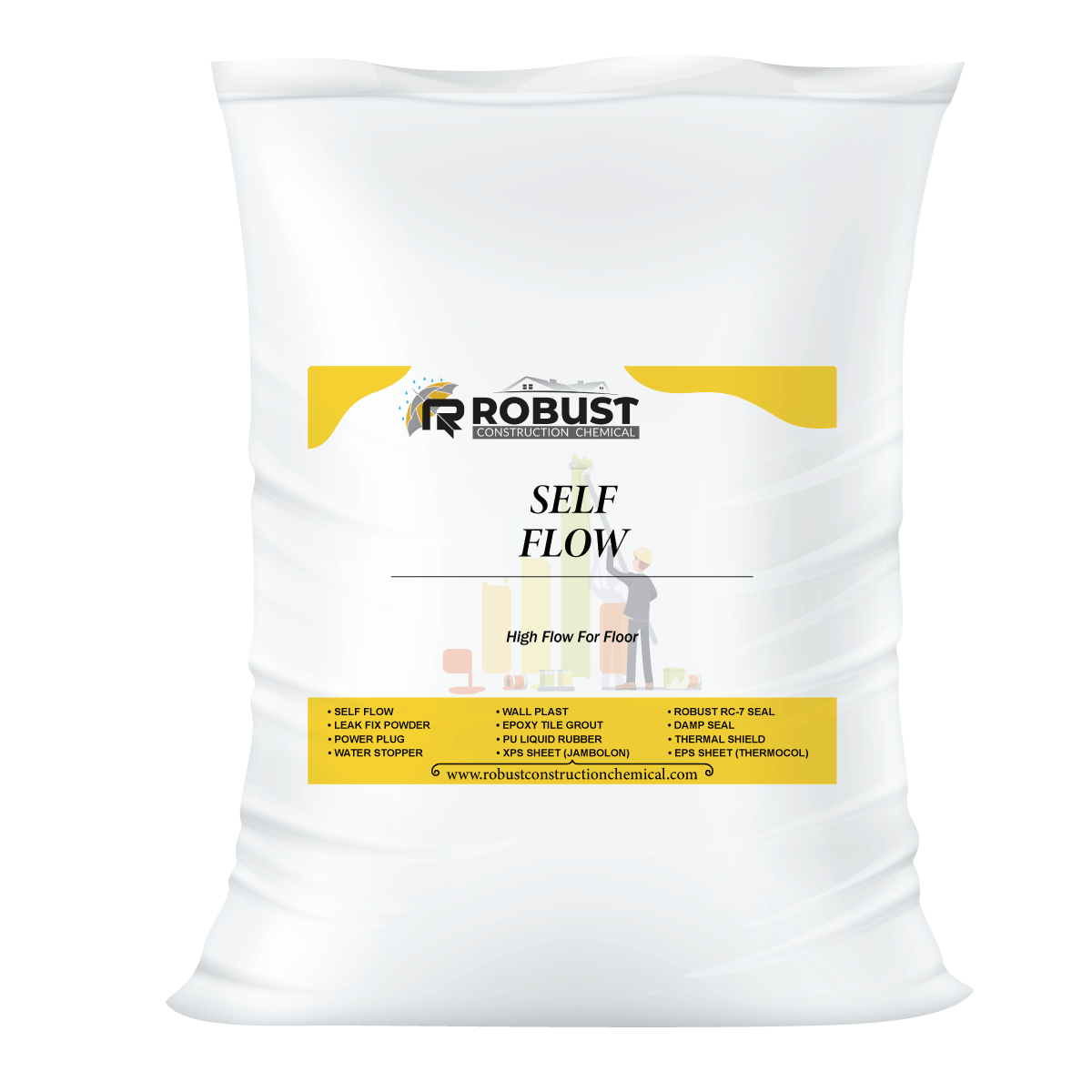
Robust Self-Flow Epoxy Flooring (also specified as Self-Leveling Epoxy or Flow-Applied Seamless Epoxy) is a solvent-free, high-build resin flooring system engineered to spread evenly under gravity when poured onto a primed concrete slab, curing into a seamless, mirror-smooth, high-gloss hygienic floor. Noticeably listed right on the bucket labels in your product photo, Self Flow is formulated for environments requiring zero grout joints, dust-free hygiene, and resistance to heavy rolling loads and industrial chemicals.
1. System Architecture & How Self-Flow Works
Unlike thin roll-on epoxy paints (0.2–0.4 mm) that copy every concrete bump, a Self-Flow Epoxy system builds 1.5 mm to 5.0 mm of continuous structural thickness across three core layers:
-
Penetrating Epoxy Primer (150–300 microns): Seals diamond-ground concrete pores, prevents air outgassing pinholes, and establishes a high-strength bond to the slab.
-
Self-Flow Epoxy Body Coat (1.5 – 5.0 mm): A low-viscosity, 100%-solids resin-hardener-filler slurry poured in ribbons and distributed with a notched gauge rake. Its controlled surface tension allows the resin to self-level minor waves within 20–30 minutes before being spike-rolled to release trapped air.
-
Optional Protective Wear Topcoat (100–250 microns): A clear aliphatic polyurethane (PU) or polyaspartic seal coat applied in sunlit or high-abrasion zones to prevent UV yellowing and micro-scratching.
2. Technical Specifications & Performance Benchmarks
| Property / Parameter | Typical Industrial & Commercial Range | Functional Significance |
| System Thickness | 1.5 mm – 5.0 mm (Standard: 2.0 – 3.0 mm) | Eliminates concrete dusting and hides minor subfloor imperfections |
| Volume Solids | 99% – 100% (Solvent-Free / Zero-VOC) | Zero shrinkage during cure and safe indoor installation |
| Mixed Specific Gravity | 1.45 – 1.65 kg/L (pigmented mineral-filled) | High density resists point-load indentation |
| Compressive Strength | 65 – 85 N/mm² (9,400 – 12,300 psi) | Supports pallet jacks, forklifts, and heavy static racking |
| Bond / Pull-Off Strength | ≥ 1.5 – 2.5 N/mm² (concrete substrate failure) | Prevents peeling or delamination under thermal/mechanical stress |
| Surface Finish & Gloss | Smooth, Seamless Mirror Gloss (≥ 85–90 GU) | Maximizes indoor lighting reflectivity and simplifies sanitation |
| Pot Life / Working Time | 30 – 40 minutes at 25°C | Requires organized batch pouring and maintaining a wet edge |
| Cure Schedule (25°C) | Touch Dry: 6–8 hrs | Light Foot Traffic: 24 hrs | Full Cure: 7 days | Ready for full chemical and forklift loads after 7 days |
3. Material Consumption & BOQ Estimation Guide (Per m²)
For a standard mineral-filled Self-Flow Epoxy system (specific gravity ~1.55–1.75), consumption scales directly with millimeter thickness:
| System Layer | Target Thickness | Consumption (kg / m²) | Coverage per 20 kg Kit |
| Penetrating Epoxy Primer | 0.15 – 0.25 mm | 0.25 – 0.35 kg/m² | ~57 – 80 m² (615 – 860 sq. ft.) |
| Self-Flow Epoxy (Light Duty) | 1.5 mm | ~2.40 – 2.70 kg/m² | ~7.4 – 8.3 m² (80 – 90 sq. ft.) |
| Self-Flow Epoxy (Standard Industrial) | 2.0 mm | ~3.20 – 3.80 kg/m² | ~5.2 – 6.2 m² (56 – 67 sq. ft.) |
| Self-Flow Epoxy (Heavy Duty) | 3.0 mm | ~4.80 – 5.50 kg/m² | ~3.6 – 4.1 m² (39 – 45 sq. ft.) |
| UV Aliphatic PU Topcoat (Optional) | 0.10 – 0.15 mm | 0.15 – 0.25 kg/m² | ~80 – 130 m² (860 – 1,400 sq. ft.) |
Note: Always include 10%–15% wastage allowance for substrate surface roughness and bucket residual.
4. Indicative Turnkey Rates in Pakistan (2026 Benchmarks)
Across major industrial and commercial hubs in Pakistan (Lahore, Karachi, Faisalabad, and Islamabad), turnkey Self-Flow Epoxy installation (including diamond grinding, primer, and self-leveling coat) is quoted per square foot:
-
2.0 mm Commercial & Light Industrial Self-Flow Epoxy: PKR 240 – 400 per sq. ft.
-
3.0 mm Heavy-Duty Industrial Self-Flow Epoxy: PKR 380 – 600 per sq. ft.
-
4.0 – 5.0 mm Extra-Heavy-Duty Self-Flow System: PKR 580 – 850+ per sq. ft.
-
Anti-Static (ESD) Self-Flow Epoxy (2.0 – 3.0 mm): PKR 550 – 900 per sq. ft. (for electronics, telecom, and cleanroom plants).
5. Step-by-Step Professional Application Protocol
-
Concrete Testing & Mechanical Profiling: Confirm slab age (≥ 28 days), compressive strength (≥ 25 MPa), and moisture content (< 4%). Diamond-grind or shot-blast the concrete to a Concrete Surface Profile (CSP) of 3–4 to remove laitance, oil, and curing membranes.
-
Crack & Joint Treatment: Route and fill static cracks with rigid epoxy putty/mortar. Honor active structural expansion joints by sawing and sealing them with flexible polyurethane/polysulfide sealant after the epoxy cures.
-
Priming: Apply penetrating epoxy primer at 0.25–0.35 kg/m² via squeegee and roller. Apply the self-flow coat within the primer’s tack-free recoat window (typically 12 to 24 hours).
-
Precision Mixing: Mix Part A (base resin) and Part B (hardener) with a low-speed helical paddle mixer (300–400 RPM) for 3 minutes, scraping container sides thoroughly to avoid unmixed soft spots.
-
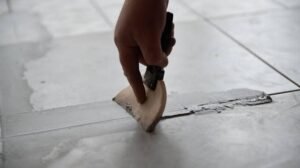
Pouring, Gauge Raking & Spike Rolling: Pour mixed material in continuous strips, spread to exact millimeter depth using a notched steel trowel or gauge rake (like the notched trowel shown in your product photo), and roll immediately in two perpendicular directions with a spiked de-airing roller within 10 minutes to eliminate trapped air bubbles.
6. Primary Industrial & Commercial Applications
-
Pharmaceuticals, Hospitals & Laboratories: Meets cGMP and cleanroom hygiene standards with zero seams, dust-free surfaces, and easy chemical sterilization.
-
Food & Beverage Processing Plants: Resists organic acids, oils, sugars, and frequent washdowns without bacterial harborages.
-
Electronics, Textile & Packaging Factories: Prevents concrete dust contamination on sensitive machinery while withstanding continuous pallet-trolley movement.
-
Commercial Showrooms, Galleries & Garages: Provides a sleek, modern, mirror-flat finish available in RAL solid colors.
-
1. Chemical & Environmental Resistance Matrix
Once cured for 7 days at 25°C, a 100%-solids Self-Flow Epoxy floor creates a dense, impermeable barrier across industrial exposures:
-
Long-Term Continuous Resistance: Water, brine, motor oil, hydraulic fluid, diesel, transmission fluid, alkaline detergents, sodium hydroxide (caustic soda up to 50%), ammonia solutions, and dilute mineral acids (pH 3–13).
-
Splash & Spill Resistance (Clean Within 24–72 Hours): Battery acid (sulfuric acid up to 30%–50%), lactic acid, citric acid, vegetable oils, ethanol, isopropyl alcohol, and household/industrial bleach (5% sodium hypochlorite).
-
Requires Novolac Epoxy or Polyurethane Cement Upgrade: Continuous immersion in concentrated glacial acetic acid, concentrated nitric/hydrochloric acids, pure aromatic solvents (xylene, toluene, acetone), or live steam washdowns above 80°C.
2. Substrate & Environmental Thresholds (Pre-Installation Checklist)
Self-flow epoxy relies on exact chemical cross-linking and low surface tension; ignoring slab or weather limits causes delamination or surface defects:
-
Concrete Age & Strength: New concrete slabs must cure for at least 28 days and achieve a minimum compressive strength of 25–30 N/mm² (3,500–4,350 psi) and surface tensile pull-off strength of ≥ 1.5 N/mm² (220 psi).
-
Moisture Vapor Limits: Slab moisture must remain below 4% by weight (or vapor emission ≤ 3 lbs / 1,000 sq. ft. / 24 hrs via ASTM F1869). Ground-floor slabs lacking a vapor barrier require a two-coat Moisture-Vapor-Barrier (MVB) primer prior to pouring.
-
Temperature & Dew Point Control: Install only when ambient and substrate temperatures are between 15°C and 35°C, relative humidity is below 80%–85%, and slab temperature is at least 3°C (5°F) above the dew point.
-
Pot Life Sensitivity to Heat: At 25°C, working time is roughly 30–45 minutes; in peak Pakistani summer heat (35°C+), pot life drops to 15–20 minutes. Store resin pails in an air-conditioned room (20°C–25°C) before mixing on hot job sites.
3. Self-Flow Epoxy vs. Epoxy Coating vs. Epoxy Screed (Comparison)
Feature / Specification Thin-Film Epoxy Coating Self-Flow Epoxy (SL) Troweled Epoxy Mortar Screed Installed Thickness 0.25 – 0.50 mm (250–500 µm) 1.5 – 5.0 mm 5.0 – 10.0 mm Application Tool Roller / Airless spray Notched gauge rake & spiked roller Steel finishing trowel & power float Surface Texture Mirrors concrete texture Mirror-smooth, self-leveling Dense, slightly textured (requires seal coat) Mechanical Duty Foot traffic & light carts Medium-to-heavy forklifts & pallet jacks Extreme heavy impact & steel wheels Turnkey Rate (Pakistan 2026) PKR 120 – 200 / sq. ft. PKR 240 – 600 / sq. ft. PKR 650 – 1,100+ / sq. ft. 4. Common Robust Self-Flow Installation Defects & Prevention
-
Pinholes & Crater Bubbles: Caused by air escaping from unsealed porous concrete (“outgassing”) as slab temperature rises during the day. Prevention: Prime porous slabs with a penetrating primer (applying two coats on thirsty concrete) and pour during late afternoon or evening when the slab is cooling down.
-
Trowel / Gauge-Rake Lines Remaining Visible: Occurs when resin is poured past its pot life, mixed at cold temperatures (high viscosity), or spread too thinly (< 1.5 mm). Prevention: Maintain minimum 1.5–2.0 mm thickness, keep a continuous wet edge between batches, and spike-roll within 10 minutes of pouring.
-
Color Shade Variations Between Batches: Caused by inconsistent mixing times or failing to stir Part A pigment thoroughly before adding Part B. Prevention: Pre-mix Part A for 1 minute before adding hardener, use identical mixing times per kit, and box/blend batch numbers across contiguous bays.
-
Dull, Greasy Surface Haze (Amine Blush): Triggered by high night-time humidity (> 80%) or sudden temperature drops during early cure. Prevention: Monitor dew point continuously and seal warehouse doors/windows overnight during curing.
5. Routine Cleaning & Lifecycle Maintenance Protocol
-
First 7 Days: Allow only light foot traffic after 24 hours; restrict heavy forklifts, pallet jacks, and chemical washdowns until full cross-linking completes at 7 days.
-
Daily Sanitation: Sweep with a soft microfiber dust mop and clean with a pH-neutral industrial floor cleaner (pH 7–8) using a soft red or white floor-machine pad. Avoid black stripping pads, wire brushes, or strong solvent cleaners that dull surface gloss.
-
Tire Mark & Scuff Removal: Clean rubber forklift skid marks promptly using an alkaline citrus or butyl-free floor degreaser and rinse with clean water.
-
5-to-8-Year Refresh Coat: When high-traffic aisles show surface dulling, lightly screen-sand the existing floor with 120–150 grit screens, solvent-wipe, and apply a single 200-micron aliphatic polyurethane or self-flow refresh coat to restore showroom gloss.
6. High-Traffic SEO Keyword Clusters & H2 Outline (For CMS Rollout)
-
Primary Focus Keyword:
self flow epoxy flooring(local variant:self-leveling epoxy flooring in Pakistan) -
Supporting Buyer & Spec Keywords:
self flow epoxy price per sq ft in Pakistan,2mm self leveling epoxy flooring Lahore,100% solids solvent free epoxy floor,seamless pharmaceutical epoxy flooring,industrial warehouse self leveling epoxy -
1. Chemical & Environmental Resistance Matrix
Once cured for 7 days at 25°C, a 100%-solids Self-Flow Epoxy floor creates a dense, impermeable barrier across industrial exposures:
-
Long-Term Continuous Resistance: Water, brine, motor oil, hydraulic fluid, diesel, transmission fluid, alkaline detergents, sodium hydroxide (caustic soda up to 50%), ammonia solutions, and dilute mineral acids (pH 3–13).
-
Splash & Spill Resistance (Clean Within 24–72 Hours): Battery acid (sulfuric acid up to 30%–50%), lactic acid, citric acid, vegetable oils, ethanol, isopropyl alcohol, and household/industrial bleach (5% sodium hypochlorite).
-
Requires Novolac Epoxy or Polyurethane Cement Upgrade: Continuous immersion in concentrated glacial acetic acid, concentrated nitric/hydrochloric acids, pure aromatic solvents (xylene, toluene, acetone), or live steam washdowns above 80°C.
2. Substrate & Environmental Thresholds (Pre-Installation Checklist)
Self-flow epoxy relies on exact chemical cross-linking and low surface tension; ignoring slab or weather limits causes delamination or surface defects:
-
Concrete Age & Strength: New concrete slabs must cure for at least 28 days and achieve a minimum compressive strength of 25–30 N/mm² (3,500–4,350 psi) and surface tensile pull-off strength of ≥ 1.5 N/mm² (220 psi).
-
Moisture Vapor Limits: Slab moisture must remain below 4% by weight (or vapor emission ≤ 3 lbs / 1,000 sq. ft. / 24 hrs via ASTM F1869). Ground-floor slabs lacking a vapor barrier require a two-coat Moisture-Vapor-Barrier (MVB) primer prior to pouring.
-
Temperature & Dew Point Control: Install only when ambient and substrate temperatures are between 15°C and 35°C, relative humidity is below 80%–85%, and slab temperature is at least 3°C (5°F) above the dew point.
-
Pot Life Sensitivity to Heat: At 25°C, working time is roughly 30–45 minutes; in peak Pakistani summer heat (35°C+), pot life drops to 15–20 minutes. Store resin pails in an air-conditioned room (20°C–25°C) before mixing on hot job sites.
3. Self-Flow Epoxy vs. Epoxy Coating vs. Epoxy Screed (Comparison)
Feature / Specification Thin-Film Epoxy Coating Self-Flow Epoxy (SL) Troweled Epoxy Mortar Screed Installed Thickness 0.25 – 0.50 mm (250–500 µm) 1.5 – 5.0 mm 5.0 – 10.0 mm Application Tool Roller / Airless spray Notched gauge rake & spiked roller Steel finishing trowel & power float Surface Texture Mirrors concrete texture Mirror-smooth, self-leveling Dense, slightly textured (requires seal coat) Mechanical Duty Foot traffic & light carts Medium-to-heavy forklifts & pallet jacks Extreme heavy impact & steel wheels Turnkey Rate (Pakistan 2026) PKR 120 – 200 / sq. ft. PKR 240 – 600 / sq. ft. PKR 650 – 1,100+ / sq. ft. 4. Common Self-Flow Installation Defects & Prevention
-
Pinholes & Crater Bubbles: Caused by air escaping from unsealed porous concrete (“outgassing”) as slab temperature rises during the day. Prevention: Prime porous slabs with a penetrating primer (applying two coats on thirsty concrete) and pour during late afternoon or evening when the slab is cooling down.
-
Trowel / Gauge-Rake Lines Remaining Visible: Occurs when resin is poured past its pot life, mixed at cold temperatures (high viscosity), or spread too thinly (< 1.5 mm). Prevention: Maintain minimum 1.5–2.0 mm thickness, keep a continuous wet edge between batches, and spike-roll within 10 minutes of pouring.
-
Color Shade Variations Between Batches: Caused by inconsistent mixing times or failing to stir Part A pigment thoroughly before adding Part B. Prevention: Pre-mix Part A for 1 minute before adding hardener, use identical mixing times per kit, and box/blend batch numbers across contiguous bays.
-
Dull, Greasy Surface Haze (Amine Blush): Triggered by high night-time humidity (> 80%) or sudden temperature drops during early cure. Prevention: Monitor dew point continuously and seal warehouse doors/windows overnight during curing.
5. Routine Cleaning & Lifecycle Maintenance Protocol
-
First 7 Days: Allow only light foot traffic after 24 hours; restrict heavy forklifts, pallet jacks, and chemical washdowns until full cross-linking completes at 7 days.
-
Daily Sanitation: Sweep with a soft microfiber dust mop and clean with a pH-neutral industrial floor cleaner (pH 7–8) using a soft red or white floor-machine pad. Avoid black stripping pads, wire brushes, or strong solvent cleaners that dull surface gloss.
-
Tire Mark & Scuff Removal: Clean rubber forklift skid marks promptly using an alkaline citrus or butyl-free floor degreaser and rinse with clean water.
-
5-to-8-Year Refresh Coat: When high-traffic aisles show surface dulling, lightly screen-sand the existing floor with 120–150 grit screens, solvent-wipe, and apply a single 200-micron aliphatic polyurethane or self-flow refresh coat to restore showroom gloss.
6. High-Traffic SEO Keyword Clusters & H2 Outline (For CMS Rollout)
-
Primary Focus Keyword:
self flow epoxy flooring(local variant:self-leveling epoxy flooring in Pakistan) -
Supporting Buyer & Spec Keywords:
self flow epoxy price per sq ft in Pakistan,2mm self leveling epoxy flooring Lahore,100% solids solvent free epoxy floor,seamless pharmaceutical epoxy flooring,industrial warehouse self leveling epoxy 
-

-
-
Self-Flow Epoxy Flooring (also specified as Self-Leveling Epoxy or Flow-Applied Seamless Epoxy) is a solvent-free, high-build resin flooring system engineered to spread evenly under gravity when poured onto a primed concrete slab, curing into a seamless, mirror-smooth, high-gloss hygienic floor. Noticeably listed right on the bucket labels in your product photo, Self Flow is formulated for environments requiring zero grout joints, dust-free hygiene, and resistance to heavy rolling loads and industrial chemicals.
1. System Architecture & How Self-Flow Works
Unlike thin roll-on epoxy paints (0.2–0.4 mm) that copy every concrete bump, a Self-Flow Epoxy system builds 1.5 mm to 5.0 mm of continuous structural thickness across three core layers:
-
Penetrating Epoxy Primer (150–300 microns): Seals diamond-ground concrete pores, prevents air outgassing pinholes, and establishes a high-strength bond to the slab.
-
Self-Flow Epoxy Body Coat (1.5 – 5.0 mm): A low-viscosity, 100%-solids resin-hardener-filler slurry poured in ribbons and distributed with a notched gauge rake. Its controlled surface tension allows the resin to self-level minor waves within 20–30 minutes before being spike-rolled to release trapped air.
-
Optional Protective Wear Topcoat (100–250 microns): A clear aliphatic polyurethane (PU) or polyaspartic seal coat applied in sunlit or high-abrasion zones to prevent UV yellowing and micro-scratching.
2. Technical Specifications & Performance Benchmarks
Property / Parameter Typical Industrial & Commercial Range Functional Significance System Thickness 1.5 mm – 5.0 mm (Standard: 2.0 – 3.0 mm) Eliminates concrete dusting and hides minor subfloor imperfections Volume Solids 99% – 100% (Solvent-Free / Zero-VOC) Zero shrinkage during cure and safe indoor installation Mixed Specific Gravity 1.45 – 1.65 kg/L (pigmented mineral-filled) High density resists point-load indentation Compressive Strength 65 – 85 N/mm² (9,400 – 12,300 psi) Supports pallet jacks, forklifts, and heavy static racking Bond / Pull-Off Strength ≥ 1.5 – 2.5 N/mm² (concrete substrate failure) Prevents peeling or delamination under thermal/mechanical stress Surface Finish & Gloss Smooth, Seamless Mirror Gloss (≥ 85–90 GU) Maximizes indoor lighting reflectivity and simplifies sanitation Pot Life / Working Time 30 – 40 minutes at 25°C Requires organized batch pouring and maintaining a wet edge Cure Schedule (25°C) Touch Dry: 6–8 hrs | Light Foot Traffic: 24 hrs | Full Cure: 7 days Ready for full chemical and forklift loads after 7 days 3. Material Consumption & BOQ Estimation Guide (Per m²)
For a standard mineral-filled Self-Flow Epoxy system (specific gravity ~1.55–1.75), consumption scales directly with millimeter thickness:
System Layer Target Thickness Consumption (kg / m²) Coverage per 20 kg Kit Penetrating Epoxy Primer 0.15 – 0.25 mm 0.25 – 0.35 kg/m² ~57 – 80 m² (615 – 860 sq. ft.) Self-Flow Epoxy (Light Duty) 1.5 mm ~2.40 – 2.70 kg/m² ~7.4 – 8.3 m² (80 – 90 sq. ft.) Self-Flow Epoxy (Standard Industrial) 2.0 mm ~3.20 – 3.80 kg/m² ~5.2 – 6.2 m² (56 – 67 sq. ft.) Self-Flow Epoxy (Heavy Duty) 3.0 mm ~4.80 – 5.50 kg/m² ~3.6 – 4.1 m² (39 – 45 sq. ft.) UV Aliphatic PU Topcoat (Optional) 0.10 – 0.15 mm 0.15 – 0.25 kg/m² ~80 – 130 m² (860 – 1,400 sq. ft.) Note: Always include 10%–15% wastage allowance for substrate surface roughness and bucket residual.
4. Indicative Turnkey Rates in Pakistan (2026 Benchmarks)
Across major industrial and commercial hubs in Pakistan (Lahore, Karachi, Faisalabad, and Islamabad), turnkey Self-Flow Epoxy installation (including diamond grinding, primer, and self-leveling coat) is quoted per square foot:
-
2.0 mm Commercial & Light Industrial Self-Flow Epoxy: PKR 240 – 400 per sq. ft.
-
3.0 mm Heavy-Duty Industrial Self-Flow Epoxy: PKR 380 – 600 per sq. ft.
-
4.0 – 5.0 mm Extra-Heavy-Duty Self-Flow System: PKR 580 – 850+ per sq. ft.
-
Anti-Static (ESD) Self-Flow Epoxy (2.0 – 3.0 mm): PKR 550 – 900 per sq. ft. (for electronics, telecom, and cleanroom plants).
5. Step-by-Step Professional Application Protocol
-
Concrete Testing & Mechanical Profiling: Confirm slab age (≥ 28 days), compressive strength (≥ 25 MPa), and moisture content (< 4%). Diamond-grind or shot-blast the concrete to a Concrete Surface Profile (CSP) of 3–4 to remove laitance, oil, and curing membranes.
-
Crack & Joint Treatment: Route and fill static cracks with rigid epoxy putty/mortar. Honor active structural expansion joints by sawing and sealing them with flexible polyurethane/polysulfide sealant after the epoxy cures.
-
Priming: Apply penetrating epoxy primer at 0.25–0.35 kg/m² via squeegee and roller. Apply the self-flow coat within the primer’s tack-free recoat window (typically 12 to 24 hours).
-
Precision Mixing: Mix Part A (base resin) and Part B (hardener) with a low-speed helical paddle mixer (300–400 RPM) for 3 minutes, scraping container sides thoroughly to avoid unmixed soft spots.
-
Pouring, Gauge Raking & Spike Rolling: Pour mixed material in continuous strips, spread to exact millimeter depth using a notched steel trowel or gauge rake (like the notched trowel shown in your product photo), and roll immediately in two perpendicular directions with a spiked de-airing roller within 10 minutes to eliminate trapped air bubbles.
6. Primary Industrial & Commercial Applications
-
- Robust
- Robust
- Robust
- Robust
- Robust
- Robust
- Robust
- Robust
- Robust
- Robust
- Robust
- Robust
- Robust
- Robust
- Robust
- Robust
- Robust
- Robust
- Robust
- Robust
- Robust
- Robust
- Robust
- Robust
- Robust
- Robust
- Robust
- Robust
- Robust
- Robust
- Robust
- Robust
- Robust
- Robust
- Robust
- Robust
- Robust
- Robust
- Robust
-
-