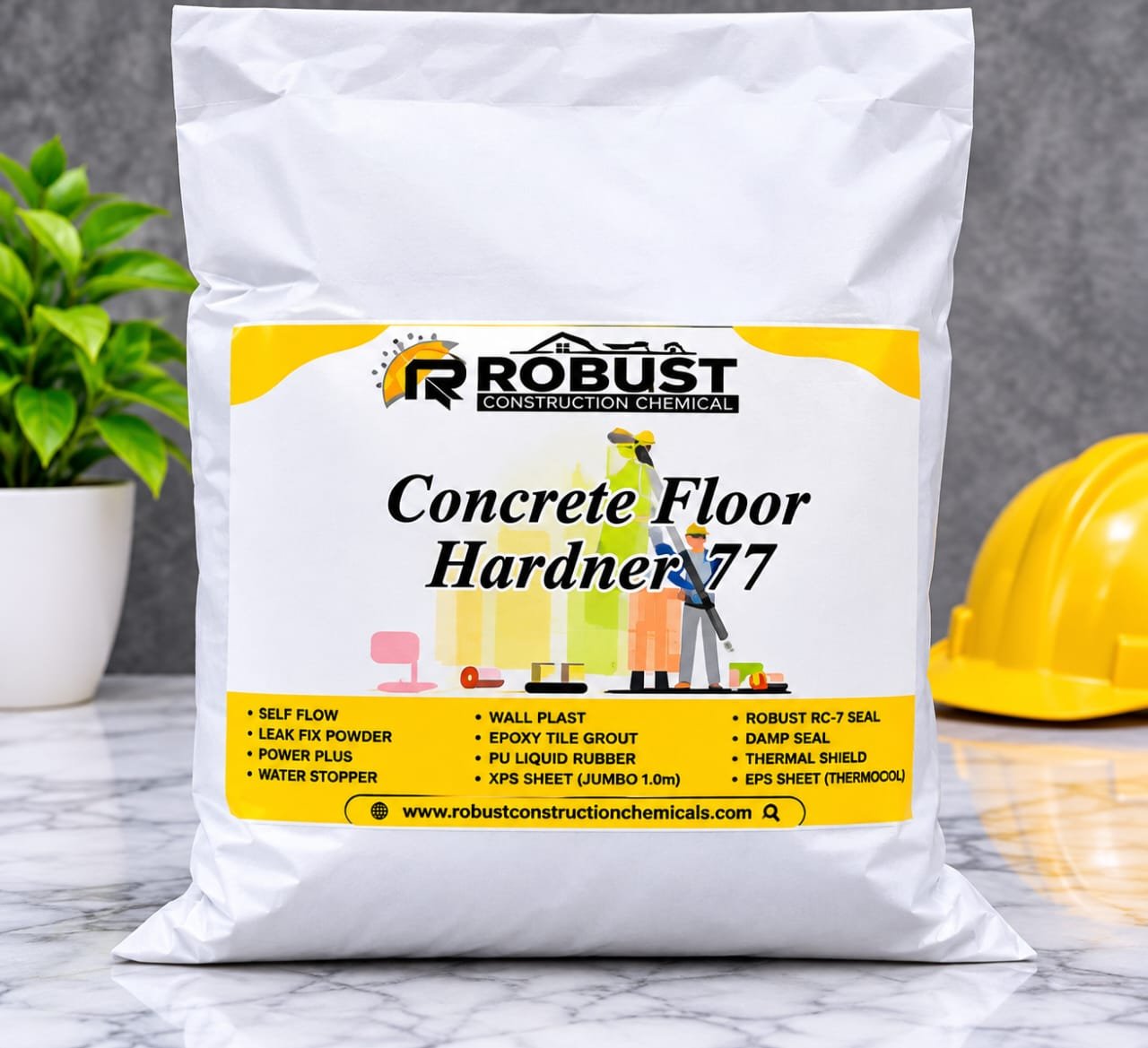
Robust Concrete Floor Hardener (available in both Dry-Shake Mineral/Metallic Surface Hardener for fresh concrete pours and Liquid Lithium/Sodium Silicate Densifier for cured concrete slabs) is an industrial-grade surface hardening system engineered to transform porous, dusting warehouse concrete into a dense, ultra-abrasion-resistant, dust-proof floor capable of withstanding heavy forklifts, steel-wheeled trolleys, and continuous industrial impact.
1. Two Core Product Formats (Dry-Shake vs. Liquid Densifier)
Depending on whether you are pouring a brand-new concrete floor or upgrading an existing cured slab, Robust Concrete Floor Hardener is specified in two distinct formulations:
-
Type A: Robust Dry-Shake Concrete Floor Hardener (Non-Metallic Quartz / Corundum / Metallic Aggregate)
-
What It Is: A ready-to-use, factory-blended dry powder containing specially graded hard mineral aggregates (high-purity quartz, emery/corundum, or non-rusting iron aggregates), ordinary Portland cement, and superplasticizing dispersing agents.
-
When Applied: Broadcast (“shaken”) directly onto freshly leveled, floated wet concrete before final power-troweling, integrating monolithically into the top 2–3 mm wearing crust.
-
Best For: New industrial warehouses, logistics hubs, factory floors, parking basements, loading bays, and cold storages.
-
-
Type B: Robust Liquid Concrete Hardener & Densifier (Lithium / Sodium Silicate)
-
What It Is: A penetrating, water-based chemical silicate solution sprayed onto existing cured concrete slabs. It reacts with free calcium hydroxide ($Ca(OH)_2$) inside concrete pores to form insoluble Calcium Silicate Hydrate (C-S-H) crystals—permanently sealing capillary voids from within.
-
When Applied: Sprayed onto cured concrete (≥ 7–28 days old) or mechanically diamond-polished concrete floors.
-
Best For: Dust-proofing existing factory/warehouse slabs, polished concrete showrooms, and commercial basements without adding a topical film that can peel.
-
2. Technical Specifications & ASTM / EN Performance Benchmarks
| Property / Metric | Non-Metallic Mineral Dry-Shake (Quartz / Corundum) | Heavy-Duty Metallic Dry-Shake | Liquid Lithium Silicate Densifier |
| Hardness Rating (Mohs Scale) | 7.0 (Quartz) – 9.0 (Corundum) | 7.5 – 8.5 (Iron-Alloy) | Increases surface Mohs hardness by 2–3 points |
| Abrasion Resistance Improvement | 200% – 300% over plain M25 concrete | 400% – 600% over plain concrete | 40% – 65% improvement (ASTM C779) |
| Compressive Strength (28 Days) | ≥ 70 – 85 N/mm² (10,150 – 12,300 psi) | ≥ 85 – 100 N/mm² (12,300 – 14,500 psi) | Boosts surface compressive strength by 25% – 40% |
| Impact & Point-Load Resistance | High (Non-rusting in wet zones) | Maximum (Steel-wheel & heavy impact) | Moderate-to-High (Zero surface delamination) |
| Dust-Proofing & Oil Resistance | Dense, low-porosity troweled crust | Dense, non-dusting metallic crust | 100% permanent internal pore sealing |
| Standard Colors | Natural Grey, Green, Terracotta Red, Yellow | Natural Grey & Industrial Shades | Clear / Transparent (Matte to Polished Sheen) |
| Standard Packaging | 25 kg & 50 kg Moisture-Proof Bags | 25 kg & 50 kg Moisture-Proof Bags | 20 L Jerrycans & 200 L HDPE Drums |
3. Consumption & BOQ Estimation Guide (Per m² & Per Sq. Ft.)
Dry-Shake Floor Hardener Consumption (By Traffic Duty)
-
Light-to-Medium Duty (Commercial Showrooms, Retail & Light Storage): 3.0 – 4.0 kg/m² (0.28 – 0.37 kg/sq. ft.) — 1 bag (25 kg) covers ~6.2 – 8.3 m² (67 – 90 sq. ft.).
-
Medium-to-Heavy Duty (Industrial Warehouses, Forklifts & Manufacturing): 5.0 – 6.0 kg/m² (0.46 – 0.56 kg/sq. ft.) — 1 bag (25 kg) covers ~4.1 – 5.0 m² (45 – 54 sq. ft.).
-
Extra-Heavy Duty (Steel-Wheeled Trolleys, Heavy Engineering & Loading Docks): 7.0 – 8.0 kg/m² (0.65 – 0.74 kg/sq. ft.) — 1 bag (25 kg) covers ~3.1 – 3.5 m² (33 – 38 sq. ft.).
Liquid Silicate Densifier Coverage
-
Standard Two-Pass Saturation: 0.15 – 0.25 Liters/m² (4 – 6.5 m² per liter / ~45 – 70 sq. ft. per liter) depending on slab porosity.
4. Step-by-Step Professional Application Protocol
A. Dry-Shake Hardener Application (On Fresh Concrete Pour)
-
Concrete Slab Requirements: Pour concrete with minimum grade M25 (3,500 psi) and a controlled water-to-cement ratio (≤ 0.45–0.50). Strike off, bull-float, and wait until surface bleed water evaporates and footprints sink only 3–5 mm.
-
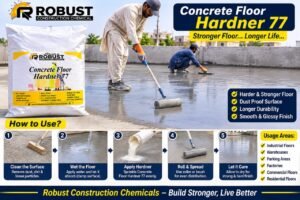
First Broadcast (2/3 of Total Dosage): Evenly broadcast two-thirds of the Robust Dry-Shake Floor Hardener across the damp concrete surface. Allow the powder to absorb surface moisture from the slab until it darkens uniformly (do not sprinkle extra water on top).
-
First Power-Trowel Floating: Float the wetted hardener into the concrete surface using a mechanical power trowel (helicopter) fitted with flat float pans until integrated.
-
Second Broadcast (Remaining 1/3 Dosage) & Final Burnishing: Immediately broadcast the remaining one-third perpendicular to the first pass, allow moisture absorption, and power-trowel in multiple passes with pitched finishing blades until a dense, glossy, marble-smooth finish is achieved.
-
Mandatory Curing: Apply a clear resin/acrylic curing compound (or cover with polythene sheets) immediately after final troweling to prevent rapid moisture loss and crazing cracks.
B. Liquid Silicate Densifier Application (On Existing Cured Concrete)
-
Surface Cleaning: Sweep and auto-scrub the cured concrete slab to remove all dust, curing compounds, oil, and laitance.
-
Flood & Agitate: Spray Robust Liquid Concrete Densifier at ~5–6 m²/L, keeping the surface wet for 20–30 minutes while agitating with a soft-bristle broom or floor scrubber so the silicate penetrates deeply.
-
Rinse / Buff: Remove excess puddles before they dry into white residue, allow 24 hours to cure, and optionally burnish with diamond pads for a high-gloss architectural finish.
-
Robust Concrete Floor Hardener (available in both Dry-Shake Mineral/Metallic Surface Hardener for fresh concrete pours and Liquid Lithium/Sodium Silicate Densifier for cured concrete slabs) is an industrial-grade surface hardening system engineered to transform porous, dusting warehouse concrete into a dense, ultra-abrasion-resistant, dust-proof floor capable of withstanding heavy forklifts, steel-wheeled trolleys, and continuous industrial impact.
1. Two Core Product Formats (Dry-Shake vs. Liquid Densifier)
Depending on whether you are pouring a brand-new concrete floor or upgrading an existing cured slab, Robust Concrete Floor Hardener is specified in two distinct formulations:
-
Type A: Robust Dry-Shake Concrete Floor Hardener (Non-Metallic Quartz / Corundum / Metallic Aggregate)
-
What It Is: A ready-to-use, factory-blended dry powder containing specially graded hard mineral aggregates (high-purity quartz, emery/corundum, or non-rusting iron aggregates), ordinary Portland cement, and superplasticizing dispersing agents.
-
When Applied: Broadcast (“shaken”) directly onto freshly leveled, floated wet concrete before final power-troweling, integrating monolithically into the top 2–3 mm wearing crust.
-
Best For: New industrial warehouses, logistics hubs, factory floors, parking basements, loading bays, and cold storages.
-
-
Type B: Robust Liquid Concrete Hardener & Densifier (Lithium / Sodium Silicate)
-
What It Is: A penetrating, water-based chemical silicate solution sprayed onto existing cured concrete slabs. It reacts with free calcium hydroxide ($Ca(OH)_2$) inside concrete pores to form insoluble Calcium Silicate Hydrate (C-S-H) crystals—permanently sealing capillary voids from within.
-
When Applied: Sprayed onto cured concrete (≥ 7–28 days old) or mechanically diamond-polished concrete floors.
-
Best For: Dust-proofing existing factory/warehouse slabs, polished concrete showrooms, and commercial basements without adding a topical film that can peel.
-
2. Technical Specifications & ASTM / EN Performance Benchmarks
Property / Metric Non-Metallic Mineral Dry-Shake (Quartz / Corundum) Heavy-Duty Metallic Dry-Shake Liquid Lithium Silicate Densifier Hardness Rating (Mohs Scale) 7.0 (Quartz) – 9.0 (Corundum) 7.5 – 8.5 (Iron-Alloy) Increases surface Mohs hardness by 2–3 points Abrasion Resistance Improvement 200% – 300% over plain M25 concrete 400% – 600% over plain concrete 40% – 65% improvement (ASTM C779) Compressive Strength (28 Days) ≥ 70 – 85 N/mm² (10,150 – 12,300 psi) ≥ 85 – 100 N/mm² (12,300 – 14,500 psi) Boosts surface compressive strength by 25% – 40% Impact & Point-Load Resistance High (Non-rusting in wet zones) Maximum (Steel-wheel & heavy impact) Moderate-to-High (Zero surface delamination) Dust-Proofing & Oil Resistance Dense, low-porosity troweled crust Dense, non-dusting metallic crust 100% permanent internal pore sealing Standard Colors Natural Grey, Green, Terracotta Red, Yellow Natural Grey & Industrial Shades Clear / Transparent (Matte to Polished Sheen) Standard Packaging 25 kg & 50 kg Moisture-Proof Bags 25 kg & 50 kg Moisture-Proof Bags 20 L Jerrycans & 200 L HDPE Drums 3. Consumption & BOQ Estimation Guide (Per m² & Per Sq. Ft.)
Dry-Shake Floor Hardener Consumption (By Traffic Duty)
-
Light-to-Medium Duty (Commercial Showrooms, Retail & Light Storage): 3.0 – 4.0 kg/m² (0.28 – 0.37 kg/sq. ft.) — 1 bag (25 kg) covers ~6.2 – 8.3 m² (67 – 90 sq. ft.).
-
Medium-to-Heavy Duty (Industrial Warehouses, Forklifts & Manufacturing): 5.0 – 6.0 kg/m² (0.46 – 0.56 kg/sq. ft.) — 1 bag (25 kg) covers ~4.1 – 5.0 m² (45 – 54 sq. ft.).
-
Extra-Heavy Duty (Steel-Wheeled Trolleys, Heavy Engineering & Loading Docks): 7.0 – 8.0 kg/m² (0.65 – 0.74 kg/sq. ft.) — 1 bag (25 kg) covers ~3.1 – 3.5 m² (33 – 38 sq. ft.).
Liquid Silicate Densifier Coverage
-
Standard Two-Pass Saturation: 0.15 – 0.25 Liters/m² (4 – 6.5 m² per liter / ~45 – 70 sq. ft. per liter) depending on slab porosity.
4. Step-by-Step Professional Application Protocol
A. Dry-Shake Hardener Application (On Fresh Concrete Pour)
-
Concrete Slab Requirements: Pour concrete with minimum grade M25 (3,500 psi) and a controlled water-to-cement ratio (≤ 0.45–0.50). Strike off, bull-float, and wait until surface bleed water evaporates and footprints sink only 3–5 mm.
-
First Broadcast (2/3 of Total Dosage): Evenly broadcast two-thirds of the Robust Dry-Shake Floor Hardener across the damp concrete surface. Allow the powder to absorb surface moisture from the slab until it darkens uniformly (do not sprinkle extra water on top).
-
First Power-Trowel Floating: Float the wetted hardener into the concrete surface using a mechanical power trowel (helicopter) fitted with flat float pans until integrated.
-
Second Broadcast (Remaining 1/3 Dosage) & Final Burnishing: Immediately broadcast the remaining one-third perpendicular to the first pass, allow moisture absorption, and power-trowel in multiple passes with pitched finishing blades until a dense, glossy, marble-smooth finish is achieved.
-
Mandatory Curing: Apply a clear resin/acrylic curing compound (or cover with polythene sheets) immediately after final troweling to prevent rapid moisture loss and crazing cracks.
B. Liquid Silicate Densifier Application (On Existing Cured Concrete)
-
Surface Cleaning: Sweep and auto-scrub the cured concrete slab to remove all dust, curing compounds, oil, and laitance.
-
Flood & Agitate: Spray Robust Liquid Concrete Densifier at ~5–6 m²/L, keeping the surface wet for 20–30 minutes while agitating with a soft-bristle broom or floor scrubber so the silicate penetrates deeply.
-
Rinse / Buff: Remove excess puddles before they dry into white residue, allow 24 hours to cure, and optionally burnish with diamond pads for a high-gloss architectural finish.
-
Here are the extended technical comparisons, substrate engineering rules, troubleshooting guides, and SEO rollout blueprints for Robust Concrete Floor Hardener, structured with clear headings for direct copy-pasting into your CMS:
1. Dry-Shake Hardener vs. Liquid Silicate Densifier vs. Epoxy Flooring (Selection Matrix)
Facility owners and project engineers often debate whether to specify a dry-shake hardener, a liquid densifier, or a resinous epoxy topcoat. Use this side-by-side matrix to guide B2B procurement decisions:
Decision Factor Dry-Shake Floor Hardener (Quartz / Metallic) Liquid Silicate Densifier (Lithium / Sodium) 100%-Solids Epoxy Flooring (Self-Flow / Coating) Best Stage of Construction New concrete pour only (applied wet-on-wet) Existing cured concrete (≥ 7–28 days old) Existing or new cured concrete (after 28-day cure) Mechanism Monolithic 2–3 mm mineral/metallic wearing crust Internal C-S-H crystal growth inside pores Seamless topical polymer film (0.3 – 3.0 mm) Peeling / Delamination Risk Zero (integrates into base concrete slab) Zero (penetrating chemical reaction) Low if primed properly; possible under high moisture Heavy Impact & Steel Wheels Highest (especially Metallic / Corundum grade) Moderate-to-High (depends on base concrete MPa) High (up to 85 MPa), but can gouge under sharp drop Chemical & Acid Resistance Moderate (concrete matrix still vulnerable to strong acids) Moderate (resists oil/water; etched by strong acids) Superior (resists fuels, solvents, acids & alkalis) Hygiene & Cleanroom Compliance Good (troweled smooth, saw-cut joints remain) Good (dust-proof, breathable matte/polished finish) Mandatory for pharma, food & cleanroom audits Turnkey Rate (Pakistan 2026) PKR 75 – 130 / sq. ft. (hardener + power trowel) PKR 95 – 180 / sq. ft. (densifier + diamond buff) PKR 180 – 600 / sq. ft. (coating to self-flow) 2. Base Concrete Mix & Slab Engineering Rules (Crucial for Dry-Shake Success)
A dry-shake floor hardener is only as strong as the concrete slab beneath it. Enforce these concrete batching rules before broadcasting Robust Dry-Shake Floor Hardener:
-
Minimum Concrete Grade: Specify M25 to M30 (3,500 – 4,350 psi) ready-mix or site-batched concrete with a minimum cement content of 320 – 350 kg/m³.
-
Strict Water-to-Cement (W/C) Ratio (0.42 – 0.48): Excess mixing water causes heavy bleeding, trapping a weak water layer beneath the dry-shake crust that leads to surface delamination (“blistering” or “scaling”). Use a polycarboxylate or naphthalene superplasticizer for pumpability rather than adding extra site water.
-
Air Entrainment Limit (< 3%): Never use air-entraining admixtures in dry-shake troweled floors—entrapped air bubbles rise under power-trowel blades and cause surface blisters.
-
Control Joint Saw-Cutting Timing: Cut contraction control joints within 6 to 12 hours of final power-troweling (to a depth of 1/4 to 1/3 of slab thickness) to prevent random shrinkage cracking, and seal joints after 28 days with Robust PU Tube Sealant (High-Modulus Shore A 40–50).
3. Lithium Silicate vs. Sodium Silicate Densifier (Chemistry Breakdown)
When specifying Robust Liquid Concrete Hardener & Densifier, understanding the difference between lithium and sodium formulations prevents costly slab blemishes:
-
Lithium Silicate Densifier (Premium Architectural & Industrial Grade):
-
Zero White Residue / Efflorescence: Lithium ions are small and self-limiting—they react completely with free lime without forming expansive alkaline gels, leaving zero white powdery haze even if excess liquid dries on the surface.
-
ASR Mitigation: Actively prevents Alkali-Silica Reaction (ASR) micro-cracking in reactive aggregate concrete.
-
Fastest Cure & No Rinsing Required: Reacts rapidly within 1–2 hours without needing labor-intensive flood-rinsing and wet-vacuuming.
-
-
Sodium / Potassium Silicate Densifier (Economical Warehouse Grade):
-
Cost-Effective Dust-Proofing: Ideal for large industrial logistics sheds and basement parking decks on a tight budget.
-
Mandatory Scrub & Rinse Protocol: Requires thorough mechanical scrubbing and clean-water rinsing of excess liquid before drying; otherwise, unreacted sodium salts crystallize into white surface stains.
-
4. Common Floor Hardener Defects & Site Troubleshooting
-
Surface Delamination / Hollow Scaling: Caused by broadcasting dry-shake powder too early while bleed water is still rising, or sprinkling water onto dry powder during hot Pakistani afternoons. Prevention: Wait until bleed water sheen disappears completely before the first broadcast, and never throw water onto the surface to ease troweling.
-
Plastic Crazing (Spiderweb Hairline Cracks): Triggered by hot winds (loo) or direct sunlight drying the top 2 mm crust faster than the underlying slab. Prevention: Erect windbreaks around open warehouse bays, mist-fog the air (not the slab), and spray Robust Resin Curing Compound immediately after the final power-trowel pass.
-
Uneven Color Patchiness (On Colored Green/Red Floors): Caused by inconsistent broadcast thickness or burning the surface with overly pitched steel trowel blades. Prevention: Divide the floor into measured grid bays (e.g., 4 m × 5 m = 20 m²) and place exact bag counts per bay (e.g., 4 bags of 25 kg = 5 kg/m²), keeping final trowel blade angles flat and clean.
-
Rust Spots in Wet Areas (Metallic Grade): Standard iron-aggregate metallic hardeners oxidize if exposed to continuous water or chemical washdowns. Prevention: Restrict Metallic Dry-Shake Hardener to dry heavy-engineering/steel plants, and specify Non-Metallic Quartz or Corundum Hardener for wet food plants, car washes, and exterior loading ramps.
5. Complete SEO Pillar Page Outline & Keyword Clusters (For CMS Rollout)
-
Primary Focus Keyword:
concrete floor hardener(local variants:concrete floor hardener price in Pakistan,dry shake floor hardener Lahore) -
Supporting Buyer & Spec Keywords:
non metallic quartz floor hardener 25kg,liquid concrete densifier lithium silicate Pakistan,warehouse industrial floor hardener per sq ft,power trowel flooring rate in Pakistan,dust proof concrete floor chemical -
Recommended H2 Sections for Your 3,000-Word Pillar Page:
-
H2: What Is Concrete Floor Hardener & How Does It Eliminate Slab Dusting?
-
H2: Dry-Shake Floor Hardener vs. Liquid Silicate Densifier (Which System Do You Need?)
-
H2: Technical Specifications, Mohs Hardness & Compressive Strength Benchmarks
-
H2: BOQ Material Consumption Chart (3 kg/m² to 8 kg/m² by Forklift Traffic Duty)
-
H2: Step-by-Step Power-Trowel Application & Curing Protocol
-
H2: Concrete Floor Hardener vs. Epoxy Flooring (2026 Cost & Performance Comparison)
-
Here are the extended technical comparisons, substrate engineering rules, troubleshooting guides, and SEO rollout blueprints for Robust Concrete Floor Hardener, structured with clear headings for direct copy-pasting into your CMS:
1. Dry-Shake Hardener vs. Liquid Silicate Densifier vs. Epoxy Flooring (Selection Matrix)
Facility owners and project engineers often debate whether to specify a dry-shake hardener, a liquid densifier, or a resinous epoxy topcoat. Use this side-by-side matrix to guide B2B procurement decisions:
Decision Factor Dry-Shake Floor Hardener (Quartz / Metallic) Liquid Silicate Densifier (Lithium / Sodium) 100%-Solids Epoxy Flooring (Self-Flow / Coating) Best Stage of Construction New concrete pour only (applied wet-on-wet) Existing cured concrete (≥ 7–28 days old) Existing or new cured concrete (after 28-day cure) Mechanism Monolithic 2–3 mm mineral/metallic wearing crust Internal C-S-H crystal growth inside pores Seamless topical polymer film (0.3 – 3.0 mm) Peeling / Delamination Risk Zero (integrates into base concrete slab) Zero (penetrating chemical reaction) Low if primed properly; possible under high moisture Heavy Impact & Steel Wheels Highest (especially Metallic / Corundum grade) Moderate-to-High (depends on base concrete MPa) High (up to 85 MPa), but can gouge under sharp drop Chemical & Acid Resistance Moderate (concrete matrix still vulnerable to strong acids) Moderate (resists oil/water; etched by strong acids) Superior (resists fuels, solvents, acids & alkalis) Hygiene & Cleanroom Compliance Good (troweled smooth, saw-cut joints remain) Good (dust-proof, breathable matte/polished finish) Mandatory for pharma, food & cleanroom audits Turnkey Rate (Pakistan 2026) PKR 75 – 130 / sq. ft. (hardener + power trowel) PKR 95 – 180 / sq. ft. (densifier + diamond buff) PKR 180 – 600 / sq. ft. (coating to self-flow) 2. Base Concrete Mix & Slab Engineering Rules (Crucial for Dry-Shake Success)
A dry-shake floor hardener is only as strong as the concrete slab beneath it. Enforce these concrete batching rules before broadcasting Robust Dry-Shake Floor Hardener:
-
Minimum Concrete Grade: Specify M25 to M30 (3,500 – 4,350 psi) ready-mix or site-batched concrete with a minimum cement content of 320 – 350 kg/m³.
-
Strict Water-to-Cement (W/C) Ratio (0.42 – 0.48): Excess mixing water causes heavy bleeding, trapping a weak water layer beneath the dry-shake crust that leads to surface delamination (“blistering” or “scaling”). Use a polycarboxylate or naphthalene superplasticizer for pumpability rather than adding extra site water.
-
Air Entrainment Limit (< 3%): Never use air-entraining admixtures in dry-shake troweled floors—entrapped air bubbles rise under power-trowel blades and cause surface blisters.
-
Control Joint Saw-Cutting Timing: Cut contraction control joints within 6 to 12 hours of final power-troweling (to a depth of 1/4 to 1/3 of slab thickness) to prevent random shrinkage cracking, and seal joints after 28 days with Robust PU Tube Sealant (High-Modulus Shore A 40–50).
3. Lithium Silicate vs. Sodium Silicate Densifier (Chemistry Breakdown)
When specifying Robust Liquid Concrete Hardener & Densifier, understanding the difference between lithium and sodium formulations prevents costly slab blemishes:
-
Lithium Silicate Densifier (Premium Architectural & Industrial Grade):
-
Zero White Residue / Efflorescence: Lithium ions are small and self-limiting—they react completely with free lime without forming expansive alkaline gels, leaving zero white powdery haze even if excess liquid dries on the surface.
-
ASR Mitigation: Actively prevents Alkali-Silica Reaction (ASR) micro-cracking in reactive aggregate concrete.
-
Fastest Cure & No Rinsing Required: Reacts rapidly within 1–2 hours without needing labor-intensive flood-rinsing and wet-vacuuming.
-
-
Sodium / Potassium Silicate Densifier (Economical Warehouse Grade):
-
Cost-Effective Dust-Proofing: Ideal for large industrial logistics sheds and basement parking decks on a tight budget.
-
Mandatory Scrub & Rinse Protocol: Requires thorough mechanical scrubbing and clean-water rinsing of excess liquid before drying; otherwise, unreacted sodium salts crystallize into white surface stains.
-
4. Common Floor Hardener Defects & Site Troubleshooting
-
Surface Delamination / Hollow Scaling: Caused by broadcasting dry-shake powder too early while bleed water is still rising, or sprinkling water onto dry powder during hot Pakistani afternoons. Prevention: Wait until bleed water sheen disappears completely before the first broadcast, and never throw water onto the surface to ease troweling.
-
Plastic Crazing (Spiderweb Hairline Cracks): Triggered by hot winds (loo) or direct sunlight drying the top 2 mm crust faster than the underlying slab. Prevention: Erect windbreaks around open warehouse bays, mist-fog the air (not the slab), and spray Robust Resin Curing Compound immediately after the final power-trowel pass.
-
Uneven Color Patchiness (On Colored Green/Red Floors): Caused by inconsistent broadcast thickness or burning the surface with overly pitched steel trowel blades. Prevention: Divide the floor into measured grid bays (e.g., 4 m × 5 m = 20 m²) and place exact bag counts per bay (e.g., 4 bags of 25 kg = 5 kg/m²), keeping final trowel blade angles flat and clean.
-
Rust Spots in Wet Areas (Metallic Grade): Standard iron-aggregate metallic hardeners oxidize if exposed to continuous water or chemical washdowns. Prevention: Restrict Metallic Dry-Shake Hardener to dry heavy-engineering/steel plants, and specify Non-Metallic Quartz or Corundum Hardener for wet food plants, car washes, and exterior loading ramps.
5. Complete SEO Pillar Page Outline & Keyword Clusters (For CMS Rollout)
-
Primary Focus Keyword:
concrete floor hardener(local variants:concrete floor hardener price in Pakistan,dry shake floor hardener Lahore) -
Supporting Buyer & Spec Keywords:
non metallic quartz floor hardener 25kg,liquid concrete densifier lithium silicate Pakistan,warehouse industrial floor hardener per sq ft,power trowel flooring rate in Pakistan,dust proof concrete floor chemical -
Recommended H2 Sections for Your 3,000-Word Pillar Page:
-
H2: What Is Concrete Floor Hardener & How Does It Eliminate Slab Dusting?
-
H2: Dry-Shake Floor Hardener vs. Liquid Silicate Densifier (Which System Do You Need?)
-
H2: Technical Specifications, Mohs Hardness & Compressive Strength Benchmarks
-
H2: BOQ Material Consumption Chart (3 kg/m² to 8 kg/m² by Forklift Traffic Duty)
-
H2: Step-by-Step Power-Trowel Application & Curing Protocol
-
H2: Concrete Floor Hardener vs. Epoxy Flooring (2026 Cost & Performance Comparison)
-
- robust
- robust
- robust
- robust
- robust
- robust
- robust
- robust
- robust
- robust
- robust
- robust
- robust
- robust
- robust
- robust
- robust
- robust
- robust
- robust
- robust
- robust
- robust
- robust
- robust
- robust
- robust
- robust
- robust
- robust
- robust
- robust
- robust
- robust
- robust
- robust
- robust
- robust
- robu
-
-
-
-
-