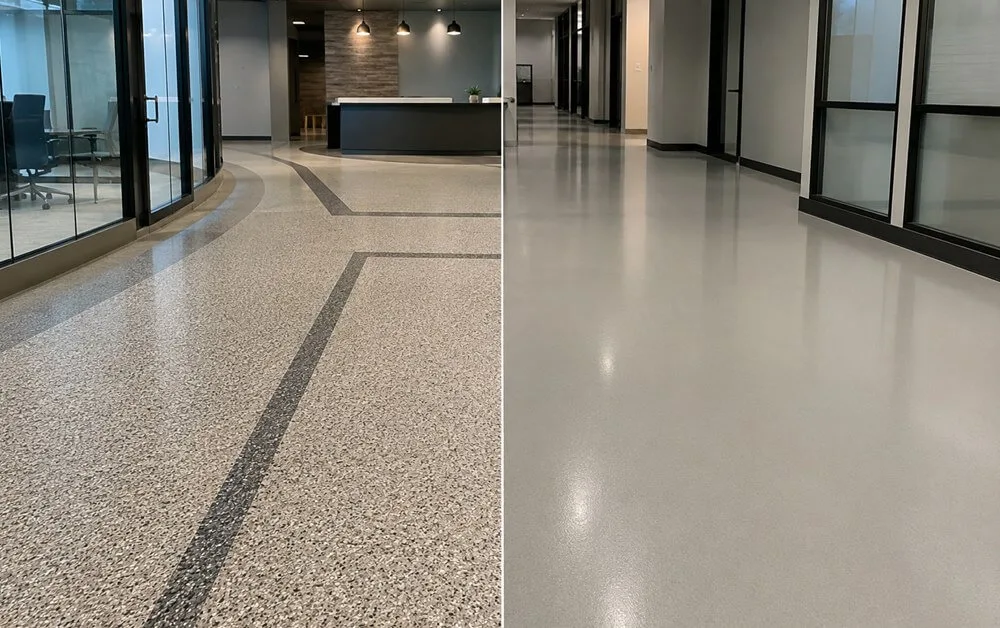
Robust Epoxy Colored Sand Flooring – Decorative & Heavy-Duty Flooring System
Premium Epoxy Colored Sand Flooring
Epoxy Colored Sand Flooring is a durable, decorative, and high-performance flooring system designed to provide an attractive finish along with excellent mechanical strength. It combines high-quality epoxy resin with specially selected colored aggregate or sand to create a textured, slip-resistant, and visually appealing floor surface.
This flooring system is suitable for commercial, industrial, residential, retail, showroom, warehouse, workshop, garage, and other high-traffic areas where both appearance and long-term performance are important.
Strong, Durable & Decorative Surface
The combination of epoxy resin and colored sand creates a tough flooring surface that can withstand regular foot traffic, equipment movement, abrasion, and everyday wear. The decorative colored aggregate also helps produce a unique flooring appearance that can be customized according to the project requirements.
Epoxy Colored Sand Flooring can be designed in different colors, patterns, and textures, making it suitable for projects where a functional floor is required without compromising on visual appeal.
Key Features of Epoxy Colored Sand Flooring
- High mechanical strength and durability.
- Attractive decorative colored finish.
- Excellent abrasion resistance.
- Good resistance to everyday chemical exposure.
- Slip-resistant textured surface.
- Easy to clean and maintain.
- Suitable for medium to heavy traffic areas.
- Seamless and hygienic flooring finish.
- Available in different colors and aggregate combinations.
- Helps improve the appearance of old or worn concrete floors.
- Suitable for commercial and industrial applications.
Applications
Epoxy Colored Sand Flooring can be used in a wide range of environments, including:
- Industrial floors.
- Warehouses and storage areas.
- Workshops and garages.
- Showrooms and retail stores.
- Commercial buildings.
- Offices and corridors.
- Restaurants and service areas.
- Residential garages.
- Schools and institutional buildings.
- Production and utility areas.
- Walkways and high-traffic zones.
What Is Epoxy Color Sand Self-Leveling Flooring?
A Simple Definition
- Epoxy-based: A two-component epoxy system forms the cured flooring layer.
- Decorative colored sand: Fine colored sand and mineral materials create color, texture, and a marble-like appearance.
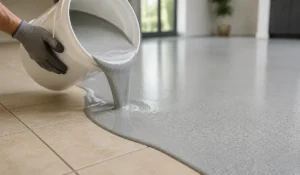
- Self-leveling: After the material is mixed, poured, and spread, it continues to flow and settle into a smooth surface.
What Are Part A and Part B?
How Does Self-Leveling Work?
- Inspect and prepare the existing floor.
- Mix the complete Part A and Part B components.
- Pour the mixed material onto the substrate.
- Spread it evenly with a notched trowel or suitable long-handled spreading tool.
- Allow the material to flow and level.
- Protect the floor while it cures.
What Does “Seamless Flooring” Mean?
- A more continuous appearance
- Fewer visible joint lines
- Easier routine cleaning
- A consistent decorative finish
- A marble-like or finely speckled surface
Can It Be Applied Directly Over Existing Tiles?
- Firmly bonded
- Structurally stable
- Clean and dry
- Free from oil, wax, dust, and contaminants
- Properly mechanically prepared
- Free from unresolved movement or moisture problems
Does It Require a Primer?
- Mechanical grinding
- Dust removal
- Oil and wax removal
- Crack repair
- Repairing loose tiles
- Correcting major unevenness
- Checking substrate moisture
Can It Be Applied Over Concrete and Terrazzo?
What Is the Recommended Thickness?
- Application thickness
- Surface roughness
- Existing tile joints
- Floor flatness
- Local repairs
- Normal installation loss
How Is It Different from Other Epoxy Products?
|
Product
|
Main characteristic
|
Typical use
|
|---|---|---|
|
Epoxy color sand self-leveling
|
Epoxy resin combined with fine decorative colored sand
|
Seamless decorative floor renovation
|
|
Conventional self-leveling epoxy
|
Usually creates a smooth, uniform resin surface
|
Commercial and industrial floors
|
|
Epoxy terrazzo
|
Uses larger decorative aggregates and may require grinding and polishing
|
Premium terrazzo-style surfaces
|
|
Epoxy tile grout
|
Fills individual tile joints
|
Tile-joint filling and renovation
|
What Does the Finished Floor Look Like?
- Marble-like
- Finely speckled
- Smooth and continuous
- Glossy, satin, or matte
- Neutral or strongly colored
How Strong Is the Cured Material?
- Mohs hardness: Level 8
- Compressive strength: ≥80 MPa
- Solid content: approximately 98%
- VOC content: 16 g/L
- Surface dry time: 4–6 hours
- Hard dry time: 24 hours
Where Can Epoxy Color Sand Flooring Be Used?
- Residential floor renovation
- Garages
- Retail stores
- Showrooms
- Hotels
- Offices
- Workshops
- Warehouses
- Schools
- Hospital circulation areas
- Commercial and suitable industrial spaces
Professional Flooring Solution
A properly prepared concrete substrate is essential for achieving a strong and long-lasting epoxy flooring system. The floor should be clean, dry, sound, and free from oil, grease, dust, loose particles, and other contaminants before application.
Depending on the required finish and project conditions, the system may include surface preparation, primer, epoxy resin, colored sand or aggregate, and a suitable protective topcoat.
Why Choose Epoxy Colored Sand Flooring?
Epoxy Colored Sand Flooring provides a practical combination of durability, decorative appearance, easy maintenance, and surface protection. It is particularly useful for customers who want a stronger alternative to conventional painted floors while also achieving a textured and attractive finish.
For industrial, commercial, and decorative flooring projects, the system can be customized according to the required color, texture, thickness, traffic conditions, and application environment.
Conclusion
Epoxy Colored Sand Flooring is a versatile flooring solution for creating a durable, attractive, and easy-to-maintain surface. Its combination of epoxy resin and colored aggregate provides both functional performance and decorative appeal, making it suitable for a variety of commercial, industrial, and residential flooring applications.
For professional flooring installation, the final system specification should be selected according to the substrate condition, expected traffic, chemical exposure, slip-resistance requirements, and project environment.
Epoxy Colored Sand Flooring – Decorative, Durable & Heavy-Duty Flooring System
What Is Epoxy Colored Sand Flooring?
Epoxy Colored Sand Flooring is a high-performance decorative flooring system that combines durable epoxy resin with specially selected colored quartz sand or decorative aggregate. The system creates a strong, textured, attractive, and wear-resistant surface that can be used in residential, commercial, industrial, institutional, and high-traffic environments.
Unlike ordinary floor paint, which mainly provides a thin protective coating, an epoxy colored sand system can provide a more substantial flooring build-up with decorative aggregate embedded within the resin matrix. This produces a distinctive textured appearance while improving surface durability and traction.
The flooring can be designed in a variety of colors and aggregate combinations to meet architectural and functional requirements. Depending on the project, the finished surface can be specified with different textures, thicknesses, aggregate sizes, and levels of slip resistance.
Premium Decorative Epoxy Flooring Solution
Modern flooring is expected to provide more than just a finished appearance. It should withstand regular traffic, cleaning, abrasion, impact, and the demanding conditions of the area where it is installed.
Epoxy Colored Sand Flooring is designed to address these requirements by combining the adhesion and chemical resistance of epoxy resin with the decorative and textured properties of colored sand or aggregate.
The result is a professional-looking floor that can help transform plain concrete surfaces into attractive and functional flooring areas.
Main Components of the Flooring System
A typical Epoxy Colored Sand Flooring system may consist of several layers, depending on the required performance and site conditions.
1. Concrete Surface
The existing concrete or cementitious substrate provides the foundation of the flooring system. The substrate should have sufficient strength and should be properly prepared before application.
2. Epoxy Primer
An epoxy primer may be applied to improve adhesion between the concrete substrate and subsequent flooring layers. It can also help consolidate the prepared surface and provide a suitable base for the epoxy system.
3. Epoxy Resin Layer
The epoxy resin acts as the binding component of the system. It surrounds and bonds the colored aggregate to create a durable flooring surface.
4. Colored Sand or Decorative Aggregate
Specially selected colored sand, quartz, or decorative aggregate is incorporated into the flooring system. The aggregate provides the characteristic decorative appearance and textured surface.
5. Protective Topcoat
Where required, a compatible clear or pigmented epoxy or polyurethane topcoat can be applied to improve protection, cleanability, appearance, and resistance to regular wear.
The exact layer configuration should be selected according to the intended application and site conditions.
Key Features of Epoxy Colored Sand Flooring
High Durability
The epoxy binder creates a strong surface capable of handling regular pedestrian and commercial traffic. With correct substrate preparation and application, the system can provide long-term service performance.
Decorative Appearance
Colored sand and decorative aggregate allow designers and contractors to create visually attractive floors. Different aggregate colors can be combined to produce customized finishes suitable for modern architectural spaces.
Textured Surface
The aggregate produces a textured finish that can provide better traction than a smooth floor, particularly when the system is correctly specified for the environmental conditions.
Abrasion Resistance
Epoxy flooring systems are commonly selected for areas where the floor is exposed to repeated foot traffic, wheeled movement, and general wear.
Easy Maintenance
A properly finished epoxy colored sand floor can be relatively easy to clean and maintain. Its sealed surface can reduce the accumulation of dirt compared with heavily porous unfinished concrete.
Chemical Resistance
Depending on the specific epoxy formulation and final system design, epoxy flooring can provide resistance to various commonly encountered chemicals. Chemical compatibility should always be confirmed for aggressive or specialized chemical exposure.
Seamless Finish
When properly installed, resin-based flooring can provide a continuous surface with minimal joints. This can create a clean and professional appearance and simplify routine cleaning.
Slip-Resistant Flooring Option
One of the important advantages of incorporating aggregate into a resin flooring system is the ability to create a textured sur
Epoxy Colored Sand Flooring – Decorative & Heavy-Duty Flooring System
Premium Epoxy Colored Sand Flooring
Epoxy Colored Sand Flooring is a durable, decorative, and high-performance flooring system designed to provide an attractive finish along with excellent mechanical strength. It combines high-quality epoxy resin with specially selected colored aggregate or sand to create a textured, slip-resistant, and visually appealing floor surface.
This flooring system is suitable for commercial, industrial, residential, retail, showroom, warehouse, workshop, garage, and other high-traffic areas where both appearance and long-term performance are important.
Strong, Durable & Decorative Surface
The combination of epoxy resin and colored sand creates a tough flooring surface that can withstand regular foot traffic, equipment movement, abrasion, and everyday wear. The decorative colored aggregate also helps produce a unique flooring appearance that can be customized according to the project requirements.
Epoxy Colored Sand Flooring can be designed in different colors, patterns, and textures, making it suitable for projects where a functional floor is required without compromising on visual appeal.
Key Features of Epoxy Colored Sand Flooring
- High mechanical strength and durability.
- Attractive decorative colored finish.
- Excellent abrasion resistance.
- Good resistance to everyday chemical exposure.
- Slip-resistant textured surface.
- Easy to clean and maintain.
- Suitable for medium to heavy traffic areas.
- Seamless and hygienic flooring finish.
- Available in different colors and aggregate combinations.
- Helps improve the appearance of old or worn concrete floors.
- Suitable for commercial and industrial applications.
Applications
Epoxy Colored Sand Flooring can be used in a wide range of environments, including:
- Industrial floors.
- Warehouses and storage areas.
- Workshops and garages.
- Showrooms and retail stores.
- Commercial buildings.
- Offices and corridors.
- Restaurants and service areas.
- Residential garages.
- Schools and institutional buildings.
- Production and utility areas.
- Walkways and high-traffic zones.
Professional Flooring Solution
A properly prepared concrete substrate is essential for achieving a strong and long-lasting epoxy flooring system. The floor should be clean, dry, sound, and free from oil, grease, dust, loose particles, and other contaminants before application.
Depending on the required finish and project conditions, the system may include surface preparation, primer, epoxy resin, colored sand or aggregate, and a suitable protective topcoat.
Why Choose Epoxy Colored Sand Flooring?
Epoxy Colored Sand Flooring provides a practical combination of durability, decorative appearance, easy maintenance, and surface protection. It is particularly useful for customers who want a stronger alternative to conventional painted floors while also achieving a textured and attractive finish.
For industrial, commercial, and decorative flooring projects, the system can be customized according to the required color, texture, thickness, traffic conditions, and application environment.
Conclusion
Epoxy Colored Sand Flooring is a versatile flooring solution for creating a durable, attractive, and easy-to-maintain surface. Its combination of epoxy resin and colored aggregate provides both functional performance and decorative appeal, making it suitable for a variety of commercial, industrial, and residential flooring applications.
For professional flooring installation, the final system specification should be selected according to the substrate condition, expected traffic, chemical exposure, slip-resistance requirements, and project environment.