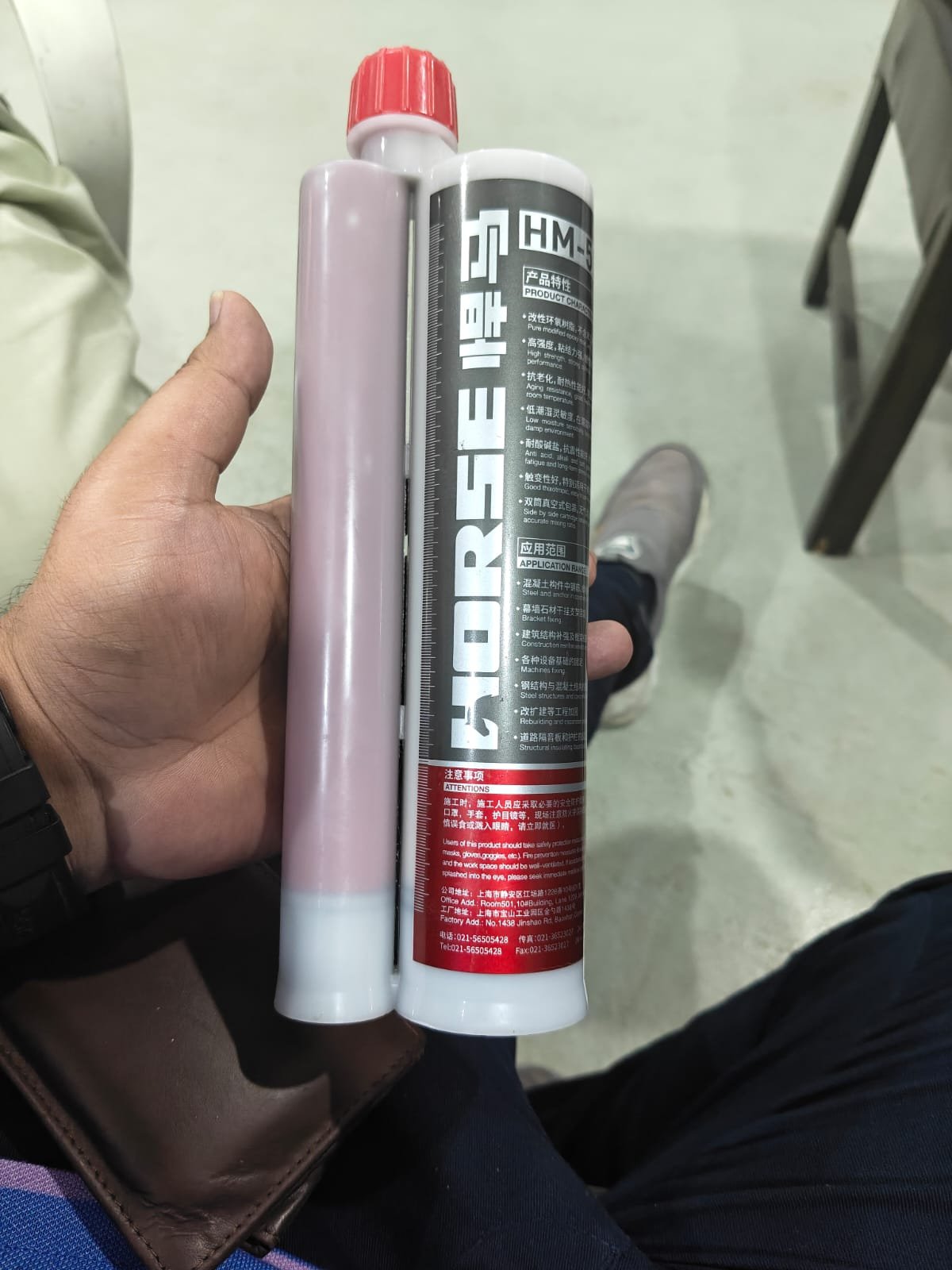
Steel Anchoring Epoxy Tube – High-Strength Chemical Anchoring Adhesive
What Is Steel Anchoring Epoxy Tube?
Steel Anchoring Epoxy Tube is a high-performance two-component chemical anchoring adhesive designed for securely fixing steel rods, threaded rods, rebars, bolts, studs, and other metal elements into concrete and masonry substrates.
The epoxy adhesive is supplied in a convenient cartridge or tube system containing resin and hardener components. When dispensed through a suitable mixing nozzle, the components are thoroughly mixed and form a strong bonding material that fills the space between the steel anchor and the drilled hole.
After curing, the hardened epoxy creates a strong mechanical and chemical bond between the embedded steel element and the surrounding substrate.
High-Strength Chemical Anchoring Solution
Traditional mechanical anchors rely primarily on expansion forces to grip the concrete. Chemical anchoring systems work differently by bonding the embedded steel element to the substrate.
Steel Anchoring Epoxy Tube can be used where engineers and contractors require reliable anchoring performance without relying solely on mechanical expansion.
It is suitable for many new construction, repair, strengthening, retrofit, and installation applications.
Main Applications
Steel Anchoring Epoxy Tube can be used for:
- Rebar doweling.
- Threaded rod anchoring.
- Steel plate fixing.
- Structural steel connections.
- Base plate installation.
- Machinery anchoring.
- Handrail fixing.
- Guardrail installation.
- Bracket installation.
- Pipe support anchoring.
- Cable tray supports.
- Equipment supports.
- Facade and frame connections.
- Concrete reinforcement connections.
- Construction and renovation projects.
Anchoring Steel Rods & Threaded Rods
One of the primary applications of chemical anchoring epoxy is fixing steel rods into concrete.
A correctly drilled and cleaned hole is filled with the specified amount of epoxy adhesive. The steel rod or threaded anchor is then inserted using the required installation procedure.
As the adhesive cures, it bonds the steel element to the surrounding substrate, creating a secure anchoring connection.
The required hole diameter, embedment depth, edge distance, spacing, curing time, and allowable load should always be determined according to the product’s technical data and the design requirements.
Two-Component Epoxy Technology
Steel Anchoring Epoxy Tube typically contains two separate components:
Component A – Epoxy Resin
The resin provides the primary bonding properties and forms the structural adhesive matrix.
Component B – Hardener
The hardener initiates the curing reaction when mixed with the resin.
When both components pass through the static mixing nozzle, they are combined in the correct proportion and become ready for installation.
This cartridge-based delivery method helps provide consistent mixing and convenient application when the appropriate dispensing equipment is used.
Key Features
Strong Bonding Performance
The cured epoxy can provide strong adhesion between steel anchors and suitable concrete substrates.
Convenient Application
The tube or cartridge format makes the product practical for controlled job-site application, particularly when used with a compatible dispensing gun and mixing nozzle.
Low Expansion Anchoring
Unlike many expansion anchors, chemical anchoring systems do not depend on mechanical expansion pressure for their primary bond. This can be useful where reduced expansion forces are desirable, subject to engineering design.
Versatile Applications
The system can be used for a variety of steel anchoring and construction fixing applications.
Suitable for Construction & Repair
It can be incorporated into new construction, structural repair, renovation, retrofit, and reinforcement work where chemical anchoring is specified.
Advantages of Chemical Anchoring
Chemical anchoring can offer several benefits when correctly designed and installed.
These may include:
- Strong adhesion to suitable substrates.
- Reduced reliance on expansion forces.
- Flexible anchor positioning.
- Suitable for close-to-edge applications when properly designed.
- Useful for post-installed reinforcement.
- Suitable for threaded rods and steel bars.
- Controlled installation process.
- Professional cartridge-based application.
- Suitable for many concrete repair and retrofit applications.
Actual performance depends on the substrate, anchor type, embedment depth, hole preparation, temperature, curing conditions, and product formulation.
Suitable Substrates
Depending on the product specification, Steel Anchoring Epoxy Tube may be suitable for anchoring into:
- Normal concrete.
- Reinforced concrete.
- Precast concrete.
- Solid masonry.
- Selected stone substrates.
The substrate must have sufficient strength and stability for the intended application.
The product should not automatically be assumed suitable for hollow or weak substrates unless specifically approved by the manufacturer’s technical documentation.
Installation Procedure
Step 1 – Mark the Anchor Position
Mark the exact location where the steel rod, threaded rod, rebar, or anchor is required.
Step 2 – Drill the Hole
Drill the hole to the specified diameter and depth using suitable equipment.
The hole dimensions should follow the product’s technical documentation and the engineer’s design requirements.
Step 3 – Clean the Hole Thoroughly
Hole cleaning is critical to anchoring performance.
Remove drilling dust and loose particles using an appropriate cleaning procedure, such as brushing and air cleaning, according to the manufacturer’s instructions.
Step 4 – Prepare the Epoxy Cartridge
Install the epoxy cartridge into the compatible dispensing gun and attach the correct static mixing nozzle.
Step 5 – Dispense the Material
Dispense the required amount of mixed epoxy into the prepared hole according to the installation instructions.
Avoid leaving voids or air pockets.
Step 6 – Insert the Steel Anchor
Insert the threaded rod, rebar, steel rod, or anchor into the adhesive using the specified movement and embedment depth.
Step 7 – Allow the Adhesive to Cure
The anchor must remain undisturbed during the required curing period.
Curing time depends on the product formulation and temperature.
Step 8 – Apply the Load
Do not load the anchor until the adhesive has reached the required curing condition.
The allowable load should be determined from the manufacturer’s technical data and the structural design.
Importance of Hole Cleaning
Proper hole cleaning is one of the most important factors in chemical anchoring.
Dust and drilling debris can form a weak layer between the epoxy and concrete, reducing effective bonding.
For this reason, installers should follow the specified cleaning sequence carefully rather than simply blowing out visible dust.
Steel Rebar & Post-Installed Reinforcement
Steel Anchoring Epoxy Tube can also be used for selected post-installed rebar applications where the product has been specifically designed and approved for that purpose.
Post-installed reinforcement can be used in certain construction and strengthening applications, such as connecting new concrete to existing concrete.
Because these applications can be structurally significant, the required embedment depth, bar diameter, spacing, concrete strength, development length, and design loads should be determined by a qualified engineer.
Threaded Rod Anchoring
Chemical epoxy anchoring is commonly used for installing threaded rods into concrete.
Threaded rods can be used for attaching:
- Steel brackets.
- Equipment.
- Supports.
- Frames.
- Cable trays.
- Pipe supports.
- Handrails.
- Structural components.
The correct anchor diameter and embedment depth should be selected according to the required load and engineering design.
Applications in Structural Repair
Chemical anchoring can be useful in repair and retrofit projects where new steel elements need to be connected to existing concrete.
Potential applications include:
- Structural strengthening.
- Steel plate installation.
- Beam and column connections.
- Support brackets.
- Reinforcement dowels.
- Extension of concrete elements.
- Retrofit construction.
Structural applications should always be designed and approved by an appropriately qualified professional.
Performance Factors
The performance of a chemical anchor depends on several factors, including:
- Concrete strength.
- Hole diameter.
- Embedment depth.
- Anchor diameter.
- Anchor material.
- Hole cleanliness.
- Installation temperature.
- Curing temperature.
- Moisture conditions.
- Edge distance.
- Anchor spacing.
- Applied load.
- Quality of installation.
For this reason, simply selecting a high-strength adhesive is not enough. Correct engineering design and installation are equally important.
Where Steel Anchoring Epoxy Tube Can Be Used
This product can be considered for projects such as:
Construction Projects
For fixing steel components, reinforcing bars, threaded rods, brackets, and supports.
Industrial Facilities
For anchoring equipment, machinery supports, steel frames, and service installations.
Commercial Buildings
For fixing handrails, brackets, frames, signs, supports, and other building components.
Infrastructure Projects
For selected concrete anchoring, strengthening, repair, and retrofit applications.
Residential Projects
For suitable anchoring requirements involving railings, brackets, supports, and other steel fixtures.
Storage & Handling
The epoxy cartridge should be stored according to the manufacturer’s recommended temperature and storage conditions.
Keep the product protected from excessive heat, direct sunlight, contamination, and freezing conditions where applicable.
Always check the product label, technical data sheet, shelf life, and storage requirements before use.
Safety Precautions
Use appropriate personal protective equipment during installation, including suitable gloves and eye protection.
Avoid unnecessary skin and eye contact with uncured resin components.
Ensure adequate ventilation where required.
Follow the manufacturer’s safety data sheet and installation instructions.
Why Choose Steel Anchoring Epoxy Tube?
Steel Anchoring Epoxy Tube provides a practical chemical anchoring solution for contractors, builders, engineers, fabricators, and construction professionals who require reliable bonding between steel anchors and suitable concrete substrates.
Its cartridge-based design allows controlled dispensing and mixing, while the cured epoxy provides a strong adhesive connection when the system is correctly specified and installed.
Conclusion
Steel Anchoring Epoxy Tube is a versatile chemical anchoring adhesive for fixing steel rods, threaded rods, rebars, bolts, studs, brackets, and other metal elements into suitable concrete and masonry substrates.
Its two-component epoxy technology provides strong bonding performance without depending primarily on mechanical expansion.
For best results, the substrate should be properly assessed, holes should be drilled and cleaned according to the manufacturer’s instructions, the correct anchor dimensions should be selected, and sufficient curing time should be allowed before loading.
For structural and heavy-load applications, anchoring design should always be based on the applicable engineering requirements and the manufacturer’s technical documentation.
High-strength chemical anchoring system for securely fixing steel bars, threaded rods, bolts, and structural components into concrete and masonry.
High-strength chemical anchoring system for securely fixing steel bars, threaded rods, bolts, and structural components into concrete and masonry.
Steel Anchoring Epoxy Tube – Professional Chemical Anchor Adhesive for Concrete & Steel Fixing
Advanced Steel Anchoring Epoxy Tube
Steel Anchoring Epoxy Tube is a professional-grade two-component chemical anchoring adhesive developed for high-strength fixing of steel rods, threaded rods, rebars, bolts, studs, brackets, and other metal components into concrete and suitable masonry substrates.
The product is supplied in a convenient cartridge or tube format that allows the resin and hardener components to be dispensed and mixed through a static mixing nozzle. Once thoroughly mixed and installed into a properly prepared anchoring hole, the epoxy cures to form a strong adhesive bond around the embedded steel element.
This type of chemical anchoring system is widely used for construction, renovation, repair, structural connections, equipment installation, and post-installed reinforcement applications where a reliable connection between an anchor and substrate is required.
High-Performance Chemical Anchoring System
Steel Anchoring Epoxy Tube provides an alternative to conventional mechanical expansion anchors in applications where an adhesive anchoring system is specified.
Instead of depending primarily on mechanical expansion, the epoxy transfers load between the embedded steel element and the surrounding substrate through the cured adhesive and the prepared anchoring interface.
This can make chemical anchoring particularly useful for applications where engineers need controlled embedment and where expansion forces need to be considered carefully.
The final anchoring capacity is not determined by the adhesive alone. Concrete strength, anchor diameter, embedment depth, edge distance, spacing, hole preparation, installation temperature, curing, and applied loads all affect the performance of the completed connection.
Two-Component Epoxy Adhesive Technology
The Steel Anchoring Epoxy Tube contains two separate components that remain isolated until application.
Epoxy Resin Component
The resin component forms the primary adhesive matrix and provides bonding characteristics after curing.
Hardener Component
The hardener initiates the chemical curing reaction when combined with the resin.
Static Mixing System
During application, both components pass through a static mixer. The internal mixing elements blend the materials before they enter the drilled hole.
This cartridge system provides a practical method for delivering freshly mixed adhesive directly into the anchoring hole.
Where Steel Anchoring Epoxy Is Used
Steel Anchoring Epoxy Tube can be used for many construction and installation requirements, including:
- Steel rod anchoring.
- Threaded rod installation.
- Rebar doweling.
- Reinforcement connections.
- Steel plate fixing.
- Base plate anchoring.
- Equipment mounting.
- Machinery support fixing.
- Bracket installation.
- Handrail anchoring.
- Guardrail installation.
- Pipe support installation.
- Cable tray supports.
- Structural steel connections.
- Concrete repair work.
- Retrofit construction.
- Construction extensions.
- Selected facade fixing applications.
The exact application should always match the product’s technical approval and intended use.
Steel Rebar Anchoring
One important application of chemical anchoring epoxy is post-installed reinforcement.
A steel reinforcing bar can be installed into an existing concrete element using a suitable chemical anchoring system where the application has been properly designed.
This can be useful in selected construction and repair situations where new reinforcement needs to connect with an existing concrete structure.
Examples may include:
- Concrete extensions.
- Structural modifications.
- Reinforcement doweling.
- Repair and strengthening work.
- New-to-existing concrete connections.
- Retrofit construction.
Because post-installed reinforcement can be structurally critical, the required bar diameter, embedment, spacing, concrete condition, development length, and design loads should be established by a qualified structural engineer.
Threaded Rod Chemical Anchoring
Threaded rods are commonly used with chemical anchoring systems for attaching components to concrete.
Depending on the project, threaded rods can be used for:
- Steel brackets.
- Pipe supports.
- HVAC supports.
- Cable trays.
- Machinery supports.
- Equipment frames.
- Handrails.
- Guardrails.
- Signage supports.
- Service installations.
After the epoxy has cured, the threaded rod can be connected to the required component using a suitable nut, washer, plate, or bracket.
Strong Bond Between Steel & Concrete
The objective of a chemical anchoring system is to create a continuous bonded interface between the steel anchor and the surrounding substrate.
When the hole is correctly drilled, cleaned, filled, and the anchor is properly installed, the cured adhesive can provide a strong connection.
However, anchoring strength should never be assumed solely from the adhesive’s nominal strength. The complete anchor system must be evaluated according to the design requirements.
Reduced Expansion Forces
Mechanical expansion anchors can generate expansion pressure within the surrounding concrete.
Chemical anchors work through an adhesive bond rather than relying primarily on expansion.
This characteristic can be advantageous in certain applications, particularly where the anchor layout, edge distances, or substrate conditions make expansion forces an important consideration.
The suitability of the system must still be verified for the particular concrete condition and loading requirements.
Suitable for Renovation & Retrofit Projects
Steel Anchoring Epoxy Tube can be particularly useful during renovation and retrofit work.
Existing buildings often require new brackets, supports, reinforcement, equipment, or steel components to be connected to existing concrete.
Chemical anchoring provides a practical method for creating post-installed connections where appropriate.
Potential applications include:
- Building renovation.
- Industrial plant upgrades.
- Structural modifications.
- Equipment replacement.
- Concrete strengthening.
- New service installations.
- Retrofit steelwork.
Concrete Surface Requirements
The concrete substrate should be sufficiently strong, stable, and suitable for the intended load.
Before installation, the installer should inspect the substrate for:
- Cracks.
- Weak concrete.
- Voids.
- Honeycombing.
- Excessive moisture.
- Contamination.
- Loose material.
- Reinforcement conflicts.
- Previous repairs.
Where significant substrate defects exist, they should be addressed before anchoring.
Correct Hole Drilling
Hole dimensions are extremely important in chemical anchoring.
The hole diameter and embedment depth should correspond to the approved installation requirements for the selected anchor diameter and adhesive system.
An incorrectly sized hole can affect adhesive coverage and the performance of the finished anchor.
For critical applications, drilling should be controlled carefully to achieve the specified depth and diameter.
Hole Cleaning – A Critical Step
A chemical anchor can only perform as intended if the adhesive is properly bonded to the substrate.
Drilling creates dust and loose particles inside the hole. If this material remains in place, it can interfere with adhesive contact.
The hole should therefore be cleaned according to the manufacturer’s specified procedure.
Depending on the approved installation method, cleaning may involve:
- Brushing the hole with the correct brush size.
- Removing dust using suitable air-cleaning equipment.
- Repeating the cleaning sequence as required.
- Inspecting the hole before adhesive injection.
For critical anchoring applications, installers should follow the exact manufacturer’s hole-cleaning instructions rather than using an improvised procedure.
Professional Installation Procedure
1. Mark the Location
Mark the exact position of the required steel anchor.
2. Check for Obstructions
Before drilling, check the area for existing reinforcement, embedded services, conduits, pipes, or electrical installations where applicable.
3. Drill the Hole
Drill the hole to the required diameter and embedment depth.
4. Clean the Hole
Remove drilling dust and loose material using the specified cleaning procedure.
5. Prepare the Cartridge
Install the epoxy cartridge into the compatible dispensing gun.
6. Attach the Mixing Nozzle
Fit the correct static mixing nozzle securely to the cartridge.
7. Purge Initial Material
Dispense the initial material according to the manufacturer’s instructions until the adhesive is properly mixed and uniform.
8. Inject the Epoxy
Fill the prepared hole with the required amount of mixed adhesive.
9. Insert the Anchor
Insert the steel rod, threaded rod, rebar, or other approved anchor to the specified embedment depth.
The anchor should be installed using the recommended method to ensure proper adhesive coverage.
10. Allow Curing
Leave the anchor undisturbed for the specified curing period.
Curing time depends on the adhesive formulation and temperature.
11. Install the Fixture
After the required cure has been achieved, install the bracket, plate, nut, washer, or other fixture.
12. Apply the Design Load
The anchor should only be loaded in accordance with the manufacturer’s specified curing conditions and engineering design.
Temperature & Curing
Temperature can significantly affect epoxy curing.
At lower temperatures, the curing reaction can slow down. At higher temperatures, working time may decrease while curing can occur more quickly.
For this reason, installers should always check the product’s technical documentation for:
- Working time.
- Gel time.
- Initial curing time.
- Final curing time.
- Minimum application temperature.
- Maximum application temperature.
- Substrate temperature requirements.
Do not assume that the same curing time applies under all weather conditions.
Applications in Industrial Construction
Steel Anchoring Epoxy Tube can be useful in industrial environments for fixing:
- Machinery bases.
- Steel supports.
- Equipment brackets.
- Pipe racks.
- Cable management systems.
- Service supports.
- Maintenance structures.
- Steel frames.
Heavy machinery and structural applications require proper engineering calculations and should not be based on adhesive selection alone.
Applications in Commercial Buildings
For commercial construction, chemical anchoring can be used for suitable:
- Handrails.
- Guardrails.
- Sign supports.
- Equipment brackets.
- HVAC supports.
- Electrical supports.
- Steel frames.
- Service installations.
The required anchor capacity should be determined according to the actual load and substrate conditions.
Applications in Residential Construction
For residential construction, Steel Anchoring Epoxy Tube can be used for suitable fixing requirements such as:
- Railings.
- Metal brackets.
- Equipment supports.
- Shelving supports.
- Gate supports.
- Utility fixtures.
- Selected structural connections.
Always ensure the substrate is appropriate and the anchor is correctly designed for the intended load.
Advantages of Steel Anchoring Epoxy Tube
High Bonding Capability
The cured adhesive can create a strong connection between compatible steel anchors and concrete.
Convenient Cartridge Packaging
The cartridge format simplifies controlled dispensing and reduces the need for manual component mixing.
Professional Installation
The static mixing nozzle provides a consistent method for combining the resin and hardener immediately before application.
Versatile Anchor Types
Depending on the product approval, it may be used with different steel anchoring elements, including threaded rods and reinforcing bars.
Useful for Retrofit Work
It provides a practical option for selected post-installed connections in existing concrete.
No Primary Mechanical Expansion
The system does not depend primarily on expansion pressure, making it suitable for applications where chemical anchoring is specifically designed.
Important Design Considerations
Before selecting a chemical anchoring system, consider:
- Anchor diameter.
- Anchor grade.
- Concrete strength.
- Embedment depth.
- Hole diameter.
- Edge distance.
- Anchor spacing.
- Applied tension load.
- Applied shear load.
- Combined loading.
- Concrete thickness.
- Installation temperature.
- Moisture conditions.
- Required fire performance.
- Chemical exposure.
- Long-term environmental conditions.
For structural anchoring, these factors should be evaluated by a qualified engineer using applicable design standards and the manufacturer’s approved technical data.
Quality Installation Matters
Even a high-performance epoxy cannot compensate for poor installation.
Common installation problems can include:
- Inadequate hole cleaning.
- Incorrect hole diameter.
- Insufficient embedment.
- Incorrect adhesive mixing.
- Premature loading.
- Contaminated substrate.
- Incorrect anchor placement.
- Failure to observe curing conditions.
Professional installation is therefore an essential part of the complete chemical anchoring system.
Storage & Shelf Life
Store Steel Anchoring Epoxy Tube according to the manufacturer’s recommendations.
The cartridges should generally be kept in their original packaging and protected from excessive heat, direct sunlight, moisture, contamination, and unsuitable temperatures.
Always check the printed expiry date and product documentation before use.
Do not use expired or visibly damaged cartridges for critical applications.
Safety Information
Wear appropriate personal protective equipment when handling and installing epoxy anchoring materials.
Recommended precautions may include:
- Protective gloves.
- Safety glasses.
- Suitable work clothing.
- Adequate ventilation.
- Appropriate respiratory protection where required by the safety documentation.
Avoid contact with uncured adhesive.
Always read the product Safety Data Sheet and technical documentation before installation.
Why Choose Robust Steel Anchoring Epoxy Tube?
Robust Steel Anchoring Epoxy Tube is positioned as a professional chemical anchoring solution for construction contractors, engineers, fabricators, installers, and maintenance professionals.
It is designed to provide a convenient cartridge-based method for installing steel anchors into suitable concrete and masonry substrates.
For building construction, renovation, repair, equipment installation, and selected structural applications, the system can provide a practical alternative to conventional mechanical fixing methods when properly designed and installed.
Conclusion
Steel Anchoring Epoxy Tube is a professional two-component chemical anchoring adhesive for fixing steel rods, threaded rods, rebars, bolts, studs, brackets, and other metal components into suitable concrete substrates.
Its epoxy-based bonding technology provides a strong connection without relying primarily on mechanical expansion. The cartridge system also provides convenient application through a compatible dispensing gun and static mixing nozzle.
For reliable performance, the complete installation process is important. Correct drilling, thorough hole cleaning, accurate adhesive dispensing, proper anchor insertion, suitable curing conditions, and appropriate engineering design all contribute to the final performance of the anchor.
For structural, heavy-load, or safety-critical applications, the anchoring system should be selected and designed according to the manufacturer’s technical documentation and applicable engineering requirements.