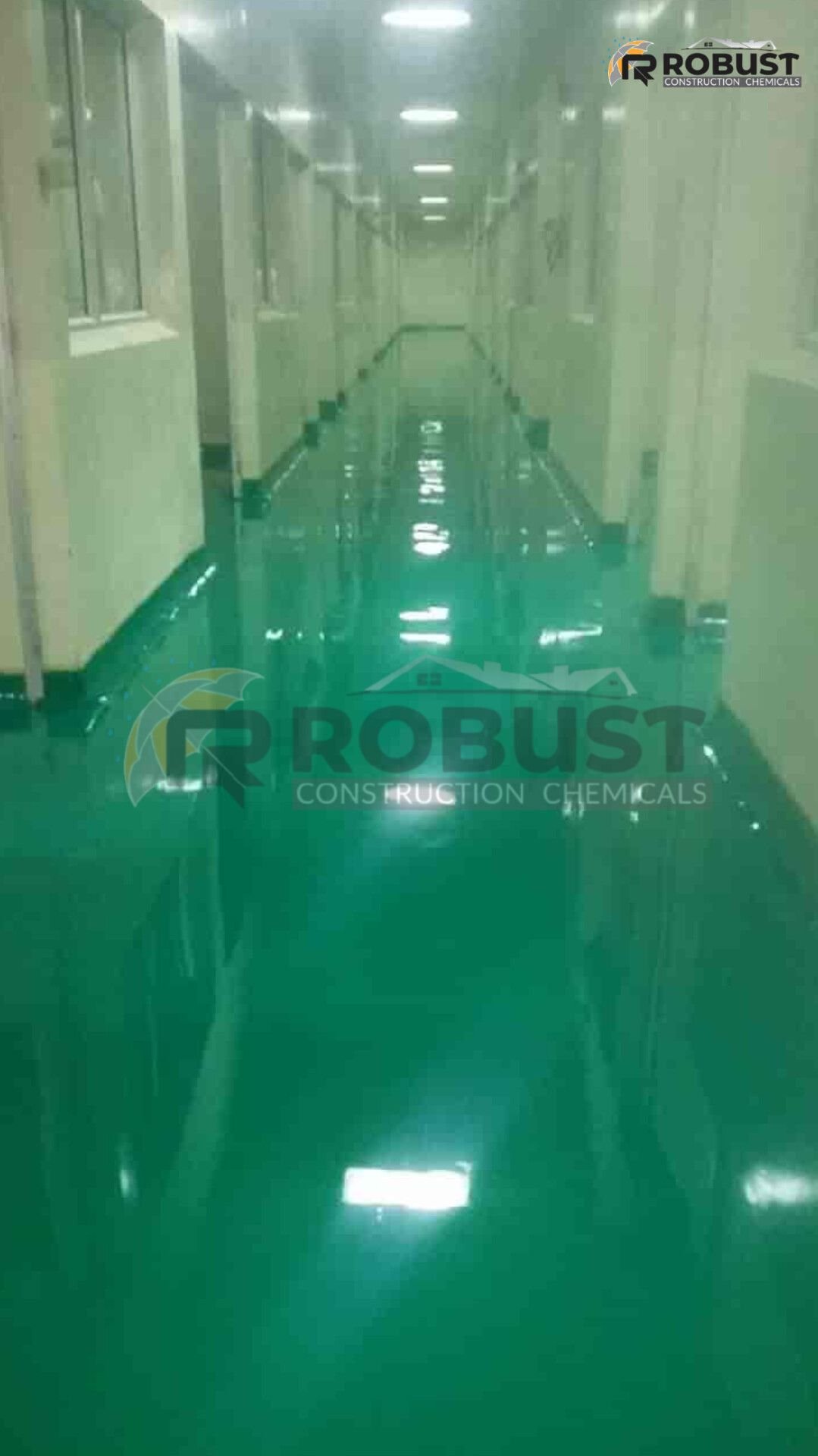
Robust Epoxy Flooring: Complete Technical Specifications, System Grades, BOQ Coverage, Installation Guide & 2026 Price in Pakistan
Robust Epoxy Flooring is a heavy-duty, two-component, 100%-solids thermosetting resin flooring system engineered to transform bare industrial concrete slabs into seamless, ultra-durable, hygienic, and chemical-resistant working surfaces. Formulated by cross-linking high-purity bisphenol-A/F epoxy resin (Part A) with a modified cycloaliphatic/polyamide amine hardener (Part B), Robust Epoxy Flooring bonds chemically and mechanically into the concrete substrate—delivering compressive strengths up to 85 N/mm² (12,300+ psi), zero-dust cleanliness, and resistance against heavy forklift traffic, hydraulic oils, acids, alkalis, and continuous washdowns.
1. Robust Epoxy Flooring System Grades (Choose by Facility Duty)
Different industrial and commercial facilities require different dry film thicknesses (DFT) and surface profiles. Robust Epoxy Flooring is engineered in four distinct system builds:
| System Grade | Total Dry Thickness (DFT) | Key Structural & Surface Characteristics | Ideal Facilities & Applications |
| 1. Robust Epoxy Roll-Coat / Seal Coat (2-Coat Thin-Film) | 0.30 – 0.50 mm (300 – 500 microns) | Economical high-gloss or satin dust-proofing sealer; locks down concrete dusting and oil stains. | Light storage warehouses, basement car parking, workshops & utility rooms. |
| 2. Robust Self-Leveling (SL) Epoxy Flooring (100%-Solids Seamless) | 1.50 – 3.00 mm (1,500 – 3,000 microns) | Mirror-smooth, pin-hole-free, seamless hygienic floor; self-vents air bubbles under spiked roller. | Pharmaceutical plants (DRAP/GMP), hospitals, food & beverage plants, electronics & cleanrooms. |
| 3. Robust Anti-Slip / Orange-Peel Textured Epoxy | 1.00 – 2.50 mm | Broadcast with graded silica quartz or aluminum oxide aggregates for wet/oily traction (R10–R12 slip rating). | Wet food processing kitchens, bottling lines, automotive service bays, loading ramps & cold storages. |
| 4. Robust Heavy-Duty Epoxy Screed / Mortar Topping | 4.00 – 6.00 mm | Ultra-high impact mortar combining epoxy resin with graded quartz aggregates for extreme mechanical shock. | Heavy engineering factories, steel-wheeled trolley aisles, battery charging rooms & damaged slab restoration. |
2. Full Technical Specifications & ASTM / EN Performance Benchmarks
| Property / Metric | Specified Performance Range | Standard Test Method | Engineering Significance |
| Chemical Base | 2-Component 100%-Solids Solvent-Free Epoxy Resin | ASTM D1763 / EN 13813 | Zero VOC odor during cure; zero shrinkage cracking |
| Volume Solids Content | 100% (Self-Leveling) | 65%–75% (Solvent-Free/High-Build Coat) | ASTM D2697 / ISO 3251 | Thick, dense protective build with maximum chemical resistance |
| Mixing Ratio (Part A : Part B) | 4 : 1 or 3 : 1 (by weight, system-specific) | Pre-Proportioned Kit | Exact stoichiometric cross-linking; zero soft spots |
| Mixed Density (at 25°C) | 1.35 – 1.55 kg/L | ASTM D1475 | High-density wear layer |
| Compressive Strength (7 Days) | ≥ 70 – 85 N/mm² (10,150 – 12,300 psi) | ASTM C579 / BS 6319 | 2.5× stronger than standard M25 structural concrete |
| Flexural Strength (7 Days) | ≥ 30 – 40 N/mm² (4,350 – 5,800 psi) | ASTM C580 / BS 6319 | Absorbs heavy forklift point-loads without brittle cracking |
| Tensile Strength (7 Days) | ≥ 18 – 24 N/mm² (2,600 – 3,480 psi) | ASTM D638 / ISO 527 | High structural toughness under thermal & mechanical stress |
| Bond / Pull-Off Strength to Concrete | ≥ 2.5 – 3.5 N/mm² (100% concrete cohesive failure) | ASTM D4541 / EN 1542 | Bond exceeds tensile strength of the concrete slab itself |
| Taber Abrasion Resistance (CS-17) | ≤ 35 – 50 mg weight loss (1,000 cycles / 1,000 g) | ASTM D4060 | Multi-year resistance against rubber & polyurethane forklift tires |
| Shore D Hardness | 78 – 85 | ASTM D2240 | Hard, scratch-resistant industrial surface |
| Chemical Resistance | Resistant to diesel, engine oil, hydraulic fluid, 20% H₂SO₄, 30% NaOH, detergents & blood/fat | ASTM D1308 / ISO 2812 | Protects slab from industrial spills and aggressive sanitization |
| Pot Life / Working Time (at 25°C) | 25 – 40 minutes | Lab Standard | Ample window for notched-trowel spreading & spike rolling |
| Curing Schedule (at 25°C, 50% RH) | Foot Traffic: 18–24 hrs | Forklift Traffic: 72 hrs | Full Chemical Cure: 7 days | Lab Standard | Rapid weekend shutdown installation capability |
| Standard Colors & Packaging | Light Grey, Industrial Grey, Emerald Green, Safety Yellow, Terracotta, Blue (20 kg & 25 kg Kits) | RAL Classic Shades | Custom RAL color matching available for corporate branding |
3. BOQ Material Consumption & Coverage Calculator (By System Thickness)
| Layer / System Component | Target Thickness | Consumption Rate (kg / m²) | Coverage per 20 kg Kit |
| 1. Robust Epoxy Penetrating Primer | 0.15 – 0.20 mm | 0.20 – 0.30 kg/m² | ~66 – 100 m² (710 – 1,075 sq. ft.) |
| 2. Epoxy Scratch / Undercoat (Optional) | 0.40 – 0.50 mm | 0.50 – 0.65 kg/m² | ~30 – 40 m² (325 – 430 sq. ft.) |
| 3. Robust Epoxy Roll-Coat (2 Coats) | 0.35 – 0.45 mm | 0.45 – 0.60 kg/m² | ~33 – 44 m² (355 – 475 sq. ft.) |
| 4. Robust Self-Leveling Epoxy (2.0 mm) | 2.00 mm DFT | 2.60 – 2.90 kg/m² | ~6.9 – 7.7 m² (74 – 83 sq. ft.) |
| 5. Robust Self-Leveling Epoxy (3.0 mm) | 3.00 mm DFT | 3.90 – 4.30 kg/m² | ~4.6 – 5.1 m² (50 – 55 sq. ft.) |
(Rule of Thumb: 1.35 to 1.45 kg of 100%-solids Self-Leveling Epoxy covers 1.0 m² at 1.0 mm thickness.)
4. Step-by-Step Professional Installation Protocol (6-Stage Standard)
-
Moisture & Slab Soundness Verification: New concrete slabs must cure for at least 28 days with a minimum compressive strength of M25 (3,500 psi). Verify slab moisture content is below 4% (using a Tramex concrete moisture meter or 24-hour ASTM D4263 plastic sheet test). (If rising ground dampness is present without a vapor barrier, apply Robust Moisture-Tolerant Epoxy Barrier Primer first).
-
Mechanical Diamond Grinding / Shot-Blasting: Grind the entire floor using heavy-duty planetary diamond floor grinders (CSP 2–3 profile) to strip weak cement laitance, curing compounds, oil stains, and old paint, opening concrete pores for mechanical keying. Vacuum all dust with an industrial HEPA dust extractor.
-
Crack Repair & Saw-Cut Joint Detailing: Chase static cracks and spalled joints into V-grooves, prime, and fill flush with Robust Epoxy Putty / Mortar. Saw-cut dynamic expansion joints clean and seal after topcoat installation using Robust PU Tube Sealant (High-Modulus Shore A 40–50) over Robust Backer Rod.
-
Epoxy Primer Application: Mix Part A + Part B of Robust Epoxy Primer with a slow-speed drill mixer (300–400 RPM) for 2–3 minutes and apply via short-nap roller or squeegee at 0.20–0.30 kg/m². Allow 6 to 12 hours to cure to a tack-free state (within the 24-hour recoat window).
-
Main Epoxy Build (Roll-Coat or Notched-Trowel Self-Leveling):
-
For Roll-Coat: Apply two uniform cross-rolled coats of Robust Epoxy Topcoat at 8–12 hour intervals.
-
For Self-Leveling (2–3 mm): Mix Part A (Base) for 1 minute, add Part B (Hardener), and mix for 3 minutes (scrape pail sides to prevent unmixed streaks). Pour onto the primed floor, spread to exact gauge thickness using a serrated V-notched trowel / pin rake, and immediately roll thoroughly in two directions with a spiked aeration roller within 15 minutes to release trapped air bubbles.
-
-
Curing & Commissioning: Protect the floor from dust, insects, and water droplets for 24 hours. Allow light pedestrian traffic after 24 hours, heavy forklift traffic after 72 hours, and full chemical/acid washdown exposure after 7 days.
-
Robust Epoxy Flooring: Complete Technical Specifications, System Grades, BOQ Coverage, Installation Guide & 2026 Price in Pakistan
Robust Epoxy Flooring is a heavy-duty, two-component, 100%-solids thermosetting resin flooring system engineered to transform bare industrial concrete slabs into seamless, ultra-durable, hygienic, and chemical-resistant working surfaces. Formulated by cross-linking high-purity bisphenol-A/F epoxy resin (Part A) with a modified cycloaliphatic/polyamide amine hardener (Part B), Robust Epoxy Flooring bonds chemically and mechanically into the concrete substrate—delivering compressive strengths up to 85 N/mm² (12,300+ psi), zero-dust cleanliness, and resistance against heavy forklift traffic, hydraulic oils, acids, alkalis, and continuous washdowns.
1. Robust Epoxy Flooring System Grades (Choose by Facility Duty)
Different industrial and commercial facilities require different dry film thicknesses (DFT) and surface profiles. Robust Epoxy Flooring is engineered in four distinct system builds:
System Grade Total Dry Thickness (DFT) Key Structural & Surface Characteristics Ideal Facilities & Applications 1. Robust Epoxy Roll-Coat / Seal Coat (2-Coat Thin-Film) 0.30 – 0.50 mm (300 – 500 microns) Economical high-gloss or satin dust-proofing sealer; locks down concrete dusting and oil stains. Light storage warehouses, basement car parking, workshops & utility rooms. 2. Robust Self-Leveling (SL) Epoxy Flooring (100%-Solids Seamless) 1.50 – 3.00 mm (1,500 – 3,000 microns) Mirror-smooth, pin-hole-free, seamless hygienic floor; self-vents air bubbles under spiked roller. Pharmaceutical plants (DRAP/GMP), hospitals, food & beverage plants, electronics & cleanrooms. 3. Robust Anti-Slip / Orange-Peel Textured Epoxy 1.00 – 2.50 mm Broadcast with graded silica quartz or aluminum oxide aggregates for wet/oily traction (R10–R12 slip rating). Wet food processing kitchens, bottling lines, automotive service bays, loading ramps & cold storages. 4. Robust Heavy-Duty Epoxy Screed / Mortar Topping 4.00 – 6.00 mm Ultra-high impact mortar combining epoxy resin with graded quartz aggregates for extreme mechanical shock. Heavy engineering factories, steel-wheeled trolley aisles, battery charging rooms & damaged slab restoration. 2. Full Technical Specifications & ASTM / EN Performance Benchmarks
Property / Metric Specified Performance Range Standard Test Method Engineering Significance Chemical Base 2-Component 100%-Solids Solvent-Free Epoxy Resin ASTM D1763 / EN 13813 Zero VOC odor during cure; zero shrinkage cracking Volume Solids Content 100% (Self-Leveling) | 65%–75% (Solvent-Free/High-Build Coat) ASTM D2697 / ISO 3251 Thick, dense protective build with maximum chemical resistance Mixing Ratio (Part A : Part B) 4 : 1 or 3 : 1 (by weight, system-specific) Pre-Proportioned Kit Exact stoichiometric cross-linking; zero soft spots Mixed Density (at 25°C) 1.35 – 1.55 kg/L ASTM D1475 High-density wear layer Compressive Strength (7 Days) ≥ 70 – 85 N/mm² (10,150 – 12,300 psi) ASTM C579 / BS 6319 2.5× stronger than standard M25 structural concrete Flexural Strength (7 Days) ≥ 30 – 40 N/mm² (4,350 – 5,800 psi) ASTM C580 / BS 6319 Absorbs heavy forklift point-loads without brittle cracking Tensile Strength (7 Days) ≥ 18 – 24 N/mm² (2,600 – 3,480 psi) ASTM D638 / ISO 527 High structural toughness under thermal & mechanical stress Bond / Pull-Off Strength to Concrete ≥ 2.5 – 3.5 N/mm² (100% concrete cohesive failure) ASTM D4541 / EN 1542 Bond exceeds tensile strength of the concrete slab itself Taber Abrasion Resistance (CS-17) ≤ 35 – 50 mg weight loss (1,000 cycles / 1,000 g) ASTM D4060 Multi-year resistance against rubber & polyurethane forklift tires Shore D Hardness 78 – 85 ASTM D2240 Hard, scratch-resistant industrial surface Chemical Resistance Resistant to diesel, engine oil, hydraulic fluid, 20% H₂SO₄, 30% NaOH, detergents & blood/fat ASTM D1308 / ISO 2812 Protects slab from industrial spills and aggressive sanitization Pot Life / Working Time (at 25°C) 25 – 40 minutes Lab Standard Ample window for notched-trowel spreading & spike rolling Curing Schedule (at 25°C, 50% RH) Foot Traffic: 18–24 hrs | Forklift Traffic: 72 hrs | Full Chemical Cure: 7 days Lab Standard Rapid weekend shutdown installation capability Standard Colors & Packaging Light Grey, Industrial Grey, Emerald Green, Safety Yellow, Terracotta, Blue (20 kg & 25 kg Kits) RAL Classic Shades Custom RAL color matching available for corporate branding 3. BOQ Material Consumption & Coverage Calculator (By System Thickness)
Layer / System Component Target Thickness Consumption Rate (kg / m²) Coverage per 20 kg Kit 1. Robust Epoxy Penetrating Primer 0.15 – 0.20 mm 0.20 – 0.30 kg/m² ~66 – 100 m² (710 – 1,075 sq. ft.) 2. Epoxy Scratch / Undercoat (Optional) 0.40 – 0.50 mm 0.50 – 0.65 kg/m² ~30 – 40 m² (325 – 430 sq. ft.) 3. Robust Epoxy Roll-Coat (2 Coats) 0.35 – 0.45 mm 0.45 – 0.60 kg/m² ~33 – 44 m² (355 – 475 sq. ft.) 4. Robust Self-Leveling Epoxy (2.0 mm) 2.00 mm DFT 2.60 – 2.90 kg/m² ~6.9 – 7.7 m² (74 – 83 sq. ft.) 5. Robust Self-Leveling Epoxy (3.0 mm) 3.00 mm DFT 3.90 – 4.30 kg/m² ~4.6 – 5.1 m² (50 – 55 sq. ft.) (Rule of Thumb: 1.35 to 1.45 kg of 100%-solids Self-Leveling Epoxy covers 1.0 m² at 1.0 mm thickness.)
4. Step-by-Step Professional Installation Protocol (6-Stage Standard)
-
Moisture & Slab Soundness Verification: New concrete slabs must cure for at least 28 days with a minimum compressive strength of M25 (3,500 psi). Verify slab moisture content is below 4% (using a Tramex concrete moisture meter or 24-hour ASTM D4263 plastic sheet test). (If rising ground dampness is present without a vapor barrier, apply Robust Moisture-Tolerant Epoxy Barrier Primer first).
-
Mechanical Diamond Grinding / Shot-Blasting: Grind the entire floor using heavy-duty planetary diamond floor grinders (CSP 2–3 profile) to strip weak cement laitance, curing compounds, oil stains, and old paint, opening concrete pores for mechanical keying. Vacuum all dust with an industrial HEPA dust extractor.
-
Crack Repair & Saw-Cut Joint Detailing: Chase static cracks and spalled joints into V-grooves, prime, and fill flush with Robust Epoxy Putty / Mortar. Saw-cut dynamic expansion joints clean and seal after topcoat installation using Robust PU Tube Sealant (High-Modulus Shore A 40–50) over Robust Backer Rod.
-
Epoxy Primer Application: Mix Part A + Part B of Robust Epoxy Primer with a slow-speed drill mixer (300–400 RPM) for 2–3 minutes and apply via short-nap roller or squeegee at 0.20–0.30 kg/m². Allow 6 to 12 hours to cure to a tack-free state (within the 24-hour recoat window).
-
Main Epoxy Build (Roll-Coat or Notched-Trowel Self-Leveling):
-
For Roll-Coat: Apply two uniform cross-rolled coats of Robust Epoxy Topcoat at 8–12 hour intervals.
-
For Self-Leveling (2–3 mm): Mix Part A (Base) for 1 minute, add Part B (Hardener), and mix for 3 minutes (scrape pail sides to prevent unmixed streaks). Pour onto the primed floor, spread to exact gauge thickness using a serrated V-notched trowel / pin rake, and immediately roll thoroughly in two directions with a spiked aeration roller within 15 minutes to release trapped air bubbles.
-
-
Curing & Commissioning: Protect the floor from dust, insects, and water droplets for 24 hours. Allow light pedestrian traffic after 24 hours, heavy forklift traffic after 72 hours, and full chemical/acid washdown exposure after 7 days.
-
Here are the extended architectural and industrial engineering details for Robust Epoxy Flooring—covering Industry-Specific Compliance Standards (DRAP/GMP, HACCP, ESD), Slab Moisture & Vapor-Barrier Diagnostics, Chemical Resistance Matrix, Maintenance & Lifecycle Costing, and Failure Troubleshooting, formatted for direct CMS publication:
1. Industry-Specific Flooring Specifications (Compliance & Facility Standards)
Different commercial and manufacturing sectors in Pakistan enforce strict regulatory audits. Specify the exact Robust Epoxy Flooring build to pass local and international inspections on the first walkthrough:
-
Pharmaceutical & Nutraceutical Plants (DRAP / WHO-GMP / ISO 14644 Cleanrooms):
-
Recommended System: 2.0 mm – 3.0 mm Robust Self-Leveling (SL) Epoxy + 100 mm Integrated Epoxy Wall-to-Floor Coving (Gola).
-
Why It Passes Audits: Zero grout lines or pinholes where bacteria, fungi, or active pharmaceutical ingredients (APIs) can harbor; seamless rounded coving allows effortless hospital-grade sanitization and prevents mop-water pooling.
-
-
Food, Beverage, Dairy & Cold Storage Plants (HACCP / Punjab Food Authority):
-
Recommended System: 2.0 mm Anti-Slip Broadcast Epoxy (graded quartz broadcast with R11–R12 slip resistance).
-
Why It Passes Audits: Non-toxic, taint-free, impermeable to lactic acid, animal fats, sugar syrups, and hot caustic washdowns while protecting workers from slipping on wet floors.
-
-
Electronics, Server Rooms, Textile Spinning & Munitions (ESD / Anti-Static Epoxy):
-
Recommended System: 2.0 mm Robust Conductive / Static-Dissipative (ESD) Epoxy over a grounded copper-tape grid.
-
Why It Passes Audits: Safely dissipates electrostatic charges (10510^5 to 10910^9 ohms surface resistance per ANSI/ESD S20.20), preventing microchip damage, lint-dust static cling, or solvent-vapor ignition.
-
-
Automotive Workshops, Basement Car Parks & Logistics Warehouses:
-
Recommended System: 0.5 mm High-Build Roll-Coat for parking bays + 1.5–2.0 mm Textured Heavy-Duty Epoxy on ramps and high-traffic forklift aisles, paired with Safety Yellow RAL 1003 pedestrian walkway line-marking.
-
2. Concrete Slab Moisture Diagnostics & Damp-Slab Protocol
Over 70% of epoxy flooring failures in Pakistan (blistering, osmotic bubbles, and peeling) happen when installers apply standard epoxy onto damp ground-floor slabs lacking a below-slab polyethylene vapor barrier:
-
Mandatory Pre-Installation Moisture Testing:
-
Electronic Impedance Meter (Tramex CME5): Slab moisture must read < 4.0%.
-
ASTM D4263 Plastic Sheet Test: Tape a 450 mm × 450 mm clear polythene sheet tightly onto the concrete slab for 24 hours. If condensation droplets appear under the sheet or the concrete turns visibly darker, rising capillary moisture is present.
-
-
Solution for Damp Ground-Floor Slabs (4% – 8% Moisture):
-
Do not use standard epoxy primer. Prime the diamond-ground slab with 2 coats of Robust Moisture-Tolerant Epoxy Vapor-Barrier Primer (at 0.45–0.55 kg/m² total), which blocks up to 12–15 lbs/1,000 sq. ft./24 hrs of Moisture Vapor Emission Rate (MVER) before pouring the self-leveling epoxy topcoat.
-
3. Chemical Resistance Matrix (7-Day Continuous Immersion Spot Test)
Tested per ASTM D1308 / ISO 2812 at 25°C for industrial plant engineers:
4. Lifecycle Cost & ROI Comparison (Epoxy vs. Industrial Tiles vs. Bare Concrete)
When evaluating a 10,000 sq. ft. factory or warehouse floor over a 10-year operational cycle in Pakistan:
5. Common Epoxy Flooring Defects & Engineering Prevention
-
Pinholes & Crater Bubbles (“Outgassing”):
-
Cause: Applying thick self-leveling epoxy in mid-afternoon when warming concrete slabs push air out of open pores, or skipping spike rolling.
-
Prevention: Apply self-leveling epoxy in late afternoon/evening when slab temperatures are cooling, apply a tight scratch-coat on porous slabs, and spike-roll thoroughly within 15 minutes of pouring.
-
-
Soft, Sticky or Uncured Patches:
-
Cause: Incomplete mixing of Part A (Resin) and Part B (Hardener) along pail walls/bottom, or inaccurate hand-scooping from bulk drums.
-
Prevention: Always mix full pre-proportioned kits, scrape pail walls with a flat spatula, and transfer mixed resin into a clean second pail (“double-potting”) before pouring.
-
-
Amine Blush (Waxy/Greasy Haze on Surface):
-
Cause: High night-time humidity (> 80% RH) or cold winter slab temperatures (< 12°C) during curing.
-
Prevention: Maintain ambient humidity below 75% RH during cure; if blush occurs between coats, wash with warm soapy water, dry, and lightly sand before recoating.
-
-
Yellowing / Chalking Near Open Loading Bays:
-
Cause: Standard aromatic epoxy resins naturally amber slightly when exposed to direct outdoor UV sunlight.
-
Prevention: On floors exposed to direct sunlight through open warehouse doors, apply a thin 0.10 mm UV-Stable Aliphatic Polyurethane Topcoat over the epoxy base.
-
6. Routine Cleaning & Maintenance Guidelines (To Maximize 15+ Year Lifespan)
-
Daily Cleaning: Sweep with soft-bristle brooms or microfiber dust mops, and wash with a neutral pH detergent (pH 6.5–8.5) using an auto-scrubber fitted with soft white or red nylon pads (never use black abrasive stripping pads or wire brushes).
-
Forklift & Machinery Protection: Fit non-marking polyurethane wheels on forklifts/pallet jacks, and place rubber or steel load-spreader pads beneath heavy stationary machine legs.
-
Annual Joint Inspection: Inspect saw-cut expansion joints annually and top up any worn Robust PU Tube Sealant beads to prevent forklift wheels from chipping concrete joint shoulders.
-
Here are the extended architectural and industrial engineering details for Robust Epoxy Flooring—covering Industry-Specific Compliance Standards (DRAP/GMP, HACCP, ESD), Slab Moisture & Vapor-Barrier Diagnostics, Chemical Resistance Matrix, Maintenance & Lifecycle Costing, and Failure Troubleshooting, formatted for direct CMS publication:
1. Industry-Specific Flooring Specifications (Compliance & Facility Standards)
Different commercial and manufacturing sectors in Pakistan enforce strict regulatory audits. Specify the exact Robust Epoxy Flooring build to pass local and international inspections on the first walkthrough:
-
Pharmaceutical & Nutraceutical Plants (DRAP / WHO-GMP / ISO 14644 Cleanrooms):
-
Recommended System: 2.0 mm – 3.0 mm Robust Self-Leveling (SL) Epoxy + 100 mm Integrated Epoxy Wall-to-Floor Coving (Gola).
-
Why It Passes Audits: Zero grout lines or pinholes where bacteria, fungi, or active pharmaceutical ingredients (APIs) can harbor; seamless rounded coving allows effortless hospital-grade sanitization and prevents mop-water pooling.
-
-
Food, Beverage, Dairy & Cold Storage Plants (HACCP / Punjab Food Authority):
-
Recommended System: 2.0 mm Anti-Slip Broadcast Epoxy (graded quartz broadcast with R11–R12 slip resistance).
-
Why It Passes Audits: Non-toxic, taint-free, impermeable to lactic acid, animal fats, sugar syrups, and hot caustic washdowns while protecting workers from slipping on wet floors.
-
-
Electronics, Server Rooms, Textile Spinning & Munitions (ESD / Anti-Static Epoxy):
-
Recommended System: 2.0 mm Robust Conductive / Static-Dissipative (ESD) Epoxy over a grounded copper-tape grid.
-
Why It Passes Audits: Safely dissipates electrostatic charges (10510^5 to 10910^9 ohms surface resistance per ANSI/ESD S20.20), preventing microchip damage, lint-dust static cling, or solvent-vapor ignition.
-
-
Automotive Workshops, Basement Car Parks & Logistics Warehouses:
-
Recommended System: 0.5 mm High-Build Roll-Coat for parking bays + 1.5–2.0 mm Textured Heavy-Duty Epoxy on ramps and high-traffic forklift aisles, paired with Safety Yellow RAL 1003 pedestrian walkway line-marking.
-
2. Concrete Slab Moisture Diagnostics & Damp-Slab Protocol
Over 70% of epoxy flooring failures in Pakistan (blistering, osmotic bubbles, and peeling) happen when installers apply standard epoxy onto damp ground-floor slabs lacking a below-slab polyethylene vapor barrier:
-
Mandatory Pre-Installation Moisture Testing:
-
Electronic Impedance Meter (Tramex CME5): Slab moisture must read < 4.0%.
-
ASTM D4263 Plastic Sheet Test: Tape a 450 mm × 450 mm clear polythene sheet tightly onto the concrete slab for 24 hours. If condensation droplets appear under the sheet or the concrete turns visibly darker, rising capillary moisture is present.
-
-
Solution for Damp Ground-Floor Slabs (4% – 8% Moisture):
-
Do not use standard epoxy primer. Prime the diamond-ground slab with 2 coats of Robust Moisture-Tolerant Epoxy Vapor-Barrier Primer (at 0.45–0.55 kg/m² total), which blocks up to 12–15 lbs/1,000 sq. ft./24 hrs of Moisture Vapor Emission Rate (MVER) before pouring the self-leveling epoxy topcoat.
-
3. Chemical Resistance Matrix (7-Day Continuous Immersion Spot Test)
Tested per ASTM D1308 / ISO 2812 at 25°C for industrial plant engineers:
4. Lifecycle Cost & ROI Comparison (Epoxy vs. Industrial Tiles vs. Bare Concrete)
When evaluating a 10,000 sq. ft. factory or warehouse floor over a 10-year operational cycle in Pakistan:
5. Common Epoxy Flooring Defects & Engineering Prevention
-
Pinholes & Crater Bubbles (“Outgassing”):
-
Cause: Applying thick self-leveling epoxy in mid-afternoon when warming concrete slabs push air out of open pores, or skipping spike rolling.
-
Prevention: Apply self-leveling epoxy in late afternoon/evening when slab temperatures are cooling, apply a tight scratch-coat on porous slabs, and spike-roll thoroughly within 15 minutes of pouring.
-
-
Soft, Sticky or Uncured Patches:
-
Cause: Incomplete mixing of Part A (Resin) and Part B (Hardener) along pail walls/bottom, or inaccurate hand-scooping from bulk drums.
-
Prevention: Always mix full pre-proportioned kits, scrape pail walls with a flat spatula, and transfer mixed resin into a clean second pail (“double-potting”) before pouring.
-
-
Amine Blush (Waxy/Greasy Haze on Surface):
-
Cause: High night-time humidity (> 80% RH) or cold winter slab temperatures (< 12°C) during curing.
-
Prevention: Maintain ambient humidity below 75% RH during cure; if blush occurs between coats, wash with warm soapy water, dry, and lightly sand before recoating.
-
-
Yellowing / Chalking Near Open Loading Bays:
-
Cause: Standard aromatic epoxy resins naturally amber slightly when exposed to direct outdoor UV sunlight.
-
Prevention: On floors exposed to direct sunlight through open warehouse doors, apply a thin 0.10 mm UV-Stable Aliphatic Polyurethane Topcoat over the epoxy base.
-
6. Routine Cleaning & Maintenance Guidelines (To Maximize 15+ Year Lifespan)
-
Daily Cleaning: Sweep with soft-bristle brooms or microfiber dust mops, and wash with a neutral pH detergent (pH 6.5–8.5) using an auto-scrubber fitted with soft white or red nylon pads (never use black abrasive stripping pads or wire brushes).
-
Forklift & Machinery Protection: Fit non-marking polyurethane wheels on forklifts/pallet jacks, and place rubber or steel load-spreader pads beneath heavy stationary machine legs.
-
Annual Joint Inspection: Inspect saw-cut expansion joints annually and top up any worn Robust PU Tube Sealant beads to prevent forklift wheels from chipping concrete joint shoulders.
-
-
-