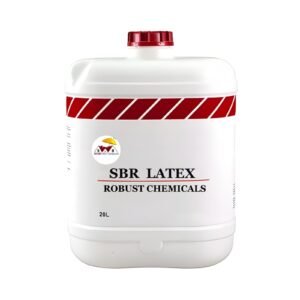
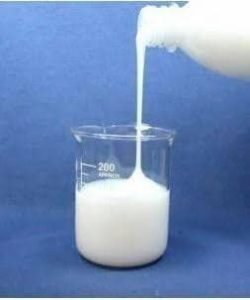
Robust SBR Latex (Styrene-Butadiene Rubber Latex Polymer Modifier & Bonding Agent) is a high-solids, milky-white liquid synthetic rubber emulsion engineered to upgrade ordinary cement mortar, plaster, concrete repair screeds, and waterproof slurries. When added to cement-based mixes, Robust SBR Latex forms a continuous, flexible polymer network within the cement hydration matrix—dramatically increasing tensile/flexural strength, eliminating shrinkage cracking, creating a monolithic bond between old and new concrete, and turning ordinary cement slurry into an impermeable waterproofing barrier.
1. Core Engineering & Multi-Purpose Capabilities
Unlike standard PVA (white glue) emulsions that re-emulsify, soften, and fail when exposed to dampness or alkaline cement, Robust SBR Latex is 100% hydrolysis-resistant and alkaline-stable for permanent exterior and submerged structures:
-
Monolithic Old-to-New Concrete Bonding: Eliminates cold-joint delamination when pouring fresh concrete screeds, floor toppings, or repair plasters over existing aged concrete slabs.
-
Waterproof Slurry & Damp-Proof Barrier: Mixed with neat Ordinary Portland Cement (OPC) at a 1:1.5 or 1:2 ratio, it forms an economical, flexible waterproof slurry coat for water tanks, bathrooms, roof slabs, and damp interior walls (shora / efflorescence barrier).
-
Superior Flexural, Tensile & Abrasion Strength: Boosts mortar tensile strength by 40%–60% and abrasion resistance by 200%+, preventing dusting and spalling in heavy-duty floor toppings.
-
Reduced Water-to-Cement Ratio & Shrinkage Control: Acts as a plasticizing water-reducer, allowing stiff, low-slump repair mortars to trowel smoothly without shrinking or cracking.
-
Chemical & Salt Resistance: Protects concrete and mortar against mild acids, alkalis, sewage gases, de-icing salts, and freeze-thaw or extreme summer thermal cycles.
2. Technical Specifications & ASTM / EN Performance Benchmarks
| Property / Metric | Specified Performance Range | Standard Test Method | Engineering Significance |
| Chemical Base | Modified Styrene-Butadiene Copolymer Emulsion | ASTM C1059 (Type II) | Non-re-emulsifiable under continuous water immersion |
| Appearance & Color | Free-flowing milky-white liquid | Visual / Lab Spec | Disperses uniformly in cement & gauging water |
| Total Solids Content | 42% – 48% (High-Solids Construction Grade) | ASTM D1644 / ISO 3251 | High polymer film density for strong bonding & waterproofing |
| Specific Gravity (at 25°C) | 1.01 – 1.04 kg/L | ASTM D1475 | Easy volumetric batching on site |
| pH Value | 8.0 – 10.5 (Alkaline-Stable) | ASTM E70 | 100% compatible with OPC, SRC, and white cement |
| Slant Shear Bond Strength (28 Days) | ≥ 10.0 – 14.0 N/mm² (1,450 – 2,030 psi) | ASTM C1042 | Exceeds Type II structural concrete bonding requirements |
| Tensile / Pull-Off Adhesion | ≥ 1.5 – 2.2 N/mm² (substrate failure) | ASTM D4541 / EN 1542 | Prevents hollow plaster or screed debonding |
| Flexural Strength Improvement | +40% to +60% over unmodified 1:3 mortar | ASTM C348 / BS 6319 | Resists structural micro-flexing without cracking |
| Water Permeability Reduction | ≥ 70% – 85% reduction vs. plain mortar | DIN 1048 / IS 2645 | Blocks capillary seepage and efflorescence |
| Chloride Content | Nil / < 0.01% (Chloride-Free) | BS EN 480-10 | 100% safe for steel reinforcement bars (rebar) |
| Standard Packaging | 1 L, 5 L, 20 L Jerrycans & 200 L HDPE Drums | Industry Standard | Suited for small repairs to industrial floor projects |
3. Application Mix Ratios & BOQ Consumption Guide
Robust SBR Latex serves four distinct site functions depending on how it is proportioned with cement and sand:
| Application Type | Recommended Mix Ratio (By Weight / Volume) | Consumption Rate | Coverage per 5 Liter Can |
| 1. Concrete Bonding Agent (Old-to-New Concrete) | 1 part SBR Latex : 1.5 parts Fresh OPC Cement (Brushable creamy slurry) | 0.20 – 0.25 L/m² (applied wet-on-wet before new pour) | ~20 – 25 m² (215 – 270 sq. ft.) |
| 2. Waterproofing Slurry Coating (2 Coats) | 1 part SBR Latex : 1.5 – 2 parts OPC Cement (Brush 2 coats perpendicular) | 0.45 – 0.60 L/m² (total across 2 coats) | ~8.5 – 11 m² (90 – 120 sq. ft.) |
| 3. Polymer-Modified Repair Mortar & Screed | 50 kg Cement : 150 kg Sand : 5 – 8 Liters SBR Latex + clean water to stiff consistency | ~0.35 – 0.50 L/m² (at 12–15 mm plaster/screed thickness) | ~10 – 14 m² (108 – 150 sq. ft.) |
| 4. Rebar Anti-Corrosion Primer Coat | 1 part SBR Latex : 1.5 parts OPC Cement (2 coats on wire-brushed steel rebar) | ~0.10 – 0.15 L per m² of steel surface | ~33 – 50 m² of exposed rebar |
4. Step-by-Step Professional Application Protocols
A. Using Robust SBR Latex as a Structural Bonding Agent (Wet-on-Wet Rule)
-
Surface Prep: Chip away weak laitance, grease, and loose concrete; wire-brush and vacuum clean, then pre-wet the old concrete to a Saturated Surface Dry (SSD) damp state (no standing puddles).
-
Mix Bonding Slurry: Stir 1 part Robust SBR Latex with 1.5 parts fresh cement until lump-free.
-
Apply & Pour Wet-on-Wet: Brush the bonding slurry firmly onto the damp concrete surface (1–2 mm thick). CRITICAL RULE: Pour the new concrete, screed, or repair mortar immediately while the SBR bond coat is still wet and tacky (within 15–20 minutes). Never let the SBR bond coat dry into a skin before pouring fresh concrete, or it will act as a bond-breaker instead of an adhesive!
B. Using Robust SBR Latex for Waterproofing Slurry (Bathrooms, Tanks & Walls)
-
Pre-Wet Substrate: Saturate the sound cement plaster or concrete surface with clean water until damp (SSD).
-
First Slurry Coat: Mix 1 part SBR Latex : 1.5 parts cement and apply Coat 1 with a stiff masonry brush in one direction. Embed Robust Fiber Mesh (60–75 GSM) wet-on-wet at all wall-to-floor coves and cracks.
-
Second Slurry Coat: Once Coat 1 is firm (4–6 hours), apply Coat 2 perpendicular (at 90°) to Coat 1. Mist-cure gently for 2–3 days after initial 24-hour set, and protect floor coatings with a 25–38 mm cement-sand screed before tiling.
-
Robust SBR Latex (Styrene-Butadiene Rubber Latex Polymer Modifier & Bonding Agent) is a high-solids, milky-white liquid synthetic rubber emulsion engineered to upgrade ordinary cement mortar, plaster, concrete repair screeds, and waterproof slurries. When added to cement-based mixes, Robust SBR Latex forms a continuous, flexible polymer network within the cement hydration matrix—dramatically increasing tensile/flexural strength, eliminating shrinkage cracking, creating a monolithic bond between old and new concrete, and turning ordinary cement slurry into an impermeable waterproofing barrier.
1. Core Engineering & Multi-Purpose Capabilities
Unlike standard PVA (white glue) emulsions that re-emulsify, soften, and fail when exposed to dampness or alkaline cement, Robust SBR Latex is 100% hydrolysis-resistant and alkaline-stable for permanent exterior and submerged structures:
-
Monolithic Old-to-New Concrete Bonding: Eliminates cold-joint delamination when pouring fresh concrete screeds, floor toppings, or repair plasters over existing aged concrete slabs.
-
Waterproof Slurry & Damp-Proof Barrier: Mixed with neat Ordinary Portland Cement (OPC) at a 1:1.5 or 1:2 ratio, it forms an economical, flexible waterproof slurry coat for water tanks, bathrooms, roof slabs, and damp interior walls (shora / efflorescence barrier).
-
Superior Flexural, Tensile & Abrasion Strength: Boosts mortar tensile strength by 40%–60% and abrasion resistance by 200%+, preventing dusting and spalling in heavy-duty floor toppings.
-
Reduced Water-to-Cement Ratio & Shrinkage Control: Acts as a plasticizing water-reducer, allowing stiff, low-slump repair mortars to trowel smoothly without shrinking or cracking.
-
Chemical & Salt Resistance: Protects concrete and mortar against mild acids, alkalis, sewage gases, de-icing salts, and freeze-thaw or extreme summer thermal cycles.
2. Technical Specifications & ASTM / EN Performance Benchmarks
Property / Metric Specified Performance Range Standard Test Method Engineering Significance Chemical Base Modified Styrene-Butadiene Copolymer Emulsion ASTM C1059 (Type II) Non-re-emulsifiable under continuous water immersion Appearance & Color Free-flowing milky-white liquid Visual / Lab Spec Disperses uniformly in cement & gauging water Total Solids Content 42% – 48% (High-Solids Construction Grade) ASTM D1644 / ISO 3251 High polymer film density for strong bonding & waterproofing Specific Gravity (at 25°C) 1.01 – 1.04 kg/L ASTM D1475 Easy volumetric batching on site pH Value 8.0 – 10.5 (Alkaline-Stable) ASTM E70 100% compatible with OPC, SRC, and white cement Slant Shear Bond Strength (28 Days) ≥ 10.0 – 14.0 N/mm² (1,450 – 2,030 psi) ASTM C1042 Exceeds Type II structural concrete bonding requirements Tensile / Pull-Off Adhesion ≥ 1.5 – 2.2 N/mm² (substrate failure) ASTM D4541 / EN 1542 Prevents hollow plaster or screed debonding Flexural Strength Improvement +40% to +60% over unmodified 1:3 mortar ASTM C348 / BS 6319 Resists structural micro-flexing without cracking Water Permeability Reduction ≥ 70% – 85% reduction vs. plain mortar DIN 1048 / IS 2645 Blocks capillary seepage and efflorescence Chloride Content Nil / < 0.01% (Chloride-Free) BS EN 480-10 100% safe for steel reinforcement bars (rebar) Standard Packaging 1 L, 5 L, 20 L Jerrycans & 200 L HDPE Drums Industry Standard Suited for small repairs to industrial floor projects 3. Application Mix Ratios & BOQ Consumption Guide
Robust SBR Latex serves four distinct site functions depending on how it is proportioned with cement and sand:
Application Type Recommended Mix Ratio (By Weight / Volume) Consumption Rate Coverage per 5 Liter Can 1. Concrete Bonding Agent (Old-to-New Concrete) 1 part SBR Latex : 1.5 parts Fresh OPC Cement (Brushable creamy slurry) 0.20 – 0.25 L/m² (applied wet-on-wet before new pour) ~20 – 25 m² (215 – 270 sq. ft.) 2. Waterproofing Slurry Coating (2 Coats) 1 part SBR Latex : 1.5 – 2 parts OPC Cement (Brush 2 coats perpendicular) 0.45 – 0.60 L/m² (total across 2 coats) ~8.5 – 11 m² (90 – 120 sq. ft.) 3. Polymer-Modified Repair Mortar & Screed 50 kg Cement : 150 kg Sand : 5 – 8 Liters SBR Latex + clean water to stiff consistency ~0.35 – 0.50 L/m² (at 12–15 mm plaster/screed thickness) ~10 – 14 m² (108 – 150 sq. ft.) 4. Rebar Anti-Corrosion Primer Coat 1 part SBR Latex : 1.5 parts OPC Cement (2 coats on wire-brushed steel rebar) ~0.10 – 0.15 L per m² of steel surface ~33 – 50 m² of exposed rebar 4. Step-by-Step Professional Application Protocols
A. Using Robust SBR Latex as a Structural Bonding Agent (Wet-on-Wet Rule)
-
Surface Prep: Chip away weak laitance, grease, and loose concrete; wire-brush and vacuum clean, then pre-wet the old concrete to a Saturated Surface Dry (SSD) damp state (no standing puddles).
-
Mix Bonding Slurry: Stir 1 part Robust SBR Latex with 1.5 parts fresh cement until lump-free.
-
Apply & Pour Wet-on-Wet: Brush the bonding slurry firmly onto the damp concrete surface (1–2 mm thick). CRITICAL RULE: Pour the new concrete, screed, or repair mortar immediately while the SBR bond coat is still wet and tacky (within 15–20 minutes). Never let the SBR bond coat dry into a skin before pouring fresh concrete, or it will act as a bond-breaker instead of an adhesive!
B. Using Robust SBR Latex for Waterproofing Slurry (Bathrooms, Tanks & Walls)
-
Pre-Wet Substrate: Saturate the sound cement plaster or concrete surface with clean water until damp (SSD).
-
First Slurry Coat: Mix 1 part SBR Latex : 1.5 parts cement and apply Coat 1 with a stiff masonry brush in one direction. Embed Robust Fiber Mesh (60–75 GSM) wet-on-wet at all wall-to-floor coves and cracks.
-
Second Slurry Coat: Once Coat 1 is firm (4–6 hours), apply Coat 2 perpendicular (at 90°) to Coat 1. Mist-cure gently for 2–3 days after initial 24-hour set, and protect floor coatings with a 25–38 mm cement-sand screed before tiling.
SBR Latex 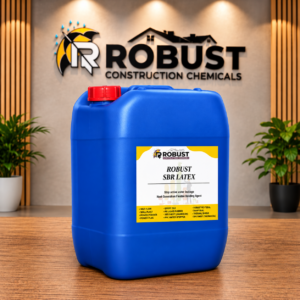
-
-
-