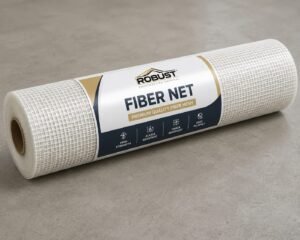
Robust Alkali-Resistant Fiber Mesh Roll (commonly specified as AR Fiberglass Reinforcement Mesh or Construction Fiber Jali) is a high-tensile, dimensionally stable woven glass-fiber grid coated with an alkali-resistant styrene-acrylic copolymer. Engineered to reinforce liquid waterproofing membranes (PU, acrylic, elastomeric, and cementitious coatings), wall plaster, brick-to-concrete joints, and EIFS insulation systems, it absorbs thermal expansion and tensile stress to prevent shrinkage cracks and membrane tearing.
1. Core Material & Engineering Characteristics
-
Alkali-Resistant Polymer Coating: Standard untreated glass fibers corrode and turn brittle inside high-pH cementitious renders and polymer-modified slurries; Robust Fiber Mesh is coated with a protective alkali-resistant copolymer that preserves tensile strength inside wet cement, plaster, and waterproofing layers.
-
Leno-Weave Dimensional Stability: Woven in an interlocking leno-weave open-grid structure that prevents yarn slippage (“slide-proof”) while allowing liquid waterproofing resins, cement slurry, or plaster to penetrate fully and encapsulate the fibers.
-
High Tensile Strength & Low Elongation (< 4%): Distributes localized structural movement across a wide surface area before hairline cracks can telegraph through roof coatings or exterior facades.
-
Rust-Free & Lightweight Alternative to Chicken Wire: Unlike galvanized steel wire mesh (murga jali) that rusts, stains plaster, and is stiff to cut, fiberglass mesh is 100% corrosion-proof, flexible around corners/parapets, and cuts effortlessly with utility scissors.
2. Technical Specifications & Standard Grades
| Property / Metric | Waterproofing & Light Grade (45 – 75 GSM) | Standard Plaster & Joint Grade (90 – 145 GSM) | Heavy-Duty EIFS & Facade Grade (160 GSM) |
| Fabric Weight (GSM) | 45 – 75 g/m² (±5%) | 90 – 145 g/m² (±5%) | 145 – 160 g/m² (±5%) |
| Mesh Aperture (Opening) | 2.5 × 2.5 mm or 3 × 3 mm | 4 × 4 mm or 5 × 5 mm | 4 × 4 mm or 5 × 5 mm |
| Tensile Strength (Warp / Weft) | ≥ 450 – 850 N / 50 mm | ≥ 1,200 – 1,800 N / 50 mm | ≥ 1,500 – 2,100 N / 50 mm |
| Elongation at Break | ≤ 3.5% – 4.0% | ≤ 3.5% – 4.5% | ≤ 3.5% – 5.0% |
| Standard Roll Size | 1 m × 50 m (50 m² / ~538 sq. ft.) | 1 m × 50 m (50 m² / ~538 sq. ft.) | 1 m × 50 m (50 m² / ~538 sq. ft.) |
| Narrow Joint Tape Rolls | 50 mm / 100 mm × 20 m – 50 m | 100 mm / 150 mm / 200 mm × 50 m | 200 mm / 300 mm × 50 m |
3. Primary Applications in Construction & Waterproofing
-
Roof & Terrace Waterproofing Reinforcement: Embedded wet-on-wet into PU Liquid Rubber, Acrylic Elastomeric Coatings, or Cementitious Waterproofing across flat roofs, parapet wall junctions, AC drain corners, and slab cracks to prevent membrane splitting under Pakistani summer heat cycles.
-
Brick-to-RCC Column & Beam Joint Reinforcement: Applied across dissimilar masonry-to-concrete junctions and electrical/plumbing wall chases prior to plastering to prevent vertical and horizontal settlement cracks.
-
Exterior Insulation & Finishing Systems (EIFS / XPS Boards): Embedded into polymer-modified base coats over XPS/EPS thermal insulation boards on exterior walls to provide impact resistance and crack-free stucco finishes.
-
Floor Screeds, Epoxy Coving & Tile Underlayment: Reinforces thin polymer-modified floor screeds, bathroom wet-zone membranes, and marble/mosaic stone backing.
4. Step-by-Step Installation Protocol (Wet-on-Wet Method)
-
Surface Preparation & Cutting: Ensure the substrate is clean, sound, and free of dust or loose debris. Pre-cut the Robust Fiber Mesh rolls to length, allowing an extra 100 mm (4 inches) for overlaps.
-
First Base Coat Application: Apply a generous first coat of liquid waterproofing membrane (e.g., PU Liquid Rubber / Damp Seal) or polymer-modified plaster base coat.
-
Wet Embedment (Never Dry-Lay): Immediately unroll and press the fiber mesh into the wet base layer from the center outward using a flat steel trowel or stiff roller so the mesh lies 100% flat without wrinkles, air pockets, or folds.
-
10 cm Mandatory Overlap: Overlap all adjacent side and end joints by at least 100 mm (10 cm), applying extra resin/mortar between overlapping layers so they bond solidly. Add diagonal 30 × 50 cm stress patches at window and door corners.
-
Topcoat Encapsulation: Apply the second coat of waterproofing membrane or plaster while the first layer is tacky (or within its recoat window) so the fiber mesh sits fully encapsulated within the upper third of the finished thickness with zero exposed fibe
-
Robust Alkali-Resistant Fiber Mesh Roll (commonly specified as AR Fiberglass Reinforcement Mesh or Construction Fiber Jali) is a high-tensile, dimensionally stable woven glass-fiber grid coated with an alkali-resistant styrene-acrylic copolymer. Engineered to reinforce liquid waterproofing membranes (PU, acrylic, elastomeric, and cementitious coatings), wall plaster, brick-to-concrete joints, and EIFS insulation systems, it absorbs thermal expansion and tensile stress to prevent shrinkage cracks and membrane tearing.
1. Core Material & Engineering Characteristics
-
Alkali-Resistant Polymer Coating: Standard untreated glass fibers corrode and turn brittle inside high-pH cementitious renders and polymer-modified slurries; Robust Fiber Mesh is coated with a protective alkali-resistant copolymer that preserves tensile strength inside wet cement, plaster, and waterproofing layers.
-
Leno-Weave Dimensional Stability: Woven in an interlocking leno-weave open-grid structure that prevents yarn slippage (“slide-proof”) while allowing liquid waterproofing resins, cement slurry, or plaster to penetrate fully and encapsulate the fibers.
-
High Tensile Strength & Low Elongation (< 4%): Distributes localized structural movement across a wide surface area before hairline cracks can telegraph through roof coatings or exterior facades.
-
Rust-Free & Lightweight Alternative to Chicken Wire: Unlike galvanized steel wire mesh (murga jali) that rusts, stains plaster, and is stiff to cut, fiberglass mesh is 100% corrosion-proof, flexible around corners/parapets, and cuts effortlessly with utility scissors.
2. Technical Specifications & Standard Grades
Property / Metric Waterproofing & Light Grade (45 – 75 GSM) Standard Plaster & Joint Grade (90 – 145 GSM) Heavy-Duty EIFS & Facade Grade (160 GSM) Fabric Weight (GSM) 45 – 75 g/m² (±5%) 90 – 145 g/m² (±5%) 145 – 160 g/m² (±5%) Mesh Aperture (Opening) 2.5 × 2.5 mm or 3 × 3 mm 4 × 4 mm or 5 × 5 mm 4 × 4 mm or 5 × 5 mm Tensile Strength (Warp / Weft) ≥ 450 – 850 N / 50 mm ≥ 1,200 – 1,800 N / 50 mm ≥ 1,500 – 2,100 N / 50 mm Elongation at Break ≤ 3.5% – 4.0% ≤ 3.5% – 4.5% ≤ 3.5% – 5.0% Standard Roll Size 1 m × 50 m (50 m² / ~538 sq. ft.) 1 m × 50 m (50 m² / ~538 sq. ft.) 1 m × 50 m (50 m² / ~538 sq. ft.) Narrow Joint Tape Rolls 50 mm / 100 mm × 20 m – 50 m 100 mm / 150 mm / 200 mm × 50 m 200 mm / 300 mm × 50 m 3. Primary Applications in Construction & Waterproofing
-
Roof & Terrace Waterproofing Reinforcement: Embedded wet-on-wet into PU Liquid Rubber, Acrylic Elastomeric Coatings, or Cementitious Waterproofing across flat roofs, parapet wall junctions, AC drain corners, and slab cracks to prevent membrane splitting under Pakistani summer heat cycles.
-
Brick-to-RCC Column & Beam Joint Reinforcement: Applied across dissimilar masonry-to-concrete junctions and electrical/plumbing wall chases prior to plastering to prevent vertical and horizontal settlement cracks.
-
Exterior Insulation & Finishing Systems (EIFS / XPS Boards): Embedded into polymer-modified base coats over XPS/EPS thermal insulation boards on exterior walls to provide impact resistance and crack-free stucco finishes.
-
Floor Screeds, Epoxy Coving & Tile Underlayment: Reinforces thin polymer-modified floor screeds, bathroom wet-zone membranes, and marble/mosaic stone backing.
4. Step-by-Step Installation Protocol (Wet-on-Wet Method)
-
Surface Preparation & Cutting: Ensure the substrate is clean, sound, and free of dust or loose debris. Pre-cut the Robust Fiber Mesh rolls to length, allowing an extra 100 mm (4 inches) for overlaps.
-
First Base Coat Application: Apply a generous first coat of liquid waterproofing membrane (e.g., PU Liquid Rubber / Damp Seal) or polymer-modified plaster base coat.
-
Wet Embedment (Never Dry-Lay): Immediately unroll and press the fiber mesh into the wet base layer from the center outward using a flat steel trowel or stiff roller so the mesh lies 100% flat without wrinkles, air pockets, or folds.
-
10 cm Mandatory Overlap: Overlap all adjacent side and end joints by at least 100 mm (10 cm), applying extra resin/mortar between overlapping layers so they bond solidly. Add diagonal 30 × 50 cm stress patches at window and door corners.
-
Topcoat Encapsulation: Apply the second coat of waterproofing membrane or plaster while the first layer is tacky (or within its recoat window) so the fiber mesh sits fully encapsulated within the upper third of the finished thickness with zero exposed fibe
-
-
-
-