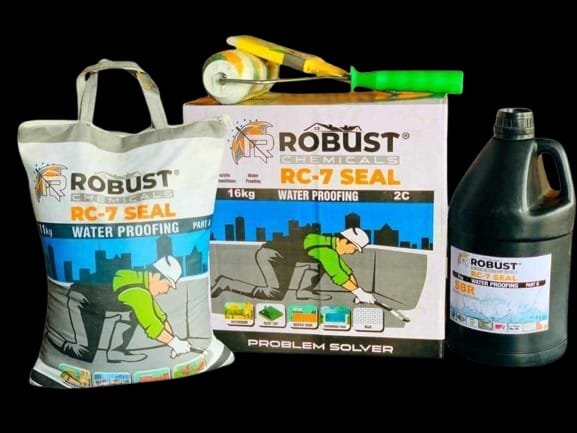
Robust RC-7 Seal: Flexible Polymer-Modified Cementitious Waterproofing Coating (Technical Specifications & Application Guide)
Robust RC-7 Seal is a heavy-duty, two-component, flexible polymer-modified cementitious waterproofing membrane engineered to create a seamless, zero-leakage barrier against positive and negative hydrostatic water pressure. Formulated by combining a high-purity specialty Portland cement and graded quartz aggregate powder (Part A) with a modified acrylic-styrene elastomeric polymer emulsion (Part B), Robust RC-7 Seal cures into a tough, flexible, yet rock-solid waterproof slurry that bonds monolithically to concrete, brick masonry, and cement plaster—bridging hairline shrinkage cracks without peeling or blistering under continuous water immersion.
1. Why Engineers Specify Robust RC-7 Seal Over Rigid Cement Slurries
Traditional rigid cement-sand waterproofing slurries crack the moment concrete slabs expand, contract, or settle. Robust RC-7 Seal overcomes brittle failure through advanced polymer-cement chemistry:
-
Elastomeric Crack-Bridging Flexibility: Unlike brittle plain cement coats, the cross-linked acrylic polymer matrix gives Robust RC-7 Seal high tensile elongation, allowing it to bridge static and hairline substrate cracks up to 1.5–2.0 mm without splitting.
-
Positive & Negative Hydrostatic Pressure Resistance: Withstands continuous water head from the positive (water-facing) side inside water tanks and swimming pools, as well as the negative (interior) side in deep basements and lift pits.
-
100% Potable Water Safe & Non-Toxic: Free from bitumen, tar, chlorides, and hazardous solvents—certified safe for drinking water reservoirs, municipal water tanks, and fish ponds.
-
Breathable Vapor-Permeable Matrix: Blocks liquid water penetration under high pressure while permitting trapped concrete substrate moisture vapor to escape harmlessly—preventing osmotic blistering.
-
Direct Tile-Adhesive & Plaster Compatibility: Provides a tough, high-bond mineral surface that allows direct installation of ceramic/porcelain tiles using polymer-modified tile adhesives or protective cement screeds without delaminating.
2. Full Technical Specifications & ASTM / EN / BS Standards
| Property / Metric | Specified Performance Range | Standard Test Method | Civil Engineering Significance |
| System Composition |
2-Component Polymer-Modified Cementitious Slurry (Part A: Reactive Cement-Quartz Powder | Part B: Acrylic Polymer Liquid) |
EN 14891 / EN 1504-2 | Pre-proportioned kit ensures exact polymer-to-cement ratio |
| Mixing Ratio (Part A : Part B) | 2.5 : 1 or 3 : 1 by weight (Kit-specific) | Pre-Proportioned Kit | Consistent creamy, brushable/trowelable slurry |
| Mixed Wet Density (at 25°C) | 1.75 – 1.90 kg/L | ASTM D1475 | High-density, pinhole-free mineral barrier |
| Positive Water Pressure Resistance | ≥ 5.0 Bar (50 meters hydrostatic water head) | DIN 1048 / EN 12390-8 | Zero leakage in deep underground & overhead tanks |
| Negative Water Pressure Resistance | ≥ 2.5 – 3.0 Bar (25–30 meters water head) | DIN 1048 (Negative Side) | Holds firmly on interior basement retaining walls |
| Tensile Adhesion / Pull-Off Strength | ≥ 1.5 – 2.2 N/mm² (Concrete cohesive failure) | ASTM D4541 / EN 1542 | Monolithic bond to concrete, brick & block masonry |
| Crack-Bridging Capability | Up to 1.5 – 2.0 mm (Reinforced with Fiber Mesh) | EN 14891 / ASTM C836 | Absorbs thermal expansion & curing shrinkage |
| Elongation at Break (Dry Film) | ≥ 80% – 120% (Unreinforced film) | ASTM D412 | Superior flexibility compared to rigid cement slurries |
| Water Vapor Permeability | Breathable ($S_d < 1.5\text{ m}$) | ISO 7783 / EN 1062-1 | Releases substrate vapor without blistering |
| Chloride Ion Diffusion Resistance | Very Low (Pass) | ASTM C1202 | Protects steel reinforcement from brackish groundwater |
| Pot Life / Working Time (at 25°C) | 45 – 60 minutes | Lab Standard | Ample working window for roller, brush, or trowel application |
| Curing Time (at 25°C, 50% RH) | Recoat: 4–6 hrs | Foot Traffic: 24 hrs | Full Water Immersion: 7 days | Lab Standard | Fast turnaround for wet areas & water reservoirs |
| Color & Standard Packaging | Cement Grey or Off-White (20 kg & 25 kg Pre-Proportioned Kits) | Industry Standard | Dual-color visual check if desired between Coat 1 & Coat 2 |
3. Primary Structural & Waterproofing Applications
-
Underground & Overhead Potable Water Tanks (UGWT & OHWT): Full internal seamless tanking of concrete floors, walls, and roof soffits to prevent drinking water loss and groundwater contamination.
-
Sunken Bathrooms, Wet Kitchens, Showers & Laundry Rooms: Applied across concrete slabs and 300 mm (12″) up perimeter walls (full shower height in wet zones) beneath floor and wall tiles.
-
Swimming Pools, Fountains, Jacuzzis & Cooling Tower Basins: Creates a flexible waterproof shell directly behind mosaic and porcelain pool tiles.
-
Basements, Lift Pits, Retaining Walls & Foundations: Applied on both external (positive) and internal (negative) concrete faces to block high water-table seepage and shora.
-
Balconies, Terraces, Podium Decks & Planter Boxes: Protects structural concrete slabs beneath protective screeds, tiles, or landscaping soil.
-
Sewage Treatment Plants (STP), Culverts & Irrigation Channels: Protects reinforced concrete structures against water ingress and mild chemical attack.
4. BOQ Material Consumption & Coverage Guide
| Application Duty Level | Recommended Coats & DFT | Consumption Rate (kg / m²) | Coverage per 20 kg Kit |
| Standard Damp-Proofing (Bathrooms, Balconies & Retaining Walls) | 2 Coats (1.2 – 1.5 mm DFT) | 2.0 – 2.5 kg/m² | ~8.0 – 10.0 m² (86 – 108 sq. ft.) |
| Heavy Hydrostatic Pressure (Underground Water Tanks, Pools & Basements) | 2–3 Coats (2.0 – 2.5 mm DFT) | 3.0 – 3.8 kg/m² | ~5.3 – 6.7 m² (57 – 72 sq. ft.) |
5. Step-by-Step Professional Installation Protocol (6-Stage Standard)
-
Surface Preparation & Cleaning: Concrete and masonry substrates must be structurally sound, clean, and free from shuttering oil, curing compounds, dust, loose plaster, and paint. Honeycomb pockets, tie-rod holes, and active water leaks must be plugged first using Robust Power Plug and repaired with Robust SBR Latex modified mortar.
-
Corner Coving (Gola) & Joint Reinforcement: Form a 40 mm × 40 mm (45°) chamfered cove along all floor-to-wall junctions and internal corners using polymer-modified mortar (1:3 cement-sand gauged with Robust SBR Latex) so the waterproofing membrane transitions smoothly without sharp 90° stress points.
-
Pre-Wetting to Saturated Surface Dry (SSD) Condition: Thoroughly saturate the concrete or brick surface with clean water 1–2 hours before coating so the substrate is damp inside the pores, then sponge off any standing water puddles. (Never apply cementitious coatings onto bone-dry, hot concrete).
-
Mechanical Mixing (Part B Liquid + Part A Powder): Pour Part B (Liquid Polymer) into a clean mixing pail first. Gradually add Part A (Cementitious Powder) while mixing continuously with a slow-speed drill mixer (300–400 RPM) for 3–4 minutes until a smooth, lump-free, creamy slurry is achieved. Let stand for 3 minutes, re-stir briefly, and never add extra water.
-
Two-Coat Cross-Hatch Application (+ Fiber Mesh at Corners):
-
Coat 1: Apply generously using a stiff masonry brush, roller, or notched trowel across the SSD surface. Immediately embed 100–150 mm wide strips of Robust Alkali-Resistant Fiber Mesh wet-on-wet along all wall-to-floor coves, pipe penetrations, and shrinkage cracks.
-
Coat 2: After 4 to 6 hours (when Coat 1 is firm enough not to smudge), apply Coat 2 perpendicular (at 90°) to Coat 1 to guarantee a continuous, pinhole-free waterproof film. (For deep water tanks and swimming pools, apply a 3rd coat).
-
-
Curing & Protection: Mist-cure gently with clean water after 24 hours for 2–3 days in hot weather (> 35°C). Allow 7 days full cure before filling water tanks or pools. On floors subject to foot traffic or tile installation, protect the cured membrane with a 20–25 mm protective cement screed or install tiles directly using polymer-modified tile adhesive.
-
1. Engineering Comparison: Robust RC-7 Seal vs. Alternative Waterproofing Systems
Specifiers and contractors frequently compare polymer-modified cementitious coatings against traditional bitumen sheets, rigid cement washes, and crystalline treatments. Use this matrix to verify why Robust RC-7 Seal is the preferred choice for wet areas, water tanks, and basements:
Selection Criterion Robust RC-7 Seal (Flexible 2K Cementitious) Traditional Bitumen / Tar Coatings Rigid Unmodified Cement Slurry Crystalline Capillary Coating Crack-Bridging Flexibility High (Bridges cracks up to 1.5–2.0 mm) Moderate (Softens in summer heat; brittle in winter) Zero (Cracks with minor slab shrinkage) Low (Seals hairline pores < 0.4 mm only) Potable Water Tank Safety 100% Non-Toxic & Potable Safe (Odorless, zero taint) Unsafe (Leaches hydrocarbons, taste & odor) Safe, but prone to shrinkage leaks Safe (Used in bulk concrete/positive side) Direct Tile Adhesion Excellent (Direct bond with polymer tile adhesive) Poor (Requires heavy protective screed + bond coat) Good (Mineral bond) Good (Mineral bond) Negative-Side Basement Resistance Strong (≥ 2.5–3.0 Bar negative head) Fails (Blisters & peels off under back-pressure) Poor (Delaminates if damp) Strong (Grows crystals into damp concrete) Application on Damp (SSD) Concrete Mandatory / Ideal (Bonds chemically to damp masonry) Fails (Requires bone-dry substrate or blisters) Requires SSD substrate Requires SSD substrate 2. Critical Detailing: Floor Drains, Pipe Penetrations & Expansion Joints
Over 85% of leaks in sunken bathrooms, swimming pools, and water tanks originate around PVC/GI pipe sleeves and floor drains rather than across the flat slab. Enforce these three detailing rules on site:
-
PVC / GI Pipe Sleeves & Puddle Flanges:
-
Roughen the outer surface of PVC pipes with coarse sandpaper where they pass through the concrete slab or tank wall.
-
Cut a 10 mm × 10 mm groove around the pipe-to-concrete interface, prime, and gun in a continuous 360° fillet of Robust PU Tube Sealant.
-
Apply Coat 1 of Robust RC-7 Seal across the slab and 100 mm up the pipe barrel, embed a collar of Robust Alkali-Resistant Fiber Mesh wet-on-wet around the pipe base, and encapsulate with Coat 2.
-
-
Sunken Bathroom Floor Drains (Nahani Traps):
-
Dress Robust RC-7 Seal down inside the drain flange throat so water traveling beneath tile grout drains safely into the waste pipe rather than soaking into the sunken slab filling.
-
-
Structural Expansion Joints Inside Water Tanks & Basements:
-
Do not bridge active structural expansion joints solely with rigid or semi-flexible cementitious slurry. Seal the expansion joint first with Robust Backer Rod + Robust PU Tube Sealant, then apply Robust RC-7 Seal reinforced with a flexible TPE/Hypalon joint tape or a wide Robust Fiber Mesh loop over the joint.
-
3. Potable Water Tank Commissioning & Sanitization Protocol
Before putting an underground or overhead drinking water tank coated with Robust RC-7 Seal into domestic or commercial service, follow this mandatory commissioning sequence:
-
Full 7-Day Polymer-Cement Cure: Allow the final coat of Robust RC-7 Seal to cure for a minimum of 7 days (at 25°C; extend to 10 days in cold winter weather below 15°C) before filling with water.
-
Initial Potable Water Flush: Fill the tank with clean fresh water, allow it to stand for 24 hours to leach out harmless surface lime dust, and drain completely.
-
Final Rinse & Service Fill: Hose down the interior walls and floor with clean potable water, pump out the rinse water, and fill the tank for normal drinking water supply.
4. Chemical, Thermal & Environmental Durability Profile
Exposure Condition Performance Rating Engineering Notes Continuous Potable & Chlorinated Pool Water Excellent (20+ Years) Resistant to standard swimming pool chlorine (1–3 ppm) and pool chemicals Brackish Groundwater, Sulfates & Chlorides High Resistance Dense polymer-cement matrix prevents sulfate attack and rebar corrosion Mild Domestic Detergents, Soaps & Shampoos Unaffected Ideal for residential/commercial bathrooms, spas, and laundries Service Temperature Range -15°C to +75°C Stable under hot water lines and extreme seasonal temperature swings UV & Weathering Exposure UV-Stable (Non-Chalking) Can remain exposed on parapet walls or terraces, though a protective screed/tile is recommended for foot traffic 5. Common Cementitious Waterproofing Mistakes & Troubleshooting
-
Adding Extra Mixing Water to Thin the Slurry:
-
Symptom: Powdery, weak, chalky surface that washes off or develops shrinkage cracks.
-
Fix: Never add extra water to Robust RC-7 Seal. Mix strictly using the pre-proportioned Part A Powder + Part B Liquid Polymer kit. If ambient heat thickens the mix slightly, mix smaller half-kits at a time.
-
-
Applying Onto Bone-Dry, Hot Concrete in Summer:
-
Symptom: Rapid moisture suction causes pinholes, crazing cracks, and weak bond strength.
-
Fix: Pre-wet concrete and brick surfaces thoroughly to Saturated Surface Dry (SSD) condition (damp pores, zero standing water) and shade work areas from direct afternoon sun.
-
-
Applying One Thick Coat Instead of Two Cross-Hatched Coats:
-
Symptom: Air bubbles escaping from concrete pores leave open pinholes straight through the membrane.
-
Fix: Always apply at least 2 coats (each 0.8–1.0 mm wet thickness) brushed or troweled at 90° perpendicular angles so Coat 2 seals every microscopic pinhole from Coat 1.
-
-
Dumping Heavy Bricks or Sharp Aggregate Onto Unprotected Membrane:
-
Symptom: Mechanical puncturing of the waterproof film by mason tools or wheelbarrows before tiling.
-
Fix: Once Robust RC-7 Seal cures for 48–72 hours, lay a 20–25 mm protective cement-sand screed (gauged with Robust SBR Latex) or install tiles directly using polymer-modified tile adhesive.
-
1. Engineering Comparison: Robust RC-7 Seal vs. Alternative Waterproofing Systems
Specifiers and contractors frequently compare polymer-modified cementitious coatings against traditional bitumen sheets, rigid cement washes, and crystalline treatments. Use this matrix to verify why Robust RC-7 Seal is the preferred choice for wet areas, water tanks, and basements:
Selection Criterion Robust RC-7 Seal (Flexible 2K Cementitious) Traditional Bitumen / Tar Coatings Rigid Unmodified Cement Slurry Crystalline Capillary Coating Crack-Bridging Flexibility High (Bridges cracks up to 1.5–2.0 mm) Moderate (Softens in summer heat; brittle in winter) Zero (Cracks with minor slab shrinkage) Low (Seals hairline pores < 0.4 mm only) Potable Water Tank Safety 100% Non-Toxic & Potable Safe (Odorless, zero taint) Unsafe (Leaches hydrocarbons, taste & odor) Safe, but prone to shrinkage leaks Safe (Used in bulk concrete/positive side) Direct Tile Adhesion Excellent (Direct bond with polymer tile adhesive) Poor (Requires heavy protective screed + bond coat) Good (Mineral bond) Good (Mineral bond) Negative-Side Basement Resistance Strong (≥ 2.5–3.0 Bar negative head) Fails (Blisters & peels off under back-pressure) Poor (Delaminates if damp) Strong (Grows crystals into damp concrete) Application on Damp (SSD) Concrete Mandatory / Ideal (Bonds chemically to damp masonry) Fails (Requires bone-dry substrate or blisters) Requires SSD substrate Requires SSD substrate 2. Critical Detailing: Floor Drains, Pipe Penetrations & Expansion Joints
Over 85% of leaks in sunken bathrooms, swimming pools, and water tanks originate around PVC/GI pipe sleeves and floor drains rather than across the flat slab. Enforce these three detailing rules on site:
-
PVC / GI Pipe Sleeves & Puddle Flanges:
-
Roughen the outer surface of PVC pipes with coarse sandpaper where they pass through the concrete slab or tank wall.
-
Cut a 10 mm × 10 mm groove around the pipe-to-concrete interface, prime, and gun in a continuous 360° fillet of Robust PU Tube Sealant.
-
Apply Coat 1 of Robust RC-7 Seal across the slab and 100 mm up the pipe barrel, embed a collar of Robust Alkali-Resistant Fiber Mesh wet-on-wet around the pipe base, and encapsulate with Coat 2.
-
-
Sunken Bathroom Floor Drains (Nahani Traps):
-
Dress Robust RC-7 Seal down inside the drain flange throat so water traveling beneath tile grout drains safely into the waste pipe rather than soaking into the sunken slab filling.
-
-
Structural Expansion Joints Inside Water Tanks & Basements:
-
Do not bridge active structural expansion joints solely with rigid or semi-flexible cementitious slurry. Seal the expansion joint first with Robust Backer Rod + Robust PU Tube Sealant, then apply Robust RC-7 Seal reinforced with a flexible TPE/Hypalon joint tape or a wide Robust Fiber Mesh loop over the joint.
-
3. Potable Water Tank Commissioning & Sanitization Protocol
Before putting an underground or overhead drinking water tank coated with Robust RC-7 Seal into domestic or commercial service, follow this mandatory commissioning sequence:
-
Full 7-Day Polymer-Cement Cure: Allow the final coat of Robust RC-7 Seal to cure for a minimum of 7 days (at 25°C; extend to 10 days in cold winter weather below 15°C) before filling with water.
-
Initial Potable Water Flush: Fill the tank with clean fresh water, allow it to stand for 24 hours to leach out harmless surface lime dust, and drain completely.
-
Final Rinse & Service Fill: Hose down the interior walls and floor with clean potable water, pump out the rinse water, and fill the tank for normal drinking water supply.
4. Chemical, Thermal & Environmental Durability Profile
Exposure Condition Performance Rating Engineering Notes Continuous Potable & Chlorinated Pool Water Excellent (20+ Years) Resistant to standard swimming pool chlorine (1–3 ppm) and pool chemicals Brackish Groundwater, Sulfates & Chlorides High Resistance Dense polymer-cement matrix prevents sulfate attack and rebar corrosion Mild Domestic Detergents, Soaps & Shampoos Unaffected Ideal for residential/commercial bathrooms, spas, and laundries Service Temperature Range -15°C to +75°C Stable under hot water lines and extreme seasonal temperature swings UV & Weathering Exposure UV-Stable (Non-Chalking) Can remain exposed on parapet walls or terraces, though a protective screed/tile is recommended for foot traffic 5. Common Cementitious Waterproofing Mistakes & Troubleshooting
-
Adding Extra Mixing Water to Thin the Slurry:
-
Symptom: Powdery, weak, chalky surface that washes off or develops shrinkage cracks.
-
Fix: Never add extra water to Robust RC-7 Seal. Mix strictly using the pre-proportioned Part A Powder + Part B Liquid Polymer kit. If ambient heat thickens the mix slightly, mix smaller half-kits at a time.
-
-
Applying Onto Bone-Dry, Hot Concrete in Summer:
-
Symptom: Rapid moisture suction causes pinholes, crazing cracks, and weak bond strength.
-
Fix: Pre-wet concrete and brick surfaces thoroughly to Saturated Surface Dry (SSD) condition (damp pores, zero standing water) and shade work areas from direct afternoon sun.
-
-
Applying One Thick Coat Instead of Two Cross-Hatched Coats:
-
Symptom: Air bubbles escaping from concrete pores leave open pinholes straight through the membrane.
-
Fix: Always apply at least 2 coats (each 0.8–1.0 mm wet thickness) brushed or troweled at 90° perpendicular angles so Coat 2 seals every microscopic pinhole from Coat 1.
-
-
Dumping Heavy Bricks or Sharp Aggregate Onto Unprotected Membrane:
-
Symptom: Mechanical puncturing of the waterproof film by mason tools or wheelbarrows before tiling.
-
Fix: Once Robust RC-7 Seal cures for 48–72 hours, lay a 20–25 mm protective cement-sand screed (gauged with Robust SBR Latex) or install tiles directly using polymer-modified tile adhesive.
-
-
-
-
-
-