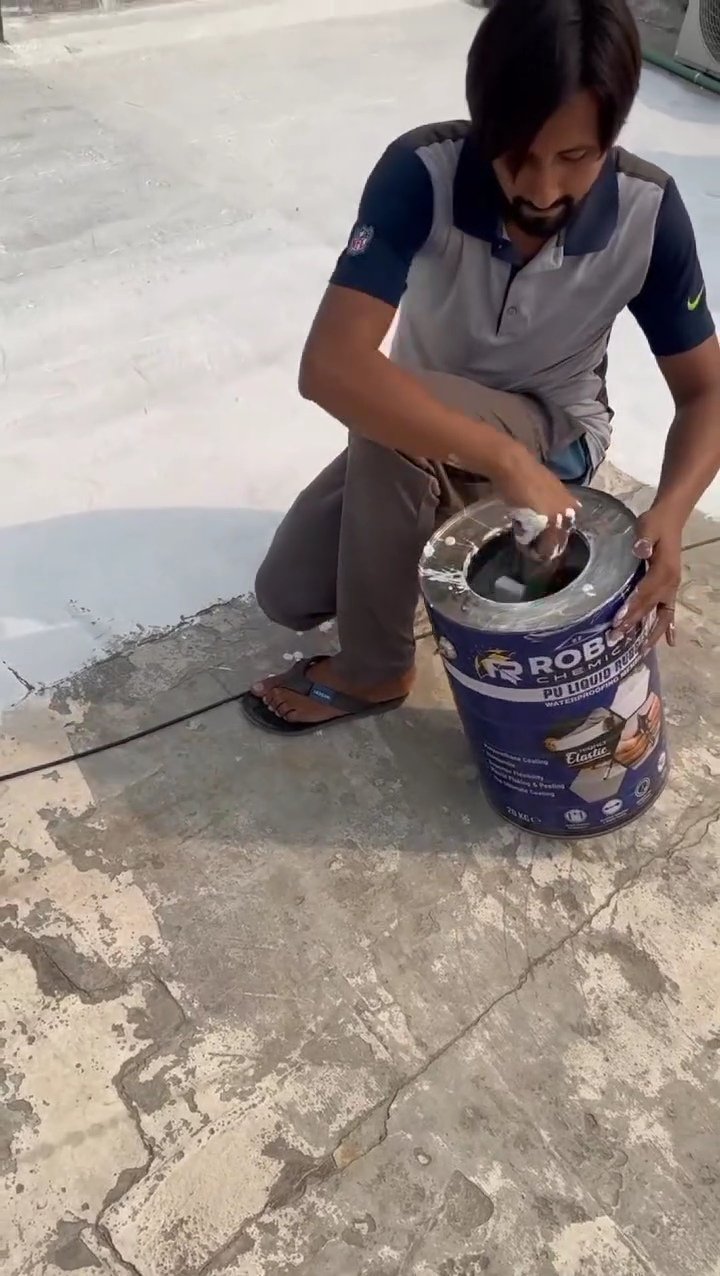
Robust PU Liquid Rubber: High-Elongation Elastomeric Polyurethane Waterproofing Membrane (Description, Specifications, Usage & Benefits)
Robust PU Liquid Rubber is a heavy-duty, single-component, moisture-curing elastomeric polyurethane (PU) liquid-applied waterproofing membrane engineered to form a seamless, joint-free, rubber-like protective shield over roofs, concrete slabs, podium decks, balconies, and wet areas. Once applied by roller, brush, or airless spray, Robust PU Liquid Rubber reacts with ambient atmospheric humidity to cure into a continuous, pinhole-free, ultra-elastic membrane with ≥ 500%–600% elongation, 100% ponding water resistance, and extreme thermal stability—withstandings scorching 45°C+ summer roof temperatures and winter cold snaps without cracking, melting, or delaminating.
1. Product Description & Engineering Technology
Traditional roof waterproofing methods in Pakistan—such as torch-on bitumen sheets, hot tar (luk), and rigid cement washes—fail prematurely because flat roofs undergo intense daily thermal expansion and contraction, while torch-on rolls inevitably leak at overlapped seams and around roof penetrations (water tank pipes, parapet walls, and solar panel pedestals).
Robust PU Liquid Rubber solves all of these failure points in a single seamless system:
-
100% Monolithic & Seam-Free Membrane: Eliminates all lap joints, weld seams, and weak corners—wrapping effortlessly around complex roof geometry, HVAC ducts, parapet upstands, drain outlets, and solar mounting bolts.
-
Permanent Rubber-Like Elasticity (≥ 500%–600% Elongation): Stretches and recovers continuously across active thermal shrinkage cracks and structural movement without tearing or losing adhesion.
-
Standing / Ponding Water Immunity: Unlike standard acrylic roof coatings that soften, re-emulsify, and blister when rainwater stagnates on poorly sloped flat roofs, Robust PU Liquid Rubber is 100% hydrophobic and non-re-emulsifiable, maintaining full mechanical strength even under continuous water ponding.
-
Vapor-Permeable (“Breathable”) Matrix: Blocks 100% of liquid rainwater while permitting trapped concrete slab moisture vapor to diffuse out harmlessly—preventing osmotic heat blisters.
2. Key Benefits of Robust PU Liquid Rubber
-
Zero-Leakage Protection Under Stagnant Ponding Water: Engineered for flat roofs with poor drainage slopes; resists continuous standing water without softening, swelling, or peeling.
-
Extreme Crack-Bridging Capability (Up to 2.5–3.0 mm): High-elongation polyurethane polymers bridge dynamic concrete hairline and thermal cracks effortlessly without splitting.
-
UV-Resistant & Solar-Reflective Cool-Roof Performance: Available in Solar-Reflective White and Light Grey grades (with aliphatic UV-stable topcoat options) that reflect up to 80%–85% of solar infrared radiation, reducing top-floor indoor room temperatures by 4°C to 7°C during peak Pakistani summers.
-
Wide Service Temperature Stability (-30°C to +90°C): Never turns brittle or cracks in freezing northern winters and never softens, flows, or gets sticky under intense summer roof heat.
-
Monolithic Adhesion to Almost Any Construction Substrate: Bonds tenaciously to concrete slabs, brick khaprail / mud-phaska screeds, existing bitumen membranes, metal roofs (GI/aluminum sheets), polyurethane spray foam, and ceramic roof tiles.
-
20 to 25+ Years Service Lifespan (Reinforced System): When reinforced with Robust Polyester Geotextile Fabric / Fiber Mesh at coves and across full roof decks, it delivers multi-decade, maintenance-free roof protection.
3. Full Technical Specifications & ASTM / ETAG Compliance
| Property / Metric | Specified Performance Range | Standard Test Method | Engineering Significance |
| Chemical Base | Single-Component Elastomeric Polyurethane Liquid Membrane | ASTM C836 / ETAG 005 | Ready-to-use straight from the pail; no two-part mixing errors |
| Total Solids Content | ≥ 82% – 88% (High-Build Grade) | ASTM D1644 / ISO 3251 | Builds a thick, durable rubber membrane in just 2 coats |
| Specific Gravity (at 25°C) | 1.30 – 1.40 kg/L | ASTM D1475 | High-density, non-sagging roof & vertical wall application |
| Tensile Strength (Unreinforced) | ≥ 2.5 – 4.0 N/mm² (360 – 580 psi) | ASTM D412 / DIN 53504 | Tough, tear-resistant elastomeric rubber film |
| Elongation at Break | ≥ 500% – 600% | ASTM D412 / DIN 53504 | Absorbs extreme roof thermal movement without cracking |
| Crack-Bridging Capability | ≥ 2.5 – 3.0 mm (Static & Dynamic) | EN 1062-7 / ASTM C836 | Bridges structural shrinkage cracks intact |
| Pull-Off Bond Strength to Concrete | ≥ 1.8 – 2.2 N/mm² (Concrete cohesive failure) | ASTM D4541 / EN 1542 | Zero wind-uplift or delamination |
| Shore A Hardness | 55 – 65 | ASTM D2240 | Tough, foot-trafficable elastomeric rubber surface |
| Water Vapor Permeability | Breathable (≥ 15–20 g/m²/24 hrs) | ASTM E96 / ISO 7783 | Prevents trapped slab moisture from blistering |
| Service Temperature Range | -30°C to +90°C (Shock up to +120°C) | ETAG 005 | All-weather durability across extreme climates |
| Ponding Water Resistance | 100% Pass (Zero softening or re-emulsification) | ASTM D2939 / ETAG 005 | Ideal for flat roofs with slow drainage |
| Curing Schedule (at 25°C, 50% RH) | Touch Dry: 4–6 hrs | Recoat: 12–24 hrs | Full Cure: 5–7 days | Lab Standard | Rapid two-coat roof waterproofing |
| Standard Colors & Packaging | Solar White, Light Grey, Terracotta Red (5 kg, 15 kg & 20 kg Pails) | Industry Standard | Easy storage & site handling |
4. Primary Usage & Structural Applications
-
Exposed Flat & Sloped Concrete Roofs (RCC Slabs): Complete seamless roof waterproofing and solar heat-reflective cool-roof coating for residential houses, commercial plazas, hospitals, and industrial warehouses.
-
Roof Refurbishment Over Existing Bitumen Sheets, Tiles & Khaprail: Seals leaking old torch-on bitumen membranes, brick tiles (choka), and weathered roof screeds directly without costly demolition.
-
Under-Tile Wet Area Waterproofing (Bathrooms, Balconies & Terraces): Applied beneath floor screeds and ceramic/porcelain tiles in sunken washrooms, open terraces, and podium decks.
-
Planter Boxes, Green Roofs & Retaining Walls: Root-resistant elastomeric barrier protecting concrete walls and podium slabs from soil moisture and root penetration.
-
Metal Roofs, Skylight Flashing, Gutters & Solar Pedestal Bases: Seals corroded GI/aluminum factory roof seams, bolt heads, parapet flashings, and rooftop water-tank bases.
5. BOQ Material Consumption & Coverage Guide
| System Specification | Target Dry Thickness (DFT) | Total Consumption Rate | Coverage per 20 kg Pail |
| Standard Exposed Roof System (2 Coats — Unreinforced) | 1.0 – 1.2 mm DFT | 1.4 – 1.6 kg/m² | ~12.5 – 14.3 m² (135 – 154 sq. ft.) |
| Heavy-Duty 20-Year Reinforced Roof System (2–3 Coats + Polyester Fleece / Fiber Mesh) | 1.5 – 2.0 mm DFT | 2.0 – 2.5 kg/m² | ~8.0 – 10.0 m² (86 – 108 sq. ft.) |
6. Step-by-Step Professional Installation Protocol (6-Stage Standard)
-
Surface Preparation & Cleaning: Concrete roof slabs must be cured for at least 28 days, structurally sound, clean, and dry (slab moisture < 4%–5%). Grind or wire-brush away loose cement laitance, dust, oil, flaking paint, and algae. Vacuum thoroughly.
-
Crack Sealing & Parapet Coving (Gola):
-
Open cracks wider than 1 mm into a V-groove, prime, and fill flush with Robust PU Tube Sealant.
-
Form a 40 mm × 40 mm (45°) chamfered mortar cove along all roof-to-parapet wall junctions so the liquid rubber transitions smoothly without sharp 90° stress points.
-
-
Priming the Substrate: Apply one uniform coat of Robust PU Primer / Epoxy Sealer at 0.15–0.20 kg/m² to seal porous concrete capillaries and prevent pinholes caused by outgassing air. Allow 3 to 6 hours to become tack-free.
-
Coat 1 & Wet-on-Wet Joint Reinforcement: Stir Robust PU Liquid Rubber thoroughly with a slow-speed paddle mixer (300 RPM) for 2 minutes. Apply Coat 1 generously at 0.70–0.80 kg/m² using a short-nap solvent-resistant roller or brush. Immediately embed 150 mm wide strips of Robust Polyester Geotextile Fleece / Fiber Mesh wet-on-wet along all parapet wall-to-roof coves, drain outlets, pipe penetrations, and repaired cracks (or across the full roof area for heavy-duty 20-year warranty systems).
-
Coat 2 (Cross-Hatch Barrier Coat): Within 12 to 24 hours (maximum 36 hours), apply Coat 2 at 0.70–0.80 kg/m² perpendicular (at 90°) to Coat 1 to build a seamless, pinhole-free rubber membrane.
-
UV Topcoat / Protective Screed & Curing: Allow 24 to 48 hours for foot traffic and 5 to 7 days for full chemical cure before pond-testing with water for 48 hours. For roofs exposed to intense direct UV sunlight or regular foot traffic, apply a finishing coat of Robust Aliphatic UV-Stable PU Topcoat (or install protective roof tiles over a mortar bed).
-
. Engineering Comparison: Robust PU Liquid Rubber vs. Acrylic Roof Coatings & Bitumen Sheets
Architects and facility engineers frequently evaluate three primary roof waterproofing technologies. Use this technical comparison matrix to understand why Robust PU Liquid Rubber outperforms traditional alternatives on flat roofs and wet decks:
2. Critical Rooftop Detailing: Solar Panel Pedestals, Rainwater Drains & Parapets
Over 90% of flat roof leaks occur at penetrations and perimeter junctions rather than across the open concrete slab. Enforce these four detailing standards on site:
-
Rooftop Solar Panel Mounting Pedestals & Anchor Bolts:
-
Apply Robust PU Liquid Rubber across the entire roof slab before installing solar mounting structures whenever possible.
-
For existing solar frames, grind clean around each concrete pedestal or steel baseplate, gun a 360° fillet of Robust PU Tube Sealant around the anchor bolts, and wrap Robust PU Liquid Rubber reinforced with a 150 mm collar of Robust Polyester Geotextile / Fiber Mesh at least 150 mm up the pedestal legs.
-
-
Parapet Wall Upstands & Roof-to-Wall Coves (Gola):
-
Always terminate the roof waterproofing membrane at least 250–300 mm (10–12 inches) vertically up all parapet walls, lift machine rooms, and stair towers.
-
Cut a 10 mm × 10 mm reglet groove into the parapet plaster at the top termination edge, tuck the reinforced PU membrane into the groove, and seal flush with Robust PU Tube Sealant so rainwater running down the parapet cannot get behind the membrane.
-
-
Rainwater Downpipe Outlets (Khurra / Roof Drains):
-
Recess the concrete around the drain mouth by 5 mm so water flows freely into the pipe without damming.
-
Dress Robust PU Liquid Rubber + Fiber Mesh reinforcement collar at least 100 mm down inside the PVC/CI drain pipe throat.
-
-
Structural Roof Expansion Joints:
-
Clean the expansion joint gap, insert closed-cell Robust Backer Rod, fill flush with Robust PU Tube Sealant, and apply a 200 mm wide bond-breaker tape over the joint before bridging with reinforced Robust PU Liquid Rubber.
-
3. Chemical, Root & Environmental Resistance Profile
4. Mandatory 48-Hour Hydrostatic Flood Test (Quality Assurance)
Before handing over any waterproofed roof, podium deck, or wet area—or before laying protective tiles/screed over Robust PU Liquid Rubber—conduct a formal flood test:
-
Allow the final coat of Robust PU Liquid Rubber to cure for 5 to 7 days at ambient temperatures (25°C+).
-
Plug all rainwater drain outlets securely with inflatable rubber plugs or sandbags.
-
Flood the roof or wet-area slab with clean water to a minimum depth of 40–50 mm (2 inches) across the highest point of the slab.
-
Mark the initial water level and maintain standing water for 48 consecutive hours, inspecting the ceiling soffit below for any signs of dampness or dripping before draining and proceeding with top finishes.
5. Common Polyurethane Liquid Rubber Mistakes & Troubleshooting
-
Pinholes & Micro-Bubbles After Coating Hot Concrete:
-
Root Cause: Applying polyurethane onto sun-baked, unprimed concrete during afternoon heat (> 40°C) causes trapped air inside concrete pores to expand upward (“outgassing”) through the wet film.
-
Prevention: Always prime porous concrete with Robust PU / Epoxy Sealer, and apply Robust PU Liquid Rubber during early morning or late afternoon as slab temperatures are cooling down.
-
-
Applying Onto Damp or Wet Concrete Slabs:
-
Root Cause: Moisture-curing polyurethane reacts rapidly with liquid water on the slab surface, creating foaming bubbles and poor adhesion.
-
Prevention: Ensure the concrete slab is thoroughly dry (moisture content < 4%–5%) with zero morning dew or rain prior to priming and coating.
-
-
Applying One Single Thick Coat (> 1.5 mm Wet) Instead of Two Coats:
-
Root Cause: An overly thick single coat skins over on top while trapping solvent/CO₂ gas underneath, resulting in surface bubbling.
-
Prevention: Apply in two thin, controlled coats (0.70–0.80 kg/m² per coat), allowing 12 to 24 hours between coats.
-
-
Exceeding the 36-Hour Recoat Window Without Reactivation:
-
Root Cause: Waiting 4–7 days between Coat 1 and Coat 2 allows Coat 1 to cross-link completely, reducing inter-coat adhesion.
-
Prevention: Apply Coat 2 within 12 to 24 hours (maximum 36 hours). If delayed beyond 36 hours, lightly abrade Coat 1 with fine sandpaper, wipe with PU solvent/primer, and apply Coat 2.
-
6. Ready-to-Use FAQ Schema Block (For CMS Deployment)
-
Q1: Can Robust PU Liquid Rubber withstand standing rainwater on a flat roof?
-
Yes. Unlike acrylic roof coatings that soften and peel under stagnant water, Robust PU Liquid Rubber is a true elastomeric polyurethane membrane engineered for 100% ponding water resistance without re-emulsifying or blistering.
-
-
Q2: Can Robust PU Liquid Rubber be applied directly over old leaking bitumen sheets or roof tiles?
-
Yes. After pressure-washing away dirt and algae, repairing loose blisters/laps, and applying the appropriate bonding primer, Robust PU Liquid Rubber forms a continuous, seamless rubber overlay directly over existing bitumen membranes, brick khaprail tiles, and concrete screeds without demolition.
-
-
Q3: How long does Robust PU Liquid Rubber last on an exposed roof?
-
When applied at the specified 1.5–2.0 mm dry film thickness with Robust Polyester Fleece / Fiber Mesh reinforcement at coves and joints and finished with a UV-stable Aliphatic PU Topcoat, it delivers 20 to 25+ years of leak-free roof protection.
-
. Engineering Comparison: Robust PU Liquid Rubber vs. Acrylic Roof Coatings & Bitumen Sheets
Architects and facility engineers frequently evaluate three primary roof waterproofing technologies. Use this technical comparison matrix to understand why Robust PU Liquid Rubber outperforms traditional alternatives on flat roofs and wet decks:
2. Critical Rooftop Detailing: Solar Panel Pedestals, Rainwater Drains & Parapets
Over 90% of flat roof leaks occur at penetrations and perimeter junctions rather than across the open concrete slab. Enforce these four detailing standards on site:
-
Rooftop Solar Panel Mounting Pedestals & Anchor Bolts:
-
Apply Robust PU Liquid Rubber across the entire roof slab before installing solar mounting structures whenever possible.
-
For existing solar frames, grind clean around each concrete pedestal or steel baseplate, gun a 360° fillet of Robust PU Tube Sealant around the anchor bolts, and wrap Robust PU Liquid Rubber reinforced with a 150 mm collar of Robust Polyester Geotextile / Fiber Mesh at least 150 mm up the pedestal legs.
-
-
Parapet Wall Upstands & Roof-to-Wall Coves (Gola):
-
Always terminate the roof waterproofing membrane at least 250–300 mm (10–12 inches) vertically up all parapet walls, lift machine rooms, and stair towers.
-
Cut a 10 mm × 10 mm reglet groove into the parapet plaster at the top termination edge, tuck the reinforced PU membrane into the groove, and seal flush with Robust PU Tube Sealant so rainwater running down the parapet cannot get behind the membrane.
-
-
Rainwater Downpipe Outlets (Khurra / Roof Drains):
-
Recess the concrete around the drain mouth by 5 mm so water flows freely into the pipe without damming.
-
Dress Robust PU Liquid Rubber + Fiber Mesh reinforcement collar at least 100 mm down inside the PVC/CI drain pipe throat.
-
-
Structural Roof Expansion Joints:
-
Clean the expansion joint gap, insert closed-cell Robust Backer Rod, fill flush with Robust PU Tube Sealant, and apply a 200 mm wide bond-breaker tape over the joint before bridging with reinforced Robust PU Liquid Rubber.
-
3. Chemical, Root & Environmental Resistance Profile
4. Mandatory 48-Hour Hydrostatic Flood Test (Quality Assurance)
Before handing over any waterproofed roof, podium deck, or wet area—or before laying protective tiles/screed over Robust PU Liquid Rubber—conduct a formal flood test:
-
Allow the final coat of Robust PU Liquid Rubber to cure for 5 to 7 days at ambient temperatures (25°C+).
-
Plug all rainwater drain outlets securely with inflatable rubber plugs or sandbags.
-
Flood the roof or wet-area slab with clean water to a minimum depth of 40–50 mm (2 inches) across the highest point of the slab.
-
Mark the initial water level and maintain standing water for 48 consecutive hours, inspecting the ceiling soffit below for any signs of dampness or dripping before draining and proceeding with top finishes.
5. Common Polyurethane Liquid Rubber Mistakes & Troubleshooting
-
Pinholes & Micro-Bubbles After Coating Hot Concrete:
-
Root Cause: Applying polyurethane onto sun-baked, unprimed concrete during afternoon heat (> 40°C) causes trapped air inside concrete pores to expand upward (“outgassing”) through the wet film.
-
Prevention: Always prime porous concrete with Robust PU / Epoxy Sealer, and apply Robust PU Liquid Rubber during early morning or late afternoon as slab temperatures are cooling down.
-
-
Applying Onto Damp or Wet Concrete Slabs:
-
Root Cause: Moisture-curing polyurethane reacts rapidly with liquid water on the slab surface, creating foaming bubbles and poor adhesion.
-
Prevention: Ensure the concrete slab is thoroughly dry (moisture content < 4%–5%) with zero morning dew or rain prior to priming and coating.
-
-
Applying One Single Thick Coat (> 1.5 mm Wet) Instead of Two Coats:
-
Root Cause: An overly thick single coat skins over on top while trapping solvent/CO₂ gas underneath, resulting in surface bubbling.
-
Prevention: Apply in two thin, controlled coats (0.70–0.80 kg/m² per coat), allowing 12 to 24 hours between coats.
-
-
Exceeding the 36-Hour Recoat Window Without Reactivation:
-
Root Cause: Waiting 4–7 days between Coat 1 and Coat 2 allows Coat 1 to cross-link completely, reducing inter-coat adhesion.
-
Prevention: Apply Coat 2 within 12 to 24 hours (maximum 36 hours). If delayed beyond 36 hours, lightly abrade Coat 1 with fine sandpaper, wipe with PU solvent/primer, and apply Coat 2.
-
6. Ready-to-Use FAQ Schema Block (For CMS Deployment)
-
Q1: Can Robust PU Liquid Rubber withstand standing rainwater on a flat roof?
-
Yes. Unlike acrylic roof coatings that soften and peel under stagnant water, Robust PU Liquid Rubber is a true elastomeric polyurethane membrane engineered for 100% ponding water resistance without re-emulsifying or blistering.
-
-
Q2: Can Robust PU Liquid Rubber be applied directly over old leaking bitumen sheets or roof tiles?
-
Yes. After pressure-washing away dirt and algae, repairing loose blisters/laps, and applying the appropriate bonding primer, Robust PU Liquid Rubber forms a continuous, seamless rubber overlay directly over existing bitumen membranes, brick khaprail tiles, and concrete screeds without demolition.
-
-
Q3: How long does Robust PU Liquid Rubber last on an exposed roof?
-
When applied at the specified 1.5–2.0 mm dry film thickness with Robust Polyester Fleece / Fiber Mesh reinforcement at coves and joints and finished with a UV-stable Aliphatic PU Topcoat, it delivers 20 to 25+ years of leak-free roof protection.
-
-
-
-